

Anti-Vinculin Antibody (Monoclonal, hVIN-1)

Référence ABO10486
Conditionnement : 100ug
Marque : Abcepta
Anti-Vinculin Antibody (Monoclonal, hVIN-1)
-
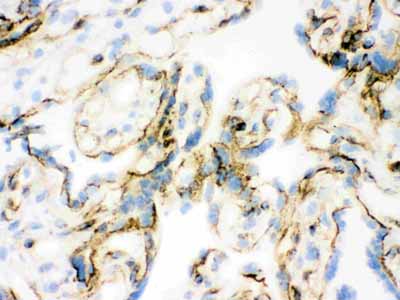
Anti- Vinculin antibody, ABO10486, IHC(P)IHC(F): Human Placenta Tissue
-
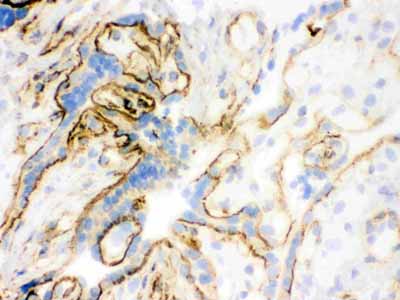
Anti- Vinculin antibody, ABO10486, IHC(P)IHC(F): Human Placenta Tissue
Anti- Vinculin antibody, ABO10486, IHC(P)IHC(F): Human Placenta Tissue
Application 
| WB, IHC-F |
|---|---|
| Primary Accession | P85972 |
| Host | Mouse |
| Isotype | Mouse IgG1 |
| Reactivity | Human, Mouse, Rat |
| Clonality | Monoclonal |
| Format | Lyophilized |
| Description | Mouse IgG monoclonal antibody for Vinculin, vinculin (VCL) detection. Tested with WB, IHC-F in Human;mouse;rat;chicken. No cross reactivity with other proteins. |
| Reconstitution | Add 1ml of PBS buffer will yield a concentration of 100ug/ml. |
| Gene ID | 305679 |
|---|---|
| Other Names | Vinculin, Vcl {ECO:0000250|UniProtKB:P18206} |
| Calculated MW | 116615 MW KDa |
| Application Details | Immunohistochemistry(Frozen Section), 2-4 µg/ml, Human, chicken, mouse, rat, - Western blot, 1-2 µg/ml, Human, chicken, mouse, rat |
| Subcellular Localization | Cell membrane ; Peripheral membrane protein ; Cytoplasmic side . Cell junction, adherens junction . Cell junction, focal adhesion . Cytoplasm, cytoskeleton . Recruitment to cell-cell junctions occurs in a myosin II-dependent manner. Interaction with CTNNB1 is necessary for its localization to the cell-cell junctions. . |
| Tissue Specificity | VCL: Metavinculin is muscle-specific. |
| Protein Name | Vinculin |
| Contents | Mouse ascites fluid, 1.2% sodium acetate, 2mg BSA, with 0.01mg NaN3 as preservative. |
| Clone Names | hVIN-1 |
| Immunogen | Human vinculin, purified from uterus. |
| Purification | Ascites |
| Cross Reactivity | No cross reactivity with other proteins |
| Storage | At -20˚C for one year. After r˚Constitution, at 4˚C for one month. It˚Can also be aliquotted and stored frozen at -20˚C for a longer time.Avoid repeated freezing and thawing. |
| Sequence Similarities | Belongs to the vinculin/alpha-catenin family. |
For Research Use Only. Not For Use In Diagnostic Procedures.
| Name | Vcl {ECO:0000250|UniProtKB:P18206} |
|---|---|
| Function | Actin filament (F-actin)-binding protein involved in cell- matrix adhesion and cell-cell adhesion. Regulates cell-surface E- cadherin expression and potentiates mechanosensing by the E-cadherin complex. May also play important roles in cell morphology and locomotion. |
| Cellular Location | Cell membrane {ECO:0000250|UniProtKB:P12003}; Peripheral membrane protein {ECO:0000250|UniProtKB:P12003}; Cytoplasmic side {ECO:0000250|UniProtKB:P12003}. Cell junction, adherens junction {ECO:0000250|UniProtKB:P12003}. Cell junction, focal adhesion {ECO:0000250|UniProtKB:P12003}. Cytoplasm, cytoskeleton. Cell membrane, sarcolemma {ECO:0000250|UniProtKB:Q64727}; Peripheral membrane protein {ECO:0000250|UniProtKB:Q64727}; Cytoplasmic side {ECO:0000250|UniProtKB:Q64727}. Cell projection, podosome {ECO:0000250|UniProtKB:Q64727}. Cytoplasm, perinuclear region {ECO:0000250|UniProtKB:Q64727}. Note=Recruitment to cell-cell junctions occurs in a myosin II-dependent manner. Interaction with CTNNB1 is necessary for its localization to the cell-cell junctions {ECO:0000250|UniProtKB:P12003} |
Vous serez peut-être également intéressé par les produits suivants :
Référence
Description
Cond.
Prix HT
