

DL-Glyceraldehyde [56-82-6]

Référence T4918-500mg
Conditionnement : 500mg
Marque : TargetMol
DL-Glyceraldehyde
(Synonyms: Glyceric aldehyde) Copy Product InfoDL-Glyceraldehyde (Glyceric aldehyde) is produced from the action of the enzyme glyceraldehyde dehydrogenase, which converts glycerol to glyceraldehyde using NADP as a cofactor. When present at sufficiently high levels, DL-Glyceraldehyde can be a cytotoxin and a mutagen. A cytotoxin is a compound that kills cells. A mutagen is a compound that causes mutations in DNA. DL-Glyceraldehyde is a highly reactive compound that can modify and cross-link proteins. DL-Glyceraldehyde modified proteins appear to be cytotoxic, depress intracellular glutathione levels, and induce reactive oxygen species (ROS) production (PMID: 14981296 ). DL-Glyceraldehyde has been shown to cause chromosome damage to human cells in culture and is mutagenic in the Ames bacterial test.
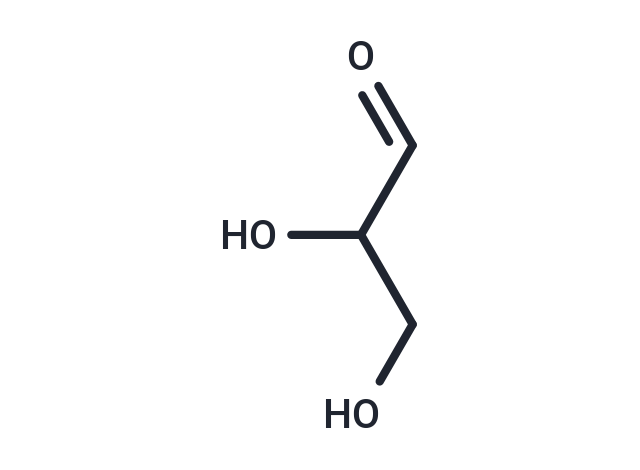
Cas No. 56-82-6
For research use only—not for human use. No sales to individuals. Use as intended only.
Select Batch
Purity:90%
Appearance:Solid
Color:White
COA HNMR
Product Information
Bioactivity
Chemical Properties
Storage & Solubility Information
| Description | DL-Glyceraldehyde (Glyceric aldehyde) is produced from the action of the enzyme glyceraldehyde dehydrogenase, which converts glycerol to glyceraldehyde using NADP as a cofactor. When present at sufficiently high levels, DL-Glyceraldehyde can be a cytotoxin and a mutagen. A cytotoxin is a compound that kills cells. A mutagen is a compound that causes mutations in DNA. DL-Glyceraldehyde is a highly reactive compound that can modify and cross-link proteins. DL-Glyceraldehyde modified proteins appear to be cytotoxic, depress intracellular glutathione levels, and induce reactive oxygen species (ROS) production (PMID: 14981296 ). DL-Glyceraldehyde has been shown to cause chromosome damage to human cells in culture and is mutagenic in the Ames bacterial test. |
| Targets & IC50 | Aldose reductase:10 nM(Human) |
| Synonyms | Glyceric aldehyde |
| Molecular Weight | 90.08 |
| Formula | C3H6O3 |
| Cas No. | 56-82-6 |
| Smiles | C(CO)(C=O)O |
| Relative Density. | 1.593 g/cm3 at -5℃ |
| Storage | Keep away from direct sunlight, Powder: -20°C for 3 years | In solvent: -80°C for 1 year Shipping with blue ice/Shipping at ambient temperature. | |||||||||||||||||||||||||||||||||||
| Solubility Information | DMSO: 250 mg/mL (2775.31 mM), Sonication is recommended.  | |||||||||||||||||||||||||||||||||||
| In Vivo Formulation | 10% DMSO+40% PEG300+5% Tween 80+45% Saline: 1 mg/mL (11.1 mM), Sonication is recommended. 10% DMSO+90% Saline: 10 mg/mL (111.01 mM), Solution. Please add the solvents sequentially, clarifying the solution as much as possible before adding the next one. Dissolve by heating and/or sonication if necessary. Working solution is recommended to be prepared and used immediately. The formulation provided above is for reference purposes only. In vivo formulations may vary and should be modified based on specific experimental conditions. | |||||||||||||||||||||||||||||||||||
Solution Preparation Table | ||||||||||||||||||||||||||||||||||||
DMSO
Note : The dilution table applies only to solid products. For liquid products, please calculate the stock solution based on the stated concentration and/or density. | ||||||||||||||||||||||||||||||||||||