

Goat F (ab')2 Anti-Mouse IgM, Human ads-HRP

Référence MBS679274-1mL
Conditionnement : 1mL
Marque : MyBiosource
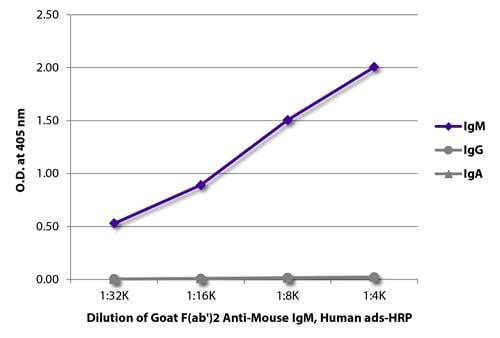
IgM Secondary Antibody – Goat
For Research Use Only. Not for use in diagnostic procedures. Catalog #: MBS679274MBS679274 is a secondary antibody targeting IgM. Also known as Goat F (ab')2 Anti-Mouse IgM, Human ads-HRP. Reactive in Mouse IgG and IgA; human immunoglobulins and pooled sera; may react with immunoglobulins from other species. Host: Goat. More details
Product Overview
Product Name
IgM, Secondary Antibody
Full Product Name
Goat F (ab')2 Anti-Mouse IgM, Human ads-HRP
Product Gene Name
IgM secondary antibody
Isotype
IgG
Host
Goat
Species Reactivity
Mouse IgG and IgA; human immunoglobulins and pooled sera; may react with immunoglobulins from other species
Form/Format
Supplied in a stock solution in 50% glycerol/50% PBS, pH 7.4; No preservative added
Specificity
Reacts with the heavy chain of mouse IgM
Preparation and Storage
Store at 2-8 degree C.
Volume
1.0 mL
Source Note
Pepsin digest of Goat Anti-Mouse IgM, Human ads
Conjugate
HRP (Horseradish Peroxidase)
Applications Tested/Suitable for IgM secondary antibody
ELISA (EIA), Fluorescence-Linked Immunosorbent Assay (FLISA), Flow Cytometry (FC/FACS), Immunohistochemistry (IHC) Formalin/Paraffin, Immunocytochemistry (ICC)
Product References and Citations for IgM secondary antibody
1. Kang M, Lu H, Yasui T, Sharpe A, Warren H, Cahir-McFarland E, et al. Epstein-Barr virus nuclear antigen 1 does not induce lymphoma in transgenic FVB mice. Proc Natl Acad Sci USA. 2005;102:820-5. (ELISA). 2. Yan J, Vetvicka V, Xia Y, Coxon A, Carroll MC, Mayadas TN, et al. beta-glucan, a "specific" biologic response modifier that uses antibodies to target tumors for cytotoxic recognition by leukocyte complement receptor type 3 (CD11b/CD18). J Immunol. 1999;163:3045-52. (FC). 3. Stabel TJ, Bolin SR, Pesch BA, Rahner TE. A simple and rapid flow cytometric method for detection of porcine cell surface markers. J Immunol Methods. 2000;245:147-52. (FC). 4. de Baey A, Mende I, Baretton G, Greiner A, Hartl WH, Baeuerle PA, et al. A subset of human dendritic cells in the T cell area of mucosa-associated lymphoid tissue with a high potential to produce TNF-alpha. J Immunol. 2003;170:5089-94. (FC). 5. Wallace DL, Zhang Y, Ghattas H, Worth A, Irvine A, Bennett AR, et al. Direct measurement of T cell subset kinetics in vivo in elderly men and women. J Immunol. 2004;173:1787-94. (FC). 6. Hoffman LM, Hall L, Batten JL, Young H, Pardasani D, Baetge EE, et al. X-inactivation status varies in human embryonic stem cell lines. Stem Cells. 2005;23:1468-78. (FC). 7. Guikema JE, Schrader CE, Leus NG, Ucher A, Linehan EK, Werling U, et al. Reassessment of the role of Mut S homolog 5 in Ig class switch recombination shows lack of involvement in cis- and trans-switching. J Immunol. 2008;181:8450-9. (FC). 8. Geraldes P, Rebrovich M, Herrmann K, Wong J, Jäck H, Wabl M, et al. Ig heavy chain promotes mature B cell survival in the absence of light chain. J Immunol. 2007;179:1659-68. (IHC-FS). 9. van Ginkel FW, Wahl SM, Kearney JF, Kweon M, Fujihashi K, Burrows PD, et al. Partial IgA-deficiency with increased Th2-type cytokines in TGF-beta1 knockout mice. J Immunol. 1999;163:1951-7. (IHC-PS). 10. Montalvo F, Almeida GM, Silva EM, Borges VM, Vasconcellos R, Takiya CM, et al. Apoptotic lymphocytes treated with IgG from Trypanosoma cruzi infection increase TNF-alpha secretion and reduce parasite replication in macrophages. Eur J Immunol. 2010;40:417-25. (ICC). 11. Miyazaki A, Yogosawa S, Murakami A, Kitamura D. Identification of CMTM7 as a transmembrane linker of BLNK and the B-cell receptor. PLoS One. 2012;7 (2):e31829. (ICC). 12. Takeshita H, Taniuchi I, Kato J, Watanabe T. Abrogation of autoimmune disease in Lyn-deficient mice by the mutation of the Btk gene. Int Immunol. 1998;10:435-44. (Stim). 13. Oliver AM, Martin F, Kearney JF. IgMhighCD21high lymphocytes enriched in the splenic marginal zone generate effector cells more rapidly than the bulk of follicular B cells. J Immunol. 1999;162:7198-207. (Stim). 14. Ochi H, Watanabe T. Negative regulation of B cell receptor-mediated signaling in B-1 cells through CD5 and Ly49 co-receptors via Lyn kinase activity. Int Immunol. 2000;12:1417-23. (Stim). 15. Kato I, Takai T, Kudo A. The pre-B cell receptor signaling for apoptosis is negatively regulated by FcgammaRIIB. J Immunol. 2002;168:629-34. (Stim). 16. Gavin AL, Aït-Azzouzene D, Ware CF, Nemazee D. deltaBAFF, an alternate splice isoform that regulates receptor binding and biopresentation of the B cell survival cytokine, BAFF. J Biol Chem. 2003;278:38220-8. (Stim). 17. Chattopadhyay G, Khan AQ, Sen G, Colino J, duBois W, Rubtsov A, et al. Transgenic expression of Bcl-xL or Bcl-2 by murine B cells enhances the in vivo antipolysaccharide, but not antiprotein, response to intact Streptococcus pneumoniae. J Immunol. 2007;179:7523-34. (Stim). 18. Bahjat FR, Pine PR, Reitsma A, Cassafer G, Baluom M, Grillo S, et al. An orally bioavailable spleen tyrosine kinase inhibitor delays disease progression and prolongs survival in murine lupus. Arthritis Rheum. 2008;58:1433-44. (Stim). 19. Hauser J, Verma-Gaur J, Wallenius A, Grundström T. Initiation of antigen receptor-dependent differentiation into plasma cells by calmodulin inhibition of E2A. J Immunol. 2009;183:1179-87. (Stim). 20. Woo A, Kim J, Jeong Y, Maeng HG, Lee Y, Kang JS, et al. Vitamin C acts indirectly to modulate isotype switching in mouse B cells. Anat Cell Biol. 2010;43:25-35. (Stim). 21. Hauser J, Grundström C, Grundström T. Allelic exclusion of IgH through inhibition of E2A in a VDJ recombination complex. J Immunol. 2014;192:2460-70. (Stim). 22. Lindner JM, Kayo H, Hedlund S, Fukuda Y, Fukao T, Nielsen PJ. Cutting edge: The transcription factor Bob1 counteracts B cell activation and regulates miR-146a in B cells. J Immunol. 2014;192:4483-6. (Stim). 23. Goverse G, Olivier BJ, Molenaar R, Knippenberg M, Greuter M, Konijn T, et al. Vitamin A metabolism and mucosal immune function are distinct between BALB/c and C57BL/6 mice. Eur J Immunol. 2015;45:89-100. (Stim). 24. Hu J, Oda SK, Shotts K, Donovan EE, Strauch P, Pujanauski LM, et al. Lysophosphatidic acid receptor 5 inhibits B cell antigen receptor signaling and antibody response. J Immunol. 2014;193:85-95. (Stim). 25. Bestas B, Moreno PM, Blomberg KE, Mohammad DK, Saleh AF, Sutlu T, et al. Splice-correcting oligonucleotides restore BTK function in X-linked agammaglobulinemia model. J Clin Invest. 2014;124:4067-81. (Stim)
Other Notes
Small volumes of IgM secondary antibody vial(s) may occasionally become entrapped in the seal of the product vial during shipment and storage. If necessary, briefly centrifuge the vial on a tabletop centrifuge to dislodge any liquid in the container`s cap. Certain products may require to ship with dry ice and additional dry ice fee may apply.
Additional Details
NCBI/Uniprot data below describe general gene information for IgM. It may not necessarily be applicable to this product.
Protein Family
IgM protease
Precautions
All of MyBioSource's Products are for scientific laboratory research purposes and are not for diagnostic, therapeutics, prophylactic or in vivo use. Through your purchase, you expressly represent and warrant to MyBioSource that you will properly test and use any Products purchased from MyBioSource in accordance with industry standards. MyBioSource and its authorized distributors reserve the right to refuse to process any order where we reasonably believe that the intended use will fall outside of our acceptable guidelines.
Disclaimer
While every efforts were made to ensure the accuracy of the information provided in this datasheet, MyBioSource will not be liable for any omissions or errors contained herein. MyBioSource reserves the right to make changes to this datasheet at any time without prior notice.
It is the responsibility of the customer to report product performance issues to MyBioSource within 30 days of receipt of the product. Please visit our Terms & Conditions page for more information.
It is the responsibility of the customer to report product performance issues to MyBioSource within 30 days of receipt of the product. Please visit our Terms & Conditions page for more information.
Product Note
Select online data sheet information is drawn from bioinformatics databases, occasionally resulting in ambiguous or non-relevant product information. It is the responsibility of the customer to review, verify, and evaluate the information to make sure it matches their requirements before purchasing the kit. Our ELISA Kit assays are dynamic research tools and sometimes they may be updated and improved. If the format of this assay is important to you then please request the current manual or contact our technical support team with a presales inquiry before placing an order. We will confirm the current details of the assay. We cannot guarantee the sample manual posted online is the most current manual, it is intended to serve as an example only. Please refer to the instructions For Use provided with the assay kit for precise details.