HSP90AA1 ELISA Kit (Bovine)

Référence OKEH06998
Conditionnement : 96Wells
Marque : Aviva Systems Biology
HSP90AA1 ELISA Kit (Bovine) (OKEH06998)
| Datasheets/Manuals | Printable datasheet for HSP90AA1 ELISA Kit (Bovine) (OKEH06998) |
|---|
| Predicted Species Reactivity | Bos taurus|Bovine | ||||||||||||||||||||||
|---|---|---|---|---|---|---|---|---|---|---|---|---|---|---|---|---|---|---|---|---|---|---|---|
| Application | ELISA-Sandwich | ||||||||||||||||||||||
| ELISA Kit Detection Method | Colorimetric, OD 450 nm | ||||||||||||||||||||||
| ELISA Kit Duration | ~3 Hours | ||||||||||||||||||||||
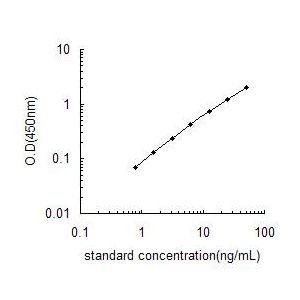
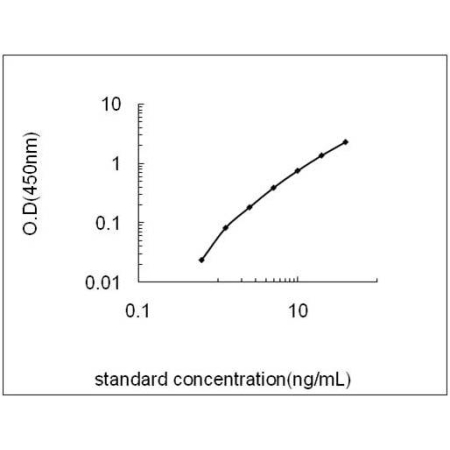
| ELISA Kit Principle | Aviva Systems Biology Hsp90aa1 ELISA Kit (Bovine) (OKEH06998) is based on standard sandwich enzyme-linked immuno-sorbent assay technology. An antibody specific for Hsp90aa1 has been pre-coated onto a 96-well plate (12 x 8 Well Strips) and blocked. Standards or test samples are added to the wells, incubated and removed. A biotinylated detector antibody specific for Hsp90aa1 is added, incubated and followed by washing. Avidin-Peroxidase Conjugate is then added, incubated and unbound conjugate is washed away. An enzymatic reaction is produced through the addition of TMB substrate which is catalyzed by HRP generating a blue color product that changes to yellow after adding acidic stop solution. The density of yellow coloration read by absorbance at 450 nm is quantitatively proportional to the amount of sample Hsp90aa1 captured in the well. | ||||||||||||||||||||||
| ELISA Kit Range | 0.625-40ng/mL | ||||||||||||||||||||||
| ELISA Kit Reproducibility | Intra-assay reproducibility was evaluated with 20 replicates of 3 samples representing low, middle and high level LIPC. Inter-assay reproducibility was evaluated with 3 samples representing low, middle and high level LIPC using 8 replicates on each of 3 plates. Intra-Assay CV <10% Inter-Assay CV <12% | ||||||||||||||||||||||
| ELISA Kit Component |
| ||||||||||||||||||||||
| Reconstitution and Storage | Store as indicated in product manual. | ||||||||||||||||||||||
| Sample Type | Serum, Plasma, Tissue Homogenates | ||||||||||||||||||||||
| Sensitivity | 0.284 ng/mL | ||||||||||||||||||||||
| Specificity | Natural and recombinant Bovine Heat shock protein HSP 90-alpha | ||||||||||||||||||||||
| Assay Info | Assay Methodology: Quantitative Sandwich ELISA |
| Gene Symbol | HSP90AA1 |
|---|---|
| Gene Full Name | heat shock protein 90 alpha family class A member 1 |
| Alias Symbols | heat shock 90kD protein 1, alpha, heat shock protein 90kDa alpha (cytosolic), class A member 1, heat shock protein HSP 90-alpha, HSPCA. |
| NCBI Gene Id | 281832 |
| Protein Name | Heat shock protein HSP 90-alpha |
| Description of Target | Molecular chaperone that promotes the maturation, structural maintenance and proper regulation of specific target proteins involved for instance in cell cycle control and signal transduction. Undergoes a functional cycle that is linked to its ATPase activity which is essential for its chaperone activity. This cycle probably induces conformational changes in the client proteins, thereby causing their activation. Interacts dynamically with various co-chaperones that modulate its substrate recognition, ATPase cycle and chaperone function. Engages with a range of client protein classes via its interaction with various co-chaperone proteins or complexes, that act as adapters, simultaneously able to interact with the specific client and the central chaperone itself. Recruitment of ATP and co-chaperone followed by client protein forms a functional chaperone. After the completion of the chaperoning process, properly folded client protein and co-chaperone leave HSP90 in an ADP-bound partially open conformation and finally, ADP is released from Hsp90 which acquires an open conformation for the next cycle. Apart from its chaperone activity, it also plays a role in the regulation of the transcription machinery. HSP90 and its co-chaperones modulate transcription at least at three different levels. In the first place, they alter the steady-state levels of certain transcription factors in response to various physiological cues. Second, they modulate the activity of certain epigenetic modifiers, such as histone deacetylases or DNA methyl transferases, and thereby respond to the change in the environment. Third, they participate in the eviction of histones from the promoter region of certain genes and thereby turn on gene expression. Binds bacterial lipopolysaccharide (LPS) and mediates LPS-induced inflammatory response, including TNF secretion by monocytes. Antagonizes STUB1-mediated inhibition of TGF-beta signaling via inhibition of STUB1-mediated SMAD3 ubiquitination and degradation. Interacts with HECTD1 (via N-terminus) (By similarity). |
| Uniprot ID | Q76LV2 |
| Protein Accession # | NP_001012688 |
| Nucleotide Accession # | NM_001012670 |