


- A micro ELISA plate --- The 96-well plate has been pre-coated with the anti-mouse Alb antibody. This dismountable microplate can be divided into 12 x 8 strip plates.
- Two vials lyophilized standard --- Dilute a bottle of the standard at dilution series, read the OD values, and then draw a standard curve.
- One vial Biotin-labeled Alb (100 x concentrate) (60 μl/bottle)
- One vial HRP-avidin (100 x concentrate) (120 μl/bottle) --- Bind to the detection antibody and react with the TMB substrate to make the solution chromogenic.
- One vial Biotin-antibody Diluent (20 ml/bottle) ---Dilute the Biotin-antibody.
- One vial HRP-avidin Diluent (20 ml/bottle) ---Dilute the HRP-avidin solution.
Mouse Albumin (Alb)ELISA Kit
Référence CSB-E13878m-96T
Conditionnement : 96T
Marque : Cusabio
| Size | 96T,5×96T,10×96T |
Product Details
Target Name
albumin
Associated names
Alb 1 ELISA Kit; alb ELISA Kit; ALBU_MOUSE ELISA Kit; Albumin 1 ELISA Kit; Albumin ELISA Kit; Serum albumin ELISA Kit
Abbreviation
Uniprot No.
Species
Mus musculus (Mouse)
Sample Types
serum, plasma, tissue homogenates
Detection Range
0.781 μg/mL-200 μg/mL
Sensitivity
0.110 μg/mL
Assay Time
1-5h
Sample Loading Volume
50-100ul
Detection Wavelength
450 nm
Research Area
Metabolism
Assay Principle
quantitative
Measurement
Competitive
Precision
Intra-assay Precision (Precision within an assay): CV%<8%
Three samples of known concentration were tested twenty times on one plate to assess.
Inter-assay Precision (Precision between assays):CV%<10%
Three samples of known concentration were tested in twenty assays to assess.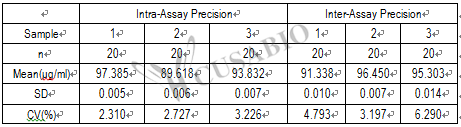
Linearity
To assess the linearity of the assay, samples were spiked with high concentrations of mouse albumin in various matrices and diluted with the Sample Diluent to produce samples with values within the dynamic range of the assay.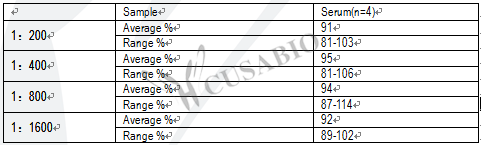
Typical Data
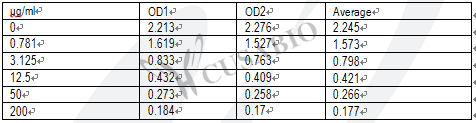
These standard curves are provided for demonstration only. A standard curve should be generated for each set of samples assayed.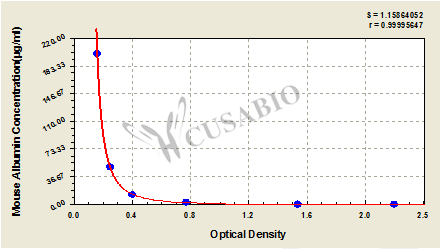
Materials provided
Materials not provided
- A microplate reader capable of measuring absorbance at 450 nm, with the correction wavelength set at 540 nm or 570 nm.
- An incubator that can provide stable incubation conditions up to 37°C±5°C.
- Centrifuge
- Vortex
- Squirt bottle, manifold dispenser, or automated microplate washer
- Absorbent paper for blotting the microtiter plate
ELISA Data Analysis
Troubleshooting
and FAQs
and FAQs
Storage
Store at 2-8°C. Please refer to protocol.
Shelf Life
6 months
Description
This Mouse ALB ELISA Kit was designed for the quantitative measurement of Mouse ALB protein in serum, plasma, tissue homogenates. It is a Competitive ELISA kit, its detection range is 0.781 μg/mL-200 μg/mL and the sensitivity is 0.110 μg/mL.
Citations
- L Xing, J Xie, Y Shi, R Zheng, T Zhang, X Li, Z Zhou,Scientific Reports,2026
- A Sánchez, D Ríos, M Martínez, V Monedero, M Zúñiga,Toxicology,2026
- V Bobo-Jimenez, S Gomila, R Lapresa, J Agulla,Communications Biology,2026
- A Sánchez Pajarero,Thesis & Dissertation,2025
- P He, B Hou, P Ma, L Zhang, T Xu, Z Wang, L Zhu,Journal of Future Foods,2025
- J Liu, Y Xiong, H Mo, H Niu, J Miao,International Journal of Biological Sciences,2024
- A Domene,Chemical research in toxicology,2023
- X Chen,Translational research,2023
- Z Zhang,Food and chemical toxicology,2024
- A Domene Rubio - 2023 - roderic.uv.es,/,2023
Customer Reviews and Q&A
There are currently no reviews for this product.
Target Background
Function
(From Uniprot)
(From Uniprot)
Binds water, Ca(2+), Na(+), K(+), fatty acids, hormones, bilirubin and drugs. Its main function is the regulation of the colloidal osmotic pressure of blood. Major zinc transporter in plasma, typically binds about 80% of all plasma zinc. Major calcium and magnesium transporter in plasma, binds approximately 45% of circulating calcium and magnesium in plasma. Potentially has more than two calcium-binding sites and might additionally bind calcium in a non-specific manner. The shared binding site between zinc and calcium at residue Asp-273 suggests a crosstalk between zinc and calcium transport...
Gene References into Functions
- findings suggest that HMGB1 induces the transcytosis of albumin via RAGE-dependent Src phosphorylation and Cav-1 phosphorylation. These studies revealed a new mechanism of HMGB1-induced endothelial hyperpermeability.
- Urinary L-FABP, NGAL, Kim-1 and albumin levels increased during the acute phase of kidney injury and were significantly correlated with the degree of tubulointerstitial fibrosis during the chronic phase. These markers could detect higher risk of progression to CKD.
- Extending serum half-life of albumin by engineering neonatal Fc receptor (FcRn) binding.
- We provide evidence of a transcytosis within the kidney tubular system that protects albumin and IgG from lysosomal degradation, allowing these proteins to be recycled intact.
- albumin may play a distinct role in adipocyte differentiation by promoting lipid accumulation.
- No binding of albumin was observed at physiological pH to neonatal Fc receptor. At acidic pH, a 100-fold difference in binding affinity was observed.
- Cellular oxidant stress and advanced glycation endproducts of albumin: caveats of the dichlorofluorescein assay
- albumin enhancer/promoter was succesfully used for trasient transfection of fluorescent gene reporters (for cell sorting) in ES spontaneously differentiated into hepatocytes.
Subcellular Location
Secreted.
Protein Families
ALB/AFP/VDB family
Tissue Specificity
Plasma. Expressed in the granular cells within the cerebellum.
Database Links
KEGG:
STRING:
UniGene:
