


CD3 PE-Cyanine7
Catalog #
Size
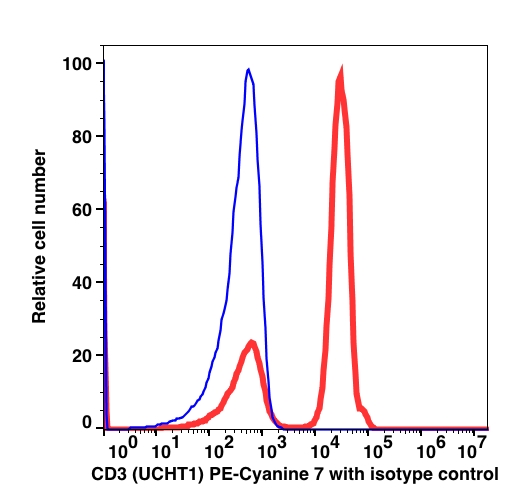
Lymphocyte-gated PBMCs stained with CD3 PE-Cyanine7 (RED); Lymphocyte-gated PBMCs FMO control (BLUE).
| Conjugation | PE-Cyanine7 |
|---|---|
| Antigen | CD3 |
| Clone | UCHT1 |
| Isotype | IgG1, k |
| Applications | FC |
| Reactivity | Human |
| Host | Mouse |
| Clonality | Monoclonal |
| Primary/Secondary | Primary |
| Storage | 2-8°C |
| Status | RUO |
| Excitation Laser | Blue (488nm) |
Description:
The monoclonal UCHT1 clone recognizes CD3ε antigen, a 20KDa transmembrane cell-surface protein that belongs to the immunoglobulin superfamily. The CD3 complex contains a CD3γ chain, a CD3δ chain, and two CD3ε chains. These chains associate with a molecule known as the T-cell receptor (TCR) and the ζ-chain (zeta-chain) to generate an activation signal in T lymphocytes. CD3ε is expressed on T lymphocytes, NK-T cells, and to varying degrees on developing thymocytes. CD3 plays central roles in TCR signaling, T lymphocyte activation, and antigen recognition. Crosslinking of the TCR via plate bound UCHT1 monoclonal is widely used to study the activation T cell response in vitro.
The monoclonal UCHT1 clone recognizes CD3ε antigen, a 20KDa transmembrane cell-surface protein that belongs to the immunoglobulin superfamily. The CD3 complex contains a CD3γ chain, a CD3δ chain, and two CD3ε chains. These chains associate with a molecule known as the T-cell receptor (TCR) and the ζ-chain (zeta-chain) to generate an activation signal in T lymphocytes. CD3ε is expressed on T lymphocytes, NK-T cells, and to varying degrees on developing thymocytes. CD3 plays central roles in TCR signaling, T lymphocyte activation, and antigen recognition. Crosslinking of the TCR via plate bound UCHT1 monoclonal is widely used to study the activation T cell response in vitro.