

Mouse Bone morphogenetic protein 7,BMP-7 ELISA Kit

Référence CSB-E08125m-96T
Conditionnement : 96T
Marque : Cusabio
 SDS
| Size | 96T,5×96T,10×96T |
Product Details
Target Name
bone morphogenetic protein 7
Associated names
Bmp7 ELISA Kit; Bmp-7 ELISA Kit; Op1 ELISA Kit; Bone morphogenetic protein 7 ELISA Kit; BMP-7 ELISA Kit; Osteogenic protein 1 ELISA Kit; OP-1 ELISA Kit
Abbreviation
Uniprot No.
Species
Mus musculus (Mouse)
Sample Types
serum, plasma, cell culture supernates, tissue homogenates
Detection Range
0.625 pg/mL-40 pg/mL
Sensitivity
0.156 pg/mL
Assay Time
1-5h
Sample Loading Volume
50-100ul
Detection Wavelength
450 nm
Research Area
Signal Transduction
Assay Principle
quantitative
Measurement
Sandwich
Precision
| Intra-assay Precision (Precision within an assay): CV%<8% | ||||||
| Three samples of known concentration were tested twenty times on one plate to assess. | ||||||
| Inter-assay Precision (Precision between assays): CV%<10% | ||||||
| Three samples of known concentration were tested in twenty assays to assess. | ||||||
Linearity
| To assess the linearity of the assay, samples were spiked with high concentrations of mouse BMP-7 in various matrices and diluted with the Sample Diluent to produce samples with values within the dynamic range of the assay. | ||||||
| Sample | Serum(n=4) | |||||
| 1:1 | Average % | 90 | ||||
| Range % | 87-92 | |||||
| 1:2 | Average % | 103 | ||||
| Range % | 98-106 | |||||
| 1:4 | Average % | 92 | ||||
| Range % | 89-97 | |||||
| 1:8 | Average % | 100 | ||||
| Range % | 97-103 | |||||
Recovery
| The recovery of mouse BMP-7 spiked to levels throughout the range of the assay in various matrices was evaluated. Samples were diluted prior to assay as directed in the Sample Preparation section. | ||||||
| Sample Type | Average % Recovery | Range | ||||
| Serum (n=5) | 94 | 91-96 | ||||
| EDTA plasma (n=4) | 95 | 93-98 | ||||
Typical Data
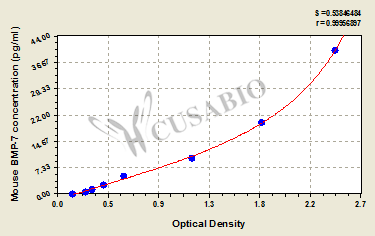
| These standard curves are provided for demonstration only. A standard curve should be generated for each set of samples assayed. | |||||||||||||||||||||||||||||||||||||||||||||||||||||||||||||||
| |||||||||||||||||||||||||||||||||||||||||||||||||||||||||||||||
ELISA Data Analysis
Troubleshooting
and FAQs
and FAQs
Storage
Store at 2-8°C. Please refer to protocol.
Shelf Life
6 months
Description
This Mouse BMP7 ELISA Kit was designed for the quantitative measurement of Mouse BMP7 protein in serum, plasma, cell culture supernates, tissue homogenates. It is a Sandwich ELISA kit, its detection range is 0.625 pg/mL-40 pg/mL and the sensitivity is 0.156 pg/mL .
Citations
- Tandrika Chattopadhyay.et al,Bio Factors,2017
Customer Reviews and Q&A
There are currently no reviews for this product.
Target Background
Function
(From Uniprot)
(From Uniprot)
Growth factor of the TGF-beta superfamily that plays important role in various biological processes, including embryogenesis, hematopoiesis, neurogenesis and skeletal morphogenesis. Initiates the canonical BMP signaling cascade by associating with type I receptor ACVR1 and type II receptor ACVR2A. Once all three components are bound together in a complex at the cell surface, ACVR2A phosphorylates and activates ACVR1. In turn, ACVR1 propagates signal by phosphorylating SMAD1/5/8 that travel to the nucleus and act as activators and repressors of transcription of target genes. For specific...
Gene References into Functions
- PTEN is a negative regulator of PI3K and BMP-7 increased PTEN expression in vivo and in vitro. These data demonstrate an important mechanism by which BMP-7 orchestrates renal protection through Akt inhibition and highlights Akt inhibitors as anti-fibrotic therapeutics.
- analysis of the mechanisms involved revealed the induction of bone morphogenetic protein-7 (BMP7) expression, a critical regulator of angiogenesis and kidney homeostasis, through a PDE5i-dependent downregulation of miR-22. In conclusion PDE5i slows the progression of Diabetic Nephropathy (DN) in mice, improving hemodynamic parameters and vessel
- Report a novel positive function of mm9_circ_009056 during osteogenesis in regulating BMP7 through miR-22-3p. Furthermore, the expression of mm9_circ_009056 was up-regulated in CGRP-induced cells, whereas miR-22-3p was decreased.
- BMP 7 is a key regulator of Tmem100-mediated cell proliferation in metanephric mesenchymal cells.There is a complicated regulation network among Tmem100, BMP7, and BMPR-II in mouse embryonic kidney-derived cells.
- Overexpression of miR-384-5p significantly decreased BMP7 protein, while depletion of miR-384-5p significantly increased BMP7 protein in renal epithelial cells.
- Bone morphogenetic protein 7 (BMP7) exerts differential effects depending on the concentration; it may expand mesenchymal cells in the stroma where BMP7 concentration is low and may upregulate cadherin-11 promoting condensation around the tip of ureteric buds.
- BMP-7 therefore is an attractive candidate for tackling a multifaceted disease such as diabetes, since it not only reduces body fat, but also strengthens insulin signaling, causing improved glucose uptake and ameliorating peripheral insulin resistance.
- Our studies indicate that BMP7 is an important factor during the process of implantation that contributes to healthy embryonic development.
- The disequilibrium between BMP-7 and TGF-beta signals plays a relevant role in the LV remodelling response to haemodynamic stress in mice subjected to transverse aortic constriction leading to left ventricular hypertrophy/dysfunction.
- the in vivo inter-relationships between Bmp7 and Usag-1, was examined.
- odontoblast beta-catenin signaling may act through regulation of BMP signaling to maintain the integrity of HERS cells
- BMP7 and FGF9 coordinately regulate AP-1 transcription to promote G1-S cell cycle progression and nephron progenitor cells proliferation.
- Gdf-5 induced the expression of the alpha5 sub-unit, while Bmp-7 induced the expression of the alphaV sub-unit.
- MiR-22 promotes the development of liver cirrhosis through BMP7 suppression.
- BMP7 induced changes in levels of mRNA and proteins associated with reactive gliosis in retinal astrocytes and Muller glial cells, including glial fibrillary acidic protein, glutamine synthetase, chondroitin sulfate proteoglycans and MMPs.
- We found that the recruited macrophages are polarized to a M2 subtype after renal injury. M2 macrophages released high levels TGFb1 to suppress BMP7 to enhance EMT-induced renal fibrosis.
- Bmp4, Bmp7 and bmpr2 signalling regulates the pre-implantation development of extra-embryonic cell lineages in the mouse embryo.
- These findings suggest that locally produced BMP7 is prerequisite for postnatal synovial joint homeostasis and may be involved in osteoarthritic changes
- Results demonstrate that disease progression in obstructive uropathy is driven by a cell type specific decrease in the expression of BMP-7 in the mouse.
- we characterize the cis-regulatory organization of a large genomic locus consisting of Tfap2c and Bmp7. We show that this locus is structurally partitioned into two distinct domains by the constitutive action of a discrete transition zone
- cross-talk between Cxcr4-TGF-beta1 and Bmp7 pathways in kidney fibrosis
- BMP-7 polarizes monocytes into M2 macrophages
- results suggest a protective role for BMP-7 in lung allergic inflammation, opposing the pro-fibrotic effects of TGF- beta1
- interactions between BMP-7 and USAG-1 (uterine sensitization-associated gene-1) regulate supernumerary organ formations
- MiR542-3p suppresses osteogenic differentiation and promotes osteoblast apoptosis by repressing BMP-7.
- BMP7 reverses the aberrant Ras protein activator (Rasal1) methylation associated with kidney fibrosis.
- results indicate that function of Bmp7 to inhibit the differentiation of progenitor cells together with its anti-apoptotic effect on progenitor cells maintains renal progenitor pool in undifferentiated status, and determines the nephron number at birth
- the anti-apoptotic effect of BMP-7 is mainly mediated through receptor BMPR2 and is associated with the activation of PI3K/AKT/GSK3beta pathway
- BMP7 increases mitochondrial activity in mature brown adipocytes via increased fatty acid uptake and oxidation, a process that requires the fatty acid transporters CPT1 and CD36.
- In Muller glia cells, EGF treatment induces the upregulation of Bmp7.
- The findings indicate a requirement for Bmp7 for the coordination of both developmental and mechanistic aspects of palatogenesis.
- Bmp2, Bmp4 and Bmp7 regulate epithelial to mesenchymal transition and have redundant functions in outflow tract myocardium.
- monoubiquitinated SMAD6 impairs the binding affinity of non-modified SMAD6 to the BMP type I receptor. Moreover, UBE2O and SMAD6 cooperated in the regulation of BMP7-induced adipogenesis
- BMP-7 induced proliferation, and mineralized nodule formation of cementoblasts.
- BMP7 and noggin have different roles in the processes of glial scar formation and neurorestoration in the ischemic brain.
- DEX reduces sepsis-induced AKI by decreasing TNF-alpha and MCP-1 and increasing BMP-7, which is associated with decreasing HDAC2 and HDAC5, as well as increasing acetyl histone H3.
- results underscore the importance of BMP7 in regulating both food intake and energy expenditure, and suggest new therapeutic approaches for obesity and its comorbidities
- Cloacal partitioning is driven by Bmp7 signaling in the cloacal endoderm.
- BMP7 is able to induce differentiation and mineral nodule formation and increase expression and proteome profile of molecules such as BMP1, TGFb and PCPE1 which are responsible for extracellular matrix formation.
- The augmented autocrine BMP7 signaling leads to increases in the anchorage-independent cell growth, migration and metastatic potential in our bone marrow metastatic breast cancer model.
- Canonical BMP7 activity is required for the generation of discrete neuronal populations in the dorsal spinal cord.
- BMP-7 enhanced renal recovery following the correction of prolonged obstructions that typically lead to irreversible renal injury.
- transfected BMP-7 enhances both in vitro and in vivo osteogenesis
- an unexpected inhibitory role of BMP7 during the onset of ureteric bud outgrowth
- these results indicate that Bmp7 is indirectly required for corpus callosum formation by controlling the timely differentiation of its guidepost cells
- BMP7 expression is induced in embryonic neurons of the cerebral cortex by activating mitogen-activated protein kinase/extracellular signal-regulated kinase signaling.
- Mineralized tissue markers were strongly regulated by BMP-7 almost 3-fold increase in BSP and OCN transcripts. significant increases in OPN and Runx2 mRNA expressions. BMP-7 treatment stimulated cementoblast-mediated biomineralization in vitro
- when both proteins are expressed in the same cell, sclerostin can antagonize BMP signaling directly by inhibiting BMP7 secretion
- Study conclude that inhibition of Gremlin exerts beneficial effects on the diabetic kidney mainly through maintenance of BMP-7 activity and that Gremlin may serve as a novel therapeutic target in the management of diabetic nephropathy.
- Endogenous neural precursor cells protect the young brain from glioblastoma by releasing bone morphogenetic protein-7, which acts as a paracrine tumour suppressor.
Subcellular Location
Secreted.
Protein Families
TGF-beta family
Database Links
KEGG:
STRING:
UniGene: