

Pyrintegrin [1228445-38-2]

Référence T16695-5mg
Conditionnement : 5mg
Marque : TargetMol
Pyrintegrin
Copy Product Info

Pyrintegrin, a β1-integrin agonist, promotes the survival of embryonic stem cells, can be used as a podocyte-protective agent, and enhances cell-extracellular matrix adhesion-mediated integrin signaling.
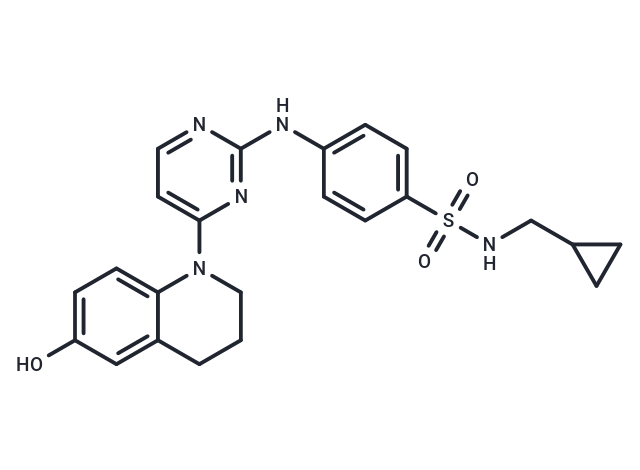
Cas No. 1228445-38-2
With extensive experience in compound synthesis, we can provide rapid custom synthesis services for this product according to your research needs.
For research use only—not for human use. No sales to individuals. Use as intended only.
Select Batch
Purity:99.19%
Appearance:Solid
Color:White
COA HPLC HNMR LCMS
Product Introduction
Bioactivity
Chemical Properties
Storage & Solubility Information
| Description | Pyrintegrin, a β1-integrin agonist, promotes the survival of embryonic stem cells, can be used as a podocyte-protective agent, and enhances cell-extracellular matrix adhesion-mediated integrin signaling. |
| In vitro | Pyrintegrin decreases Runx2 and Osx via BMP-mediated SMAD1/5 phosphorylation. Pyrintegrin treatment prevents damage-induced decreases in F-actin stress fibers, focal adhesions, and active β1-integrin levels in cultured cells. Pyrintegrin stimulates human adipose stem/progenitor cells (hASCs) to differentiate into lipid-laden adipocytes by upregulating peroxisome proliferator-activated receptor (PPARγ) and CCAAT/enhancer-binding protein-α (C/EBPα), with differentiated cells increasingly secreting adiponectin, leptin, glycerol, and total triglycerides. Pyrintegrin (0-10 μM; 1 hour; hASCs) treatment inhibits BMP4-mediated phosphorylation of BMP responsive SMAD1/5 in a dose-dependent manner (IC50 of 1.14 μM) [1][2]. |
| In vivo | Pyrintegrin induces postnatal adipose tissue formation in vivo of transplanted adipose stem/progenitor cells (ASCs) and recruited endogenous cells. Pyrintegrin decreases peak proteinuria caused by puromycin aminonucleoside-induced nephropathy. Pyrintegrin-treated human adipose stem/progenitor cells (ASCs) in 3D-bioprinted scaffolds, when transplanted in the dorsum of athymic mice, yielded ectopically formed adipose tissue that expressed human PPARγ. Pyrintegrin-adsorbed collagen gel implanted in the inguinal fat pad promoted adipogenesis formed by host endogenous cells, suggesting its ability to induce in situ adipogenesis without the need for cell transplantation. Pyrintegrin (10 mg/kg; intraperitoneal injection; once; C57BL/6J mice) treatment protects mice from LPS-induced podocyte foot process effacement and proteinuria. LPS administration decreases the levels of active β1 integrin in the podocytes, which is prevented by cotreatment with Pyrintegrin [1][2]. |
| Molecular Weight | 451.54 |
| Formula | C23H25N5O3S |
| Cas No. | 1228445-38-2 |
| Smiles | Oc1ccc2N(CCCc2c1)c1ccnc(Nc2ccc(cc2)S(=O)(=O)NCC2CC2)n1 |
| Relative Density. | 1.401 g/cm3 (Predicted) |
| Storage | Powder: -20°C for 3 years | In solvent: -80°C for 1 year Shipping with blue ice/Shipping at ambient temperature. | |||||||||||||||||||||||||||||||||||
| Solubility Information | DMSO: 150 mg/mL (332.2 mM), Sonication is recommended.  | |||||||||||||||||||||||||||||||||||
| In Vivo Formulation | 10% DMSO+40% PEG300+5% Tween 80+45% Saline: < 10 mg/mL (22.15 mM), Lower concentrations may be soluble, but exact solubility limit is unknown. 10% DMSO+90% Saline: < 10 mg/mL (22.15 mM), Lower concentrations may be soluble, but exact solubility limit is unknown. 10% DMSO+90% (20% SBE-β-CD in Saline): < 10 mg/mL (22.15 mM), Lower concentrations may be soluble, but exact solubility limit is unknown. Please add the solvents sequentially, clarifying the solution as much as possible before adding the next one. Dissolve by heating and/or sonication if necessary. Working solution is recommended to be prepared and used immediately. The formulation provided above is for reference purposes only. In vivo formulations may vary and should be modified based on specific experimental conditions. | |||||||||||||||||||||||||||||||||||
Solution Preparation Table | ||||||||||||||||||||||||||||||||||||
DMSO
Note : The dilution table applies only to solid products. For liquid products, please calculate the stock solution based on the stated concentration and/or density. | ||||||||||||||||||||||||||||||||||||