

ZO 1 Blocking Peptide

Référence MBS9616850-5x1mg
Conditionnement : 5x1mg
Marque : MyBiosource

Zo 1 Blocking Peptide – The purity is >90%,tested by HPLC and MS. Purity
For Research Use Only. Not for use in diagnostic procedures. Catalog #: MBS9616850Blocking peptides are peptides that bind specifically to the target antibody and block antibody binding. These peptide usually contains the epitope recognized by the antibody. Antibodies bound to the blocking peptide no longer bind to the epitope on the… More details
Product Overview
Online Datasheet in PDFProduct Name
ZO 1 (ZO-1), Blocking Peptide
Full Product Name
ZO 1 Blocking Peptide
Product Gene Name
ZO-1 blocking peptide
Product Synonym Gene Name
TJP1
Product Synonym Names
Tight junction protein 1; Tight junction protein ZO-1; Tight junction protein ZO1; TJP1; Zo1; ZO1_HUMAN; Zona occludens 1; Zona occludens 1 protein; Zona occludens protein 1; Zonula occludens 1 protein; Zonula occludens protein 1
Form/Format
Synthetic peptide was lyophilized with 100% acetonitrile and is supplied as a powder. Reconstitute with 0.1 ml DI water for a final concentration of 10 mg/ml.
Purity/Purification
The purity is >90%,tested by HPLC and MS.
Preparation and Storage
Maintain refrigerated at 2-8 degree C for up to 6 months. For long term storage store at -20 degree C.
Antibody/Peptide Pairs
ZO 1 peptide (MBS9616850) is used for blocking the activity of ZO 1 antibody (MBS9601318)
OMIM
601009
Supply Chain Verification
Manufactured in a lab with traceable raw materials manufactured on site. Coordinated product portfolio of antibodies, pairs, conjugates, recombinant proteins, and immunoassay materials available, please inquire.
Notes
For phospho antibody, we provide phospho peptide (0.5mg) and non-phospho peptide (0.5mg)
ISO Certification
Manufactured in an ISO 9001:2015 Certified Laboratory.
Applications Tested/Suitable for ZO-1 blocking peptide
Blocking/Control
Related Product Information for ZO-1 blocking peptide
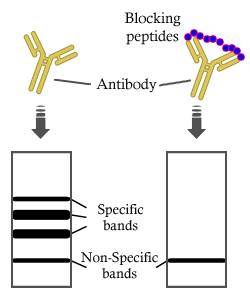
Blocking peptides are peptides that bind specifically to the target antibody and block antibody binding. These peptide usually contains the epitope recognized by the antibody. Antibodies bound to the blocking peptide no longer bind to the epitope on the target protein. This mechanism is useful when non-specific binding is an issue, for example, in Western blotting (immunoblot) and immunohistochemistry (IHC). By comparing the staining from the blocked antibody versus the antibody alone, one can see which staining is specific; Specific binding will be absent from the western blot or immunostaining performed with the neutralized antibody.
Other Notes
Small volumes of ZO-1 blocking peptide vial(s) may occasionally become entrapped in the seal of the product vial during shipment and storage. If necessary, briefly centrifuge the vial on a tabletop centrifuge to dislodge any liquid in the container`s cap. Certain products may require to ship with dry ice and additional dry ice fee may apply.
Searchable Terms for ZO-1 purchase
MBS9616850 is a blocking peptide targeting ZO-1. Also known as ZO 1 Blocking Peptide.
Additional Details
NCBI/Uniprot data below describe general gene information for ZO-1. It may not necessarily be applicable to this product.
NCBI Official Full Name
tight junction protein ZO-1 isoform a
NCBI Official Synonym Full Names
tight junction protein 1
NCBI Official Symbol
TJP1
NCBI Official Synonym Symbols
ZO-1
UniProt Protein Name
Tight junction protein ZO-1
UniProt Synonym Protein Names
Tight junction protein 1; Zona occludens protein 1; Zonula occludens protein 1
UniProt Gene Name
TJP1
UniProt Synonym Gene Names
ZO1
UniProt Entry Name
ZO1_HUMAN
NCBI Protein Information
tight junction protein ZO-1; zona occludens 1; zonula occludens 1 protein
NCBI Summary for ZO-1
This gene encodes a protein located on a cytoplasmic membrane surface of intercellular tight junctions. The encoded protein may be involved in signal transduction at cell-cell junctions. Alternative splicing of this gene results in multiple transcript variants. [provided by RefSeq, Jul 2014]
UniProt Comments for ZO-1
ZO1: a scaffolding protein of the MAGUK (membrane-associated guanylate kinase) family associated with tight junctions (TJ). May mediate dynamic changes in the composition of TJs. The N-terminal may be involved in transducing a signal required for tight junction assembly, while the C-terminal may have specific properties of tight junctions. The alpha domain might be involved in stabilizing junctions. Plays a role in the regulation of cell migration by targeting the protein kinase MRCKb to the leading edge of migrating cells. Interacts with BVES (via the C-terminus cytoplasmic tail). Interacts with HSPA4 and KIRREL1. Forms homodimers and heterodimers with ZO-2 or ZO-3. Interacts with occludin, CALM, claudins, CGN, CXADR, GJA12, GJD3 and UBN1. Interacts (via ZU5 domain) with MRCKb and MYZAP. Interacts (via PDZ domain) with Cx43. ZO-2 and ZO-3 shuttle between the TJ and the nucleus, where they may regulate gene expression. TJ, or zonula occludens, are the closely associated areas of two cells whose membranes are tightly joined together. They are composed of a branching network of strands, the efficiency of which increases exponentially with the number of strands. The strands associate with transmembrane proteins that bind to similar proteins on adjacent cells, and with submembranous proteins that are anchored to the actin component of the cytoskeleton. Thus, TJs join together the cytoskeletons of adjacent cells. They endow tissues with substantial form, shape and location, enforce cellular polarity, and form barriers to molecules and pathogens. Molecules forming the membranous part of TJs include occludin, claudins, tricellulin and junctional adhesion molecules. These molecules interact with the proteins ZO-1, ZO-2 and ZO-3. Tight junction proteins can be up- or downregulated in cancer and are involved in the epithelial-mesenchymal transitions (EMT) in tumors. Alternative splicing produces two isoforms. The long isoform is found in most epithelial cell junctions. The short isoform is found both in endothelial cells and the highly specialized epithelial junctions of renal glomeruli and Sertoli cells of the seminiferous tubules.
Protein type: Motility/polarity/chemotaxis; Adaptor/scaffold
Chromosomal Location of Human Ortholog: 15q13
Cellular Component: apical junction complex; intercellular canaliculus; tight junction; apicolateral plasma membrane; basolateral plasma membrane; cytosol; cell-cell adherens junction; apical part of cell; cytoplasm; apical plasma membrane; plasma membrane; gap junction; nucleus; cell junction
Molecular Function: protein C-terminus binding; calmodulin binding; protein domain specific binding; protein binding
Biological Process: response to drug; intercellular junction assembly; response to ethanol; sensory perception of sound; apoptosis; negative regulation of vascular permeability; blastocyst formation; response to lipopolysaccharide; cell structure disassembly during apoptosis
Show more Protein type: Motility/polarity/chemotaxis; Adaptor/scaffold
Chromosomal Location of Human Ortholog: 15q13
Cellular Component: apical junction complex; intercellular canaliculus; tight junction; apicolateral plasma membrane; basolateral plasma membrane; cytosol; cell-cell adherens junction; apical part of cell; cytoplasm; apical plasma membrane; plasma membrane; gap junction; nucleus; cell junction
Molecular Function: protein C-terminus binding; calmodulin binding; protein domain specific binding; protein binding
Biological Process: response to drug; intercellular junction assembly; response to ethanol; sensory perception of sound; apoptosis; negative regulation of vascular permeability; blastocyst formation; response to lipopolysaccharide; cell structure disassembly during apoptosis
Research Articles on ZO-1
Precautions
All of MyBioSource's Products are for scientific laboratory research purposes and are not for diagnostic, therapeutics, prophylactic or in vivo use. Through your purchase, you expressly represent and warrant to MyBioSource that you will properly test and use any Products purchased from MyBioSource in accordance with industry standards. MyBioSource and its authorized distributors reserve the right to refuse to process any order where we reasonably believe that the intended use will fall outside of our acceptable guidelines.
Disclaimer
While every efforts were made to ensure the accuracy of the information provided in this datasheet, MyBioSource will not be liable for any omissions or errors contained herein. MyBioSource reserves the right to make changes to this datasheet at any time without prior notice.
It is the responsibility of the customer to report product performance issues to MyBioSource within 30 days of receipt of the product. Please visit our Terms & Conditions page for more information.
It is the responsibility of the customer to report product performance issues to MyBioSource within 30 days of receipt of the product. Please visit our Terms & Conditions page for more information.
Product Note
Select online data sheet information is drawn from bioinformatics databases, occasionally resulting in ambiguous or non-relevant product information. It is the responsibility of the customer to review, verify, and evaluate the information to make sure it matches their requirements before purchasing the kit. Our ELISA Kit assays are dynamic research tools and sometimes they may be updated and improved. If the format of this assay is important to you then please request the current manual or contact our technical support team with a presales inquiry before placing an order. We will confirm the current details of the assay. We cannot guarantee the sample manual posted online is the most current manual, it is intended to serve as an example only. Please refer to the instructions For Use provided with the assay kit for precise details.
Product PubMed Publications
Products associated with ZO-1 blocking peptide
| Reference Product | PubMed Publications |
|---|---|
| OCLN blocking peptide | >526 publications with ZO-1 and OCLN |
| TJP2 blocking peptide | >88 publications with ZO-1 and TJP2 |
| CLDN4 blocking peptide | >46 publications with ZO-1 and CLDN4 |
| F11R blocking peptide | >24 publications with ZO-1 and F11R |
| CGN blocking peptide | >19 publications with ZO-1 and CGN |
| GJA1 blocking peptide | >14 publications with ZO-1 and GJA1 |
| CSDA blocking peptide | >10 publications with ZO-1 and CSDA |
| KIRREL blocking peptide | >5 publications with ZO-1 and KIRREL |
| CTTN blocking peptide | >4 publications with ZO-1 and CTTN |
Pathways associated with ZO-1 blocking peptide
| Products by Pathway | Pathway Diagram |
|---|---|
| Adherens Junction Pathway antibodies | Adherens Junction Pathway Diagram |
| Adherens Junction Pathway antibodies | Adherens Junction Pathway Diagram |
| Apoptosis Pathway antibodies | Apoptosis Pathway Diagram |
| Apoptotic Cleavage Of Cell Adhesion Proteins Pathway antibodies | Apoptotic Cleavage Of Cell Adhesion Proteins Pathway Diagram |
| Apoptotic Cleavage Of Cellular Proteins Pathway antibodies | Apoptotic Cleavage Of Cellular Proteins Pathway Diagram |
| Apoptotic Execution Phase Pathway antibodies | Apoptotic Execution Phase Pathway Diagram |
| E-cadherin Signaling In The Nascent Adherens Junction Pathway antibodies | E-cadherin Signaling In The Nascent Adherens Junction Pathway Diagram |
| Epithelial Cell Signaling In Helicobacter Pylori Infection Pathway antibodies | Epithelial Cell Signaling In Helicobacter Pylori Infection Pathway Diagram |
| Epithelial Cell Signaling In Helicobacter Pylori Infection Pathway antibodies | Epithelial Cell Signaling In Helicobacter Pylori Infection Pathway Diagram |
| Gap Junction Pathway antibodies | Gap Junction Pathway Diagram |
Diseases associated with ZO-1 blocking peptide
| Disease Name | Pubmed Publications |
|---|---|
| Inflammation Antibodies | >208 publications with ZO-1 and Inflammation |
| Disease Models, Animal Antibodies | >159 publications with ZO-1 and Disease Models, Animal |
| Nervous System Diseases Antibodies | >144 publications with ZO-1 and Nervous System Diseases |
| Necrosis Antibodies | >135 publications with ZO-1 and Necrosis |
| Brain Diseases Antibodies | >131 publications with ZO-1 and Brain Diseases |
| Cardiovascular Diseases Antibodies | >111 publications with ZO-1 and Cardiovascular Diseases |
| Edema Antibodies | >73 publications with ZO-1 and Edema |
| Kidney Diseases Antibodies | >65 publications with ZO-1 and Kidney Diseases |
| Fibrosis Antibodies | >44 publications with ZO-1 and Fibrosis |
| Liver Diseases Antibodies | >42 publications with ZO-1 and Liver Diseases |
Organs/Tissues associated with ZO-1 blocking peptide
| Organ/Tissue Name | Pubmed Publications |
|---|---|
| Blood Antibodies | >545 publications with ZO-1 and Blood |
| Vascular Antibodies | >351 publications with ZO-1 and Vascular |
| Brain Antibodies | >348 publications with ZO-1 and Brain |
| Kidney Antibodies | >292 publications with ZO-1 and Kidney |
| Intestine Antibodies | >278 publications with ZO-1 and Intestine |
| Eye Antibodies | >272 publications with ZO-1 and Eye |
| Liver Antibodies | >142 publications with ZO-1 and Liver |
| Muscle Antibodies | >130 publications with ZO-1 and Muscle |
| Embryonic Tissue Antibodies | >117 publications with ZO-1 and Embryonic Tissue |
| Nerve Antibodies | >110 publications with ZO-1 and Nerve |