

Anti-TGF beta 1 Antibody (9U614)

Référence NB-64-114398-200uL
Conditionnement : 200uL
Marque : Neo Biotech
Remove All
Anti-TGF beta 1 Antibody (9U614)
(Synonyms: transforming growth factor, β1, transforming growth factor, beta 1, TGF β1) Copy Product InfoSynonyms: transforming growth factor, β1, transforming growth factor, beta 1, TGF β1
Catalog No. TMAB-01826 Copy Product Info
Anti-TGF beta 1 Antibody (9U614) is a Mouse antibody targeting TGF beta 1. Anti-TGF beta 1 Antibody (9U614) can be used in IF,IHC-Fr,IHC-P.
For research use only—not for human use. No sales to individuals. Use as intended only.
Product Information
Bioactivity
Antigen Details
Chemical Properties
Stability & Storage
| Description | Anti-TGF beta 1 Antibody (9U614) is a Mouse antibody targeting TGF beta 1. Anti-TGF beta 1 Antibody (9U614) can be used in IF,IHC-Fr,IHC-P. |
| Synonyms | transforming growth factor, β1, transforming growth factor, beta 1, TGF β1 |
| Ig Type | IgG1 |
| Clone | 9U614 |
| Reactivity | Rat,Mouse (predicted:Human) |
| Verified Activity | 1. Paraformaldehyde-fixed, paraffin embedded (rat spleen); Antigen retrieval by boiling in sodium citrate buffer (pH6.0) for 15 min; Block endogenous peroxidase by 3% hydrogen peroxide for 20 min; Blocking buffer (normal goat serum) at 37°C for 30 min; Antibody incubation with (TGF beta 1) Monoclonal Antibody, Unconjugated (TMAB-01826) at 1:200 overnight at 4°C, followed by operating according to SP Kit (Mouse) instructionsand DAB staining. 2. Paraformaldehyde-fixed, paraffin embedded (mouse spleen); Antigen retrieval by boiling in sodium citrate buffer (pH6.0) for 15 min; Block endogenous peroxidase by 3% hydrogen peroxide for 20 min; Blocking buffer (normal goat serum) at 37°C for 30 min; Antibody incubation with (TGF beta 1) Monoclonal Antibody, Unconjugated (TMAB-01826) at 1:200 overnight at 4°C, followed by operating according to SP Kit (Mouse) instructionsand DAB staining. 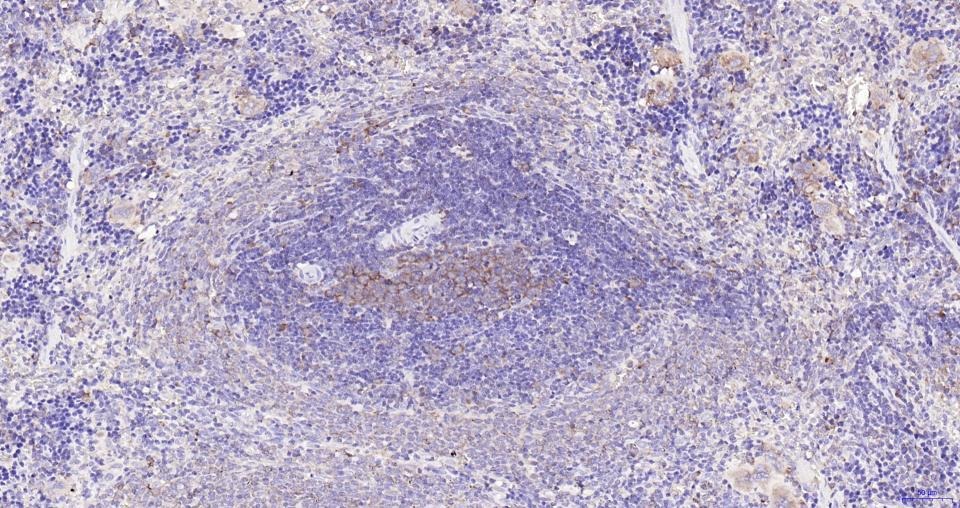 , ,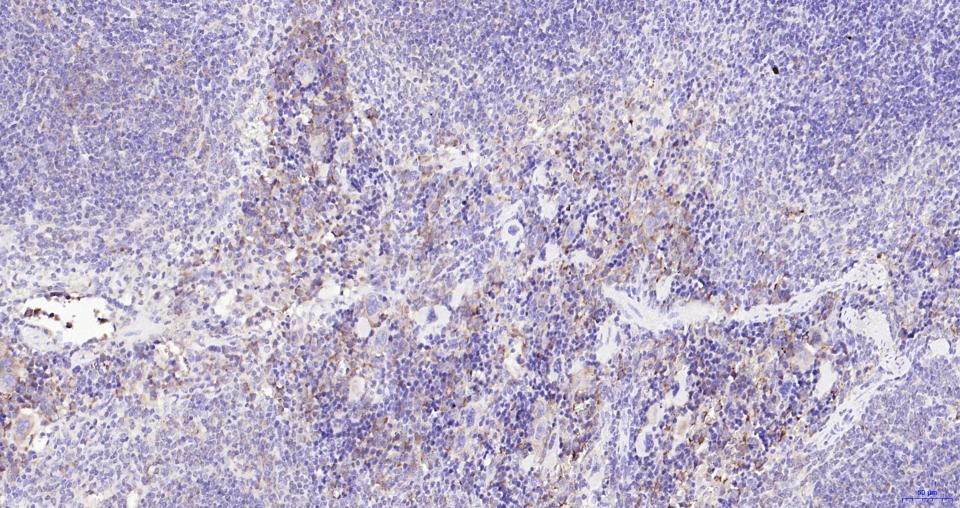 |
| Application | IF IHC-Fr IHC-P |
| Recommended Dose | IHC-P: 1:100-500; IHC-Fr: 1:100-500; IF: 1:100-500 |
| Antibody Type | Monoclonal |
| Host Species | Mouse |
| Subcellular Localization | Secreted, extracellular space, extracellular matrix. |
| Tissue Specificity | Highly expressed in bone. Abundantly expressed in articular cartilage and chondrocytes and is increased in osteoarthritis (OA). Co-localizes with ASPN in chondrocytes within OA lesions of articular cartilage. |
| Construction | Hybridoma Monoclonal Antibody |
| Purification | Protein A purified |
| Appearance | Liquid |
| Formulation | 0.01M TBS (pH7.4) with 1% BSA, 0.02% Proclin300 and 50% Glycerol. |
| Concentration | 1 mg/mL |
| Research Background | This gene encodes a member of the transforming growth factor beta (TGFB) family of cytokines, which are multifunctional peptides that regulate proliferation, differentiation, adhesion, migration, and other functions in many cell types. Many cells have TGFB receptors, and the protein positively and negatively regulates many other growth factors. The secreted protein is cleaved into a latency-associated peptide (LAP) and a mature TGFB1 peptide, and is found in either a latent form composed of a TGFB1 homodimer, a LAP homodimer, and a latent TGFB1-binding protein, or in an active form composed of a TGFB1 homodimer. The mature peptide may also form heterodimers with other TGFB family members. This gene is frequently upregulated in tumor cells, and mutations in this gene result in Camurati-Engelmann disease. |
| Immunogen | KLH conjugated synthetic peptide: human TGF beta 1 |
| Antigen Species | Human |
| Gene Name | TGFB1 |
| Gene ID | 7040 |
| Protein Name | Transforming growth factor beta-1 proprotein |
| Uniprot ID | P01137 |
| Biology Area | Response to hypoxia,TGF,Angiogenic growth factors,TGF,Co-factors,Hypoxia,tgf beta 1,TGF,Secreted |
| Function | Multifunctional protein that controls proliferation, differentiation and other functions in many cell types. Many cells synthesize TGFB1 and have specific receptors for it. It positively and negatively regulates many other growth factors. It plays an important role in bone remodeling as it is a potent stimulator of osteoblastic bone formation, causing chemotaxis, proliferation and differentiation in committed osteoblasts. |
| Molecular Weight | Theoretical: 12.8/44 kDa. |
| Stability & Storage | Store at -20°C or -80°C for 12 months. Avoid repeated freeze-thaw cycles. |
| Transport | Shipping with blue ice. |
Calculator
Keywords
transforming growth factor, β 1transforming growth factor, b 1
Preview
Related Tags: Anti-TGF beta 1 Antibody (9U614) chemical structure | Anti-TGF beta 1 Antibody (9U614) molecular weight
Generate Quote
Catalog No.: Cas No.:
Add
| Size | Quantity | Unit Price | Amount | Operation |
|---|
Generate Quote