


G-Series Human Cytokine Array 640 Kit. A combination of 16 non-overlapping arrays to measure the relative expression levels of 640 human cytokines. Suitable for all liquid sample types.
High Density
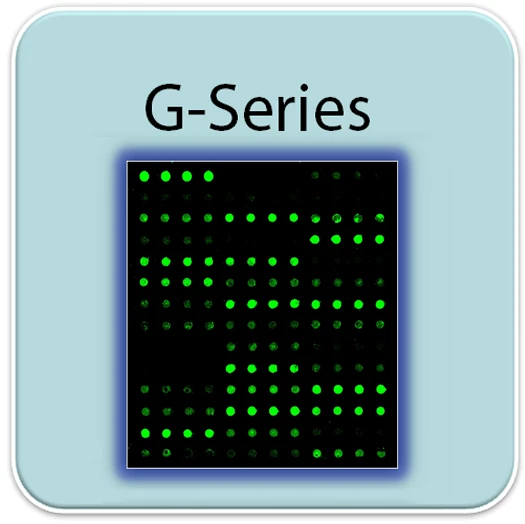
Human Cytokine Array GS640
Human Cytokine Array GS640
Contact Us for Bulk Request
Product Description
Specifications
| Size | 16 Sample Kit, 32 Sample Kit, 64 Sample Kit |
| Species | Human |
| Compatible Sample Types | Cell Culture Supernatants, Plasma, Serum, Tissue Lysates, Cell Lysates |
| Quantitative/Semi-Quantitative | Semi-Quantitative |
| Number of Targets Detected | 640 |
| Solid Support | Glass Slide |
| Design Principle | Sandwich-based |
| Method Of Detection | Fluorescence Laser Scanner |
| Shipping Type | Blue ice |
| Storage | -20°C |
Introduction
RayBio® G-Series Arrays are glass slide-based antibody arrays which allow researchers to conduct rapid, accurate expression profiling of hundreds of cytokines, chemokines, growth factors, proteases, soluble receptors and other proteins from any biological fluid. Like a traditional sandwich-based ELISA, this array uses a matched pair of cytokine-specific antibodies for detection. Like the Quantibody® Multiplex ELISA Arrays, G-Series utilizes a highly sensitive and stable fluorescent readout which can be detected by most laser fluorescent scanner systems (see below for more info). After capturing the spot densities with a laser scanner, normalization of the raw data can be easily calculated by the researcher, or by a quick copy-paste into our excel-based Analysis Tool software.
This array as well as all catalog numbers beginning with 'GS' differ from the classic G-Series Arrays in a few important ways. First, each capture antibody is printed in quadruplicate instead of duplicate, delivering higher precision. Secondly, this array features the same antibody panels used in our Quantibody Arrays, allowing a seamless transition to our quantitative multiplex assay platform. Lastly, all 16 wells are spotted as sub-arrays, delivering easy handling of 16 samples simultaneously while consuming low sample volumes (10 - 100 µl per array).
This array as well as all catalog numbers beginning with 'GS' differ from the classic G-Series Arrays in a few important ways. First, each capture antibody is printed in quadruplicate instead of duplicate, delivering higher precision. Secondly, this array features the same antibody panels used in our Quantibody Arrays, allowing a seamless transition to our quantitative multiplex assay platform. Lastly, all 16 wells are spotted as sub-arrays, delivering easy handling of 16 samples simultaneously while consuming low sample volumes (10 - 100 µl per array).
Product Features
- High sensitivity (pg/mL to ng/mL levels)
- High specificity and system reproducibility
- Suitable for diverse sample types
- Low sample volume requirement: 50 µL or less
- Get results same day (6-hour processing time)
- Well-suited for high throughput assays
- Test 16 samples on each slide
- Data analysis software provides one-step computation
Target Names
2B4 (CD244), 4-1BB Ligand (TNFSF9), 4-1BB (TNFRSF9/CD137), 6Ckine (CCL21), ACE, ACE-2, Activin A, Activin R1B (ALK-4), Activin R2B (ACVR2B), ADAM-12, ADAM23, ADAM-8, ADAM-9, ADAMTS-13, Adiponectin (ACRP30), Adipsin (Complement Factor D), ADP-Ribosyl Cyclase 2 (BST-1/CD157), aFGF (FGF-1), Aggrecan, AgRP, Albumin, ALCAM (CD166), ALK-1, ALK-6 (BMPR-IB), Alpha-fetoprotein, AMICA, AmiGO, Aminopeptidase LRAP (ERAP2), Aminopeptidase P2 (XPNPEP2), Amnionless, Amphiregulin, Angiogenin, Angiopoietin-1, Angiopoietin-2, Angiopoietin-4, Angiostatin, Angiotensinogen (SERPINA8), ANGPTL3, ANGPTL4, APRIL, Artemin, Arylsulfatase A (ARSA), AXL, B7-H1 (CD274), B7-H2 (ICOS Ligand), B7-H3 (CD276), BAFF, BAFF R, BAMBI (NMA), BCAM, bcl-w, BCMA, BDNF, beta IG-H3, Beta-2 Microglobulin, Betacellulin (BTC), beta-NGF, bFGF, BLAME (SLAMF8), BLC (CXCL13), BMP-2, BMP-4, BMP-5, BMP-7, BMP-8, BMP-9, BMPR-IA (ALK-3), BMPR-II, BOC (Brother of CDO), Brevican, C5a, CA12, CA125, CA15-3, CA19-9, CA9, Cadherin-11, Cadherin-13, Cadherin-4, Calcitonin, Calsyntenin-1 (Alcadein-alpha), Carboxypeptidase A2 (CPA2), Cardiotrophin-1 (CT-1), Cathepsin B (Pro-Cathepsin B), Cathepsin E, Cathepsin L, Cathepsin S, Cathepsin V (Cathepsin L2), CCL28 (MEC), CD109, CD14, CD147 (EMMPRIN), CD155 (PVR), CD163, CD200, CD229 (SLAMF3), CD23, CD26 (DPPIV), CD27 (TNFRSF7), CD28, CD30 (TNFRSF8), CD300c (CLM-6), CD320 (TCblR/8D6A), CD34, CD40 Ligand (TNFSF5), CD40 (TNFRSF5), CD48 (SLAMF2), CD58 (LFA-3), CD6, CD80 (B7-1), CD83, CD84 (SLAMF5), CD86 (B7-2), CD97, CD99, CDNF, CDO, CEA (CEACAM-5), CEA (CEACAM-5), CEACAM-1, Chemerin, CHI3L1, CHL-1 (L1CAM-2), CHST1 (GST-1), CHST4 (GST-3), cIAP-2, CILP-1, Ck beta 8-1 (CCL23/MPIF-1), CLEC-1, CLEC10A (CD301), Clusterin, CMG-2 (ANTXR2), CNTF, CNTF R alpha, Coagulation Factor VII, Coagulation Factor XIV (Protein C), Common beta Chain, Complement MASP3, Contactin-1, Contactin-2 (TAG1), CREG, CRIM1, Cripto-1, CRP (C-Reactive Protein), CRTAC1, CRTAM, CTACK (CCL27), CTLA-4 (CD152), CXADR, CXCL14 (BRAK), CXCL16, Cystatin A, Cystatin B, Cystatin C, Cystatin E/M, Cystatin SN, Cytokeratin 8 (KRT8), DAN, DcR3, Decorin, Dectin-1 (CLEC7A), Desmocollin-3, Desmoglein-1, Desmoglein-2, Desmoglein-3, DKK-1, DKK-3, DKK-4, DLL1, DNAM-1 (CD226), Dopa Decarboxylase (DDC), DPPII (QPP/DPP7), DR3 (TNFRSF25), DR6 (TNFRSF21), DSPG3, Dtk, E-Cadherin, EDA-A2, EDAR, EGF, EGFR, EG-VEGF (PK1), EMR2, ENA-78 (CXCL5), Endocan, Endoglin (CD105), Endoglycan (PODXL2), Eotaxin-1 (CCL11), Eotaxin-2 (MPIF-2/CCL24), Eotaxin-3 (CCL26), EphA1, EphA2, EphB4, EphB6, Ephrin-A4, Ephrin-B3, Epiregulin, ErbB2, ErbB3, ErbB4 (HER4), Erythropoietin R, ESAM, E-Selectin, FABP1, FABP2, FAP, Fas Ligand (TNFSF6), Fas (TNFRSF6/Apo-1), Fc gamma RIIB/C (CD32B/C), FCAR (CD89), FCRL1 (FcRH1), FCRL2 (FcRH2), Ferritin, Fetuin A, FGF-12, FGF-17, FGF-19, FGF-20, FGF-21, FGF-23, FGF-4, FGF-5, FGF-6, FGF-7 (KGF), FGF-9, FLRG, Flt-3 Ligand, Flt-3 (Flk-2), FOLH1 (PSMA), Follistatin, Follistatin-like 1, FOLR1, FOLR2, Fractalkine (CX3CL1), FSH, Furin, Galectin-1, Galectin-2, Galectin-3, Galectin-4, Galectin-7, Galectin-8, Galectin-9, Gas 1, Gas 6, GASP-1 (WFIKKNRP), GASP-2 (WFIKKN), GCP-2 (CXCL6), GCSF, GCSF R (CD114), GDF-15, GDF-8 (Myostatin), GDNF, GITR Ligand (TNFSF18), GITR (TNFRSF18), GLP-1, Glypican 1, Glypican 2, Glypican 5, GM-CSF, GM-CSF R alpha, GOLM1 (GP73), gp130 (sgp130), GPR56, GPVI, Granulysin (NKG5/LAG-2), GRO alpha/beta/gamma, GRO alpha (CXCL1), Growth Hormone, Growth Hormone R, HAI-1, HAI-2, HAPLN1, HB-EGF, HCC-1 (CCL14), HCC-4 (CCL16), hCG beta, Hepsin, HGF, HGFR, HTRA2, HVEM (TNFRSF14), I-309 (TCA-3/CCL1), ICAM-1 (CD54), ICAM-2 (CD102), ICAM-3 (CD50), ICOS, IFN-alpha / beta R2, IFN-gamma, IFN-gamma R1, IGF-1, IGF-1 R, IGF-2, IGF-2 R, IGFBP-1, IGFBP-2, IGFBP-3, IGFBP-4, IGFBP-5, IGFBP-6, IL-1 alpha (IL-1 F1), IL-1 beta (IL-1 F2), IL-1 R1, IL-1 R2, IL-1 R3 (IL-1 R Acp), IL-1 R4 (ST2), IL-1 R5 (IL-18 R alpha), IL-1 R6 (IL-1 Rrp2), IL-1 Ra (IL-1 F3), IL-10, IL-10 R alpha, IL-10 R beta, IL-11, IL-12 p40, IL-12 p70, IL-13, IL-13 R alpha 1 (IL-13 R1), IL-13 R alpha 2, IL-15, IL-15 R alpha, IL-16, IL-17 RA, IL-17 RB, IL-17A, IL-17B, IL-17C, IL-17E (IL-25), IL-17F, IL-18, IL-18 BP alpha, IL-18 R beta (AcPL), IL-2, IL-2 R alpha, IL-2 R beta (CD122), IL-2 R gamma (Common gamma Chain), IL-20, IL-20 R alpha, IL-21, IL-21 R, IL-22 R alpha 1, IL-22BP, IL-23, IL-23 R, IL-24, IL-27, IL-27 R alpha, IL-28A (IFN-lambda 2), IL-29 (IFN-lambda 1), IL-3, IL-31, IL-31 RA, IL-32 alpha, IL-33 (IL-1 F11), IL-34, IL-36 alpha (IL-1 F6), IL-36 beta (IL-1 F8), IL-36 gamma (IL-1 F9), IL-36 Ra (IL-1 F5), IL-37 (IL-1 F7), IL-38 (IL-1 F10), IL-4, IL-4 R alpha, IL-5, IL-5 R alpha, IL-6, IL-6 R, IL-7, IL-7 R alpha (CD127), IL-8 (CXCL8), IL-9, ILT-2 (LIR-1/CD85j), Insulin, Insulin R (CD220), Integrin alpha 5, IP-10 (CXCL10), I-TAC (CXCL11), Jagged 1, Jagged 2, JAM-A (CD321/F11R), JAM-B (VE-JAM/CD322), JAM-C (CD323), Kallikrein 14, Kallikrein 5, Kallikrein 7, KIRREL3 (NEPH2), KLF4, LAG-3, LAIR1, LAMP (LSAMP), LAMP1 (CD107a), Langerin (CD207), LAP/TGF beta 1 (TGF beta 1), Layilin, LDL R, Legumain, Leptin, Leptin R, LIF, LIF R alpha, LIGHT (TNFSF14), LIMPII, Lipocalin-1, Lipocalin-2 (NGAL), LOX-1, LRIG3, LRP-6, L-Selectin (CD62L), Lumican, Luteinizing hormone, Lymphotactin (XCL1), Lymphotoxin beta R (TNF RIII), LYVE-1, Marapsin, Matrilin-3, Matriptase (ST14), MBL, MCP-1 (CCL2), MCP-2 (CCL8), MCP-3 (MARC/CCL7), MCP-4 (CCL13), M-CSF, M-CSF R, MDC (CCL22), MDGA1, MDM2, MEPE (OF45), Meprin alpha, Meprin beta (MEP1B), Mer, Mesothelin, MFRP, MICA, MICB, Midkine, MIF, MIG (CXCL9), MIP-1 alpha (CCL3), MIP-1 beta (CCL4), MIP-1 delta (CCL15), MIP-3 alpha (CCL20), MIP-3 beta (CCL19), MIS RII (AMHR2), MMP-1, MMP-10, MMP-13, MMP-2, MMP-3, MMP-7, MMP-8, MMP-9, MPIF-1 (CCL23), MSP alpha/beta, MSP Receptor (Ron), NAP-2 (PPBP/CXCL7), N-Cadherin (Cadherin-2), NCAM-1 (CD56), Nectin-1, Nectin-3, Nectin-4, Neprilysin, Neprilysin-2 (MMEL1), Neurexin-3 beta (NRXN3), Neuropilin-2, Neurturin, NGFR (TNFRSF16), Nidogen-1, Nidogen-2, NKp30, NKp44, Nogo Receptor (Reticulon-4 Receptor), Notch-1, Notch-3, NOV (CCN3), NrCAM, NRG1-beta 1 (HRG1-beta 1), NSE, NT-3, NT-4, Olfactomedin-2 (Noelin-2), Oncostatin M, Oncostatin M R beta (IL-31 R beta), Osteoactivin (GPNMB), Osteopontin (SPP1), Osteoprotegerin (TNFRSF11B), OX40 Ligand (TNFSF4), OX40 (TNFRSF4), p27/Kip1 (CDKN1B), p53, PAI-1, PAPP-A (htPAPP-A), PAPP-A2, PARC (CCL18), P-Cadherin, PD-1, PD-ECGF (Thymidine Phosphorylase), PDGF R beta, PDGF-AA, PDGF-AB, PDGF-BB, PDGF-C, PECAM-1, Pentraxin-3 (TSG-14), Pepsinogen 1, Pepsinogen 2, Periostin, Persephin, PGRPs, Platelet Factor 4 (CXCL4), Plexin B3, Plexin D1, PLGF, Pref-1 (DLK-1/FA1), Presenilin 1, Procalcitonin, Progranulin, ProGRP, Prolactin, Prolactin R, Prostasin, PSA-free, PSA-total, PTH, PYY, RAGE, RANK (TNFRSF11A), RANTES (CCL5), RBP4, Reg1B, RELT (TNFRSF19L), Renin, Resistin, Ret, RGM-A, RGM-B, ROBO2, ROBO3, ROBO4, Ryk, S100 A8, SCF, SCF R (CD117/c-kit), SDF-1 alpha (CXCL12 alpha), SDF-1 beta (CXCL12 beta), Semaphorin 6B, Semaphorin 6D, Semaphorin 7A, SERPINA4, SERPINF1 (PEDF), sFRP-3, SIGIRR, Siglec-10, Siglec-11, Siglec-5 (CD170), Siglec-7 (CD328), Siglec-9, SLAM (CD150), Sonic Hedgehog N-Terminal (Shh-N), SOST, SOX2, SP-D, Spinesin, SREC-I (SCARF1), SREC-II (SCARF2), Syndecan-1, Syndecan-3, Syndecan-4, TACE, TACI (TNFRSF13B), TARC (CCL17), TECK (CCL25), Testican 2 (SPOCK2), TFF3 (Trefoil Factor 3), TFPI, TFPI-2, TGF alpha, TGF beta 1, TGF beta 2, TGF beta 3, TGF beta R3, Thrombomodulin, Thrombopoietin (TPO), Thrombospondin 1, Thrombospondin 2, Thrombospondin 5 (COMP), Thyroglobulin, Tie-1, Tie-2, TIM-1 (KIM-1), TIM-3 (KIM-3), TIMP-1, TIMP-2, TIMP-4, TLR1, TLR2, TLR3, TLR4, TNF alpha, TNF beta (TNFSF1B), TNF RI (TNFRSF1A), TNF RII (TNFRSF1B), TRACP (PAP/ACP5), TRAIL R1 (TNFRSF10A/DR4), TRAIL R2 (TNFRSF10B/DR5), TRAIL R3 (TNFRSF10C), TRAIL R4 (TNFRSF10D), TRAIL (TNFSF10), TRANCE (TNFSF11), Transferrin, Transferrin, Trappin-2, TREM-1, TREM-2, Tripeptidyl-peptidase I (TPP1), TRKC, TROP1 (EpCAM), Troponin I, TROY (TNFRSF19), TSH, TSLP, TWEAK R (TNFRSF12), TWEAK (TNFSF12), Ubiquitin+1, ULBP-1, ULBP-2 (ALCAN-alpha/N2DL2), ULBP-3, uPA, uPAR, Uromodulin, VCAM-1 (CD106), VE-Cadherin (CDH5), VEGF-A, VEGF-C, VEGF-D, VEGFR1, VEGFR2, VEGFR3, WIF-1, WISP-1 (CCN4), XEDAR, XIAP (BIRC4/IAP-3)Application Notes
Suggested Application
- Multiplexed Protein Detection
- Detection of Relative Protein Expression
- Detecting Patterns of Cytokine Expression
- Biomarker Screening
- Identifying Key Factors
- Confirming a Biological Process
Kit Components
- Antibody Array Slide/s
- Blocking Buffer
- Wash Buffer 1
- Wash Buffer 2
- Biotinylated Detection Antibody Cocktail
- Streptavidin-Conjugated Fluor
- 30 ml Centrifuge Tube
- Adhesive Plastic Strips
- Manual
Other Materials Required
- Distilled or deionized water
- Small plastic boxes or containers
- Pipettors, pipette tips and other common lab consumables
- Orbital shaker or oscillating rocker
- Aluminum foil
- Gene microarray scanner or similar laser fluorescence scanner
View Compatible Laser Scanners
Don't have a compatible scanner? RayBiotech now offers FREE scanning service for all RayBio glass slide antibody arrays! Learn More
Protocol Outline
- Dry the glass slide
- Prepare Standards
- Block array surface
- Incubate with samples
- Incubate with Biotinylated Detection Antibody Cocktail
- Incubate with Streptavidin-Conjugated Fluor
- Disassemble the glass slide
- Scan with a gene microarray laser scanner
- Perform densitometry and analysis
Storage/Stability
For best results, store the entire kit frozen at -20°C upon arrival. Stored frozen, the kit will be stable for at least 6 months which is the duration of the product warranty period. Once thawed, store array slide(s), detection antibody cocktail, and Cy3-Conjugated Streptavidin at -20°C and all other reagents undiluted at 4°C for no more than 3 months.
documents
GAL (GAL-QAH-INF-3.gal)
GAL (GAL-QAH-GF-1.gal)
GAL (GAL-QAH-CHE-1.gal)
GAL (GAL-QAH-REC-1.gal)
GAL (GAL-QAH-CYT-4.gal)
GAL (GAL-QAH-CYT-5.gal)
GAL (GAL-QAH-CYT-6.gal)
GAL (GAL-QAH-CYT-7.gal)
GAL (GAL-QAH-CYT-8.gal)
GAL (GAL-QAH-CYT-9.gal)
GAL (GAL-QAH-CYT-10.gal)
GAL (GAL-QAH-CYT-11.gal)
GAL (GAL-QAH-CYT-12.gal)
GAL (GAL-QAH-CYT-13.gal)
GAL (GAL-QAH-CYT-14.gal)
GAL (GAL-QAH-CYT-15.gal)
Excel (GSH-INF-3_Analysis_Tool.xlsx)
Excel (GSH-GF-1_Analysis_Tool.xlsx)
Excel (GSH-CHE-1_Analysis_Tool.xlsx)
Excel (GSH-REC-1_Analysis_Tool.xlsx)
Excel (GSH-CYT-4_Analysis_Tool.xlsx)
Excel (GSH-CYT-5_Analysis_Tool.xlsx)
Excel (GSH-CYT-6_Analysis_Tool.xlsx)
Excel (GSH-CYT-7_Analysis_Tool.xlsx)
Excel (GSH-CYT-8_Analysis_Tool.xlsx)
Excel (GSH-CYT-9_Analysis_Tool.xlsx)
Excel (GSH-CYT-10_Analysis_Tool.xlsx)
Excel (GSH-CYT-11_Analysis_Tool.xlsx)
Excel (GSH-CYT-12_Analysis_Tool.xlsx)
Excel (GSH-CYT-13_Analysis_Tool.xlsx)
Excel (GSH-CYT-14_Analysis_Tool.xlsx)
Excel (GSH-CYT-15_Analysis_Tool.xlsx)
citations
Single-cell transcriptomics and epigenomics unravel the role of monocytes in neuroblastoma bone marrow metastasis
- Species:
- Human
- Sample Type:
- CLB-Ma cell, CHLA90 cell, peripheral blood mononuclear cells (PBMCs)
- Year:
- 2023
- Journal Name:
- Nature Communications
Collective directional migration drives the formation of heteroclonal cancer cell clusters
- Species:
- Human
- Sample Type:
- MDA-MB-231 cell, PC-3 cell, MG-63 cell
- Year:
- 2023
- Journal Name:
- Molecular Oncology