


Label-based multiplex assay on glass slides for simultaneous detection of 308 mouse proteins. Ideal for exploratory biomarker screening in serum, plasma, or cell culture supernatants.
Best SellerHigh Density
Mouse Proteome Profiling Array L308 (Glass Slide)
Mouse Proteome Profiling Array L308 (Glass Slide)
Contact Us for Bulk Request
Product Description
Specifications
| Size | 4 Sample Kit, 8 Sample Kit |
| Species | Mouse |
| Compatible Sample Types | Cell Culture Supernatants, Plasma, Serum, Tissue Lysates, Cell Lysates |
| Quantitative/Semi-Quantitative | Semi-Quantitative |
| Number of Targets Detected | 308 |
| Solid Support | Glass Slide |
| Design Principle | Label-based |
| Method Of Detection | Fluorescence Laser Scanner |
| Shipping Type | Blue ice |
| Storage | -20°C |
Related Products

Mouse Cytokine Array Q4000
As low as $3,080.00
Product Features
- High density arrays
- Unbiased detection through direct biotin labeling of samples
- Low sample consumption
- High detection sensitivity
- Same day result
- Affordable and simple to use
Target Names
6Ckine, Activin A, Activin C, Activin RIB / ALK-4, Adiponectin / Acrp30, AgRP, ALCAM, Angiopoietin-like 2, Angiopoietin-like 3, AREG (Amphiregulin), Artemin, Axl, bFGF, B7-1/CD80, BAFF R / TNFRSF13C, BCMA / TNFRSF17, beta-Catenin, BLC, BTC (Betacellulin), Cardiotrophin-1, CCL1 / I-309 / TCA-3, CCL28, CCL4 / MIP-1 beta, CCL7 / MCP-3 / MARC, CCL8 / MCP-2, CCR10, CCR3, CCR4, CCR6, CCR7, CCR9, CD11b, CD14, CRP, CD27 / TNFRSF7, CD27 Ligand / TNFSF7, CD30, CD30 L, CD40, CD40 Ligand / TNFSF5, Cerberus 1, Chordin-Like 2, Coagulation Factor III / Tissue Factor, Common gamma Chain / IL-2 R gamma, CRG-2, Cripto, Crossveinless-2, Cryptic, Csk, CTACK , CTLA-4 / CD152, CXCL14 / BRAK, CXCL16, CXCR2 / IL-8 RB, CXCR3, CXCR4, CXCR6, DAN, Decorin, DKK-1, Dkk-3, Dkk-4, DPPIV / CD26, DR3 / TNFRSF25, Dtk, EDAR, EGF R, EG-VEGF / PK1, Endocan, Endoglin / CD105, Endostatin, Eotaxin, Eotaxin-2, Epigen, Epiregulin, Erythropoietin (EPO), E-Selectin, FADD, FAM3B, Fas / TNFRSF6, Fas Ligand, FCrRIIB / CD32b, FGF R3, FGF R4, FGF R5 beta, FGF-21, Fit-3 Ligand, FLRG (Follistatin), Follistatin-like 1, Fractalkine, Frizzled-1, Frizzled-6, Frizzled-7, Galectin-3, G-CSF, GDF-1, GDF-3, GDF-5, GDF-8, GDF-9, GFR alpha-2 / GDNF R alpha-2, GFR alpha-3 / GDNF R alpha-3, GFR alpha-4 / GDNF R alpha-4, GITR, GITR Ligand / TNFSF18, Glut2, GM-CSF, Granzyme B, Granzyme D, Granzyme G, Gremlin, Growth Hormone R, HGF R, HGF, HVEM / TNFRSF14, ICAM-1, ICAM-2 / CD102, ICAM-5, ICK, IFN-alpha / beta R1, IFN-alpha / beta R2, IFN-beta, IFN-gamma , IFN-gamma R1, IGFBP-1, IGFBP-2, IGFBP-3, IGFBP-5, IGFBP-6, IGFBP-rp1 / IGFBP-7, IGF-I, IGF-II, IL-1 alpha, IL-1 beta, IL-1 R4 / ST2, IL-1 R6 / IL-1 R rp2, IL-1 R9, IL-1 RI, IL-1 RII, IL-2, IL-2 R alpha, IL-2 R beta, IL-3, IL-3 R alpha, IL-3 R beta, IL-4, IL-4 R, IL-5, IL-5 R alpha, IL-6, IL-6 R, IL-7, IL-7 R alpha, IL-9, IL-9 R, IL-10, IL-10 R alpha, IL-11, IL-12 p40/p70, IL-12 p70, IL-12 R beta 1, IL-13, IL-13 R alpha 2, IL-15, IL-15 R alpha, IL-16, IL-17, IL-17B R, IL-17C, IL-17D, IL-17E, IL-17F, IL-17R, IL-17RC, IL-17RD, IL-18 R alpha/IL-1 R5, IL-20, IL-20 R alpha, IL-21, IL-21 R, IL-22, IL-22BP, IL-23, IL-23 R, IL-24, IL-27, IL-28 / IFN-lambda, IL-31, IL-31 RA, Insulin, Integrin beta 2 / CD18, I-TAC, KC, Kremen-1, Kremen-2, Lefty-1, Leptin R, LEPTIN(OB), LIF, LIGHT / TNFSF14, LIX, LRP-6, L-Selectin, Lungkine, Lymphotactin, Lymphotoxin beta R / TNFRSF3, MAdCAM-1, MCP-1, MCP-5, M-CSF, MDC, MFG-E8, MFRP, MIG, MIP-1 alpha, MIP-1 gamma, MIP-2, MIP-3 alpha, MIP-3 beta , MMP-2, MMP-3, MMP-9, MMP-12, MMP-14 / LEM-2, MMP-24 / MT5-MMP, Neuregulin-3 / NRG3, Neurturin, NGF R / TNFRSF16, NOV / CCN3, Osteoactivin / GPNMB, Osteopontin, Osteoprotegerin, OX40 Ligand / TNFSF4, PDGF C, PDGF R alpha, PDGF R beta, Pentraxin3 / TSG-14, PF-4, PlGF-2, Progranulin, Prolactin, P-Selectin, RAGE, RANTES, RELM beta, Resistin, S100A10, SCF, SCF R / c-kit, SDF-1, Serum Amyloid A1, Shh-N, SIGIRR, SLPI, Soggy-1, SPARC, Spinesin Ectodomain, TACI / TNFRSF13B, TARC, TCA-3, TCCR / WSX-1, TECK, TFPI, TGF-beta 1, TGF-beta 2, TGF-beta 3, TGF-beta RI / ALK-5, TGF-beta RII, Thrombospondin, Thymus Chemokine-1, Tie-2, TIMP-1 , TIMP-2, TIMP-4, TL1A / TNFSF15, TLR1, TLR2, TLR3, TLR4, TMEFF1 / Tomoregulin-1, TNF RI / TNFRSF1A, TNF RII, TNF-alpha, TNF-beta / TNFSF1B, TPO, TRAIL / TNFSF10, TRAIL R2 / TNFRSF10B, TRANCE / TNFSF11, TREM-1, TROY, TSLP, TSLP R, TWEAK / TNFSF12, TWEAK R / TNFRSF12, Ubiquitin, uPAR, Urokinase, VCAM-1, VE-Cadherin, VEGF, VEGF R1, VEGF R2, VEGF R3, VEGF-B, VEGF-C, VEGF-D, WIF-1, WISP-1 / CCN4
Application Notes
Suggested Application
Multiplexed Protein Detection; Detection of Relative Protein Expression; Detecting Patterns of Cytokine Expression; Biomarker Screening; Identifying Key Factors; Confirming a Biological Process; Cross-species testing
Kit Components
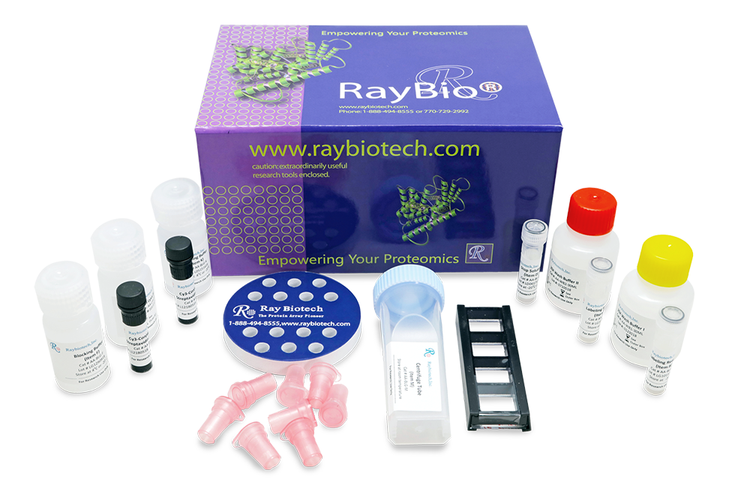
- RayBio® L-Series Antibody Array Glass Slide(s)
- Spin Columns
- Labeling Reagent
- Stop Solution
- Blocking Buffer
- Wash Buffer 1
- Wash Buffer 2
- Streptavidin-Conjugated Fluor
- Adhesive Plastic Strips
- Labeling Buffer
- Lysis Buffer
- 30 ml Centrifuge Tube
Other Materials Required
- Distilled or de-ionized water
- Small plastic or glass containers
- Orbital shaker or oscillating rocker
- 1 ml tube
- Pipettors, pipette tips and other common lab consumables
- Aluminum foil
- Gene microarray scanner or similar laser fluorescence scanner
View Compatible Laser Scanners
Don't have a compatible scanner? RayBiotech now offers FREE scanning service for all RayBio glass slide antibody arrays! Learn More
Protocol Outline
- Purify Samples with Spin Column
- Biotinylate Samples
- Purify biotinylated samples using spin column
- Dry the glass slide
- Block array surface
- Incubate with Samples
- Incubate with Streptavidin-Conjugated Fluor
- Disassemble the glass slide
- Scan with a gene microarray laser scanner
- Perform densitometry and analysis
Storage/Stability
For best results, store the entire kit frozen at -20°C upon arrival. Stored frozen, the kit will be stable for at least 6 months which is the duration of the product warranty period. Once thawed, store array slide(s) at -20°C and all other reagents undiluted at 4°C for no more than 3 months.
documents
GAL (GAL-AAM-BLG-1.gal)
Excel (AAM-BLG-1_Analysis_Tool.xlsx)
citations
Sex-specific longitudinal reversal of aging in old frail mice
- Species:
- Mouse
- Year:
- 2025
- PubMed ID:
- 40848270
Lymphopoiesis is attenuated upon hepatocyte-specific deletion of the cytochrome c oxidase assembly factor Sco1
- Year:
- 2025
- Journal Name:
- iScience
- PubMed ID:
- 40177634
The Low-density Lipoprotein Receptor-related Protein 6 Pathway in the Treatment of Intestinal Barrier Dysfunction Induced by Hypoxia and Intestinal Microbiota through the Wnt/β-catenin Pathway
- Species:
- Mouse
- Sample Type:
- colon
- Year:
- 2022
- Journal Name:
- International Journal of Biological Sciences
Stress-glucocorticoid-TSC22D3 axis compromises therapy-induced antitumor immunity
- Species:
- Mouse
- Sample Type:
- Plasma (Stress and anti-tumor immunity model)
- Year:
- 2019
- Journal Name:
- Nature Medicine
- PubMed ID:
- 31501614
Microglia Regulate Blood–Brain Barrier Integrity via MiR‐126a‐5p/MMP9 Axis during Inflammatory Demyelination
- Species:
- Mouse
- Year:
- 2022
RANKL up-regulated by progesterone aggravates lipopolysaccharide-induced acute lung injury during pregnancy
- Species:
- Mouse
- Sample Type:
- fibroblasts
- Year:
- 2022
- Journal Name:
- Journal of Reproductive Immunology
Topical Application of Probiotic-Derived EGF From Pediococcus pentosaceus Improves UVB-Induced Photoaging in Hairless Mice
- Year:
- 2026
- Journal Name:
- Annals of Dermatology
- PubMed ID:
- 42244273
Increased Lung Ischemia-Reperfusion Injury in Aquaporin 1-Null Mice Is Mediated via Decreased Hypoxia-Inducible Factor 2 Stability
- Species:
- Mouse
- Sample Type:
- Tissue lysate (Lung Tissue lysates from CD1 strain of mice.)
- Year:
- 2016
- PubMed ID:
- 26649797
Hypoxic Preconditioning Enhances the Benefit of Cardiac Progenitor Cell Therapy for Treatment of Myocardial Infarction by Inducing CXCR4 Expression
- Species:
- Mouse
- Sample Type:
- Conditioned Media (CLK cells (passages 7-8) 90% confluency in standard media, then transferred to a standard incubator or hypoxia chamber (0.1% O2) and cultured in DMEM containing 0.2% FBS. Twelve hours later, the media were collected, concentrated by usi
- Year:
- 2009
- Journal Name:
- Circulation Research
Tumor cell secretion of soluble factor(s) for specific immunosuppression
- Species:
- Mouse
- Sample Type:
- Conditioned Media (4T1 conditioned cells)
- Year:
- 2015
- Journal Name:
- Scientific reports
- PubMed ID:
- 25746680