

Bovine IFN alpha A ELISA

Katalog-Nummer DIY0663B-003
Size : 1Set
Marke : Kingfisher Biotech

Components
| Usage | Quantity | Component | Size |
|---|---|---|---|
| Detection Antibody | 50 µg | KPB1841B-050 | |
| Standard | 5 µg | RP0008B-005 | |
| Capture Antibody | 100 µg | KP1840B-100 | 1 Pack (<= 10 Plates) |
| Capture Antibody | 100 µg X 2 | KP1840B-100 | 1 Pack (<= 20 Plates) |
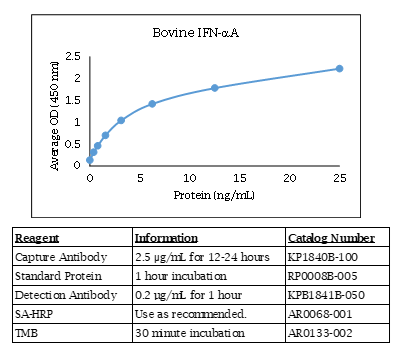
- The Bovine IFN-α (Interferon Alpha) ELISA is designed for the quantitative measurement of bovine interferon alpha in cell culture supernatants. With minor modifications to the assay procedure, this ELISA may also be used to measure IFN-α in additional biological sample types reported in the literature, including serum, plasma, whole blood-derived culture supernatants, peripheral blood mononuclear cell (PBMC) culture supernatants, tissue homogenates or lysates, bronchoalveolar lavage fluid (BALF), and milk, depending on the experimental model and disease context. This flexibility supports a wide range of immunology and translational research applications. Interferon alpha (IFN-α) is a type I interferon that plays a central role in the innate immune response, particularly during viral infection. IFN-α is rapidly produced following pathogen recognition and induces the expression of interferon-stimulated genes (ISGs) that drive antiviral defense, immune activation, and regulation of adaptive immunity. Measurement of IFN-α is widely used to assess innate immune activation, antiviral responses, vaccine efficacy, and inflammatory signaling in both experimental and disease models. In bovine and related species, IFN-α serves as an important biomarker of early immune response and disease progression, supporting studies in animal health, infectious disease, and comparative immunology. The kit contains a capture antibody, detection antibody, and recombinant protein standard for assay development. These antibodies have been validated to function together in an ELISA format using the provided standard. Optimal buffers, antibody concentrations, incubation times, temperatures, and assay conditions have not been predetermined, allowing researchers to optimize assay sensitivity and dynamic range based on their specific sample type and experimental requirements. The quantities of kit components are not matched, and individual components may be purchased separately. This product is for research use only and is manufactured in the USA.
| Use | For Research Use Only. Not for diagnostic or therapeutic use. |
| Storage Conditions | 2°C to 8°C or -20°C |
| Country Of Origin | USA |
Bovine Interferon-Alpha A (IFN-αA) is a type I interferon subtype produced primarily by plasmacytoid dendritic cells and virus-infected cells in cattle (Bos taurus), where it plays a central role in early innate antiviral defense. Upon binding to the type I interferon receptor complex (IFNAR1/IFNAR2), bovine IFN-αA activates the JAK/STAT signaling pathway, leading to induction of interferon-stimulated genes (ISGs) that inhibit viral replication, enhance antigen presentation, and promote activation of natural killer (NK) cells and adaptive immune responses. In bovine health, IFN-αA is critically involved in host responses to economically significant viral infections such as bovine viral diarrhea virus (BVDV), bovine herpesvirus-1 (IBR), bovine respiratory syncytial virus (BRSV), foot-and-mouth disease virus (FMDV), and other components of the bovine respiratory disease (BRD) complex. Altered or suppressed IFN-α responses—such as immune evasion by BVDV—can contribute to viral persistence and increased disease severity. As both a biomarker and functional mediator of antiviral immunity, bovine IFN-αA is important in vaccine evaluation, antiviral strategy development, and immunopathogenesis studies. In translational research, characterization of bovine IFN-αA supports comparative studies of type I interferon biology, viral immune evasion mechanisms, and large-animal models of respiratory and systemic viral infection relevant to both veterinary and human medicine.
Citations
Please to see
