

Mouse TCRgd Antibody : PE

Katalog-Nummer OASB01709
Size : 0.2mg
Marke : Aviva Systems Biology
Mouse TCRgd Antibody : PE (OASB01709)
| Datasheets/Manuals | Printable datasheet for Mouse TCRgd Antibody : PE (OASB01709) |
|---|
| Tested Species Reactivity | Mouse |
|---|---|
| Predicted Species Reactivity | Mouse |
| Clonality | Monoclonal |
| Clone | UC7-13D5 |
| Isotype | IgG |
| Host | Hamster |
| Conjugation | R-PE |
| Application | FC |
| Additional Information | Description: The TCR gamma/delta heterodimer of the CD3/T cell receptor complex is clonotypic and consists of Ig-like variable and constant domains. It is expressed during thymopoiesis and on the small subpopulation of gamma/delta TCR-expressing T lymphocytes in the periphery. The majority of T cells present in some epithelial tissues are gamma/delta+ and have limited receptor diversity. The TCR gamma/delta heterodimer recognizes peptide antigen bound to MHC antigens and subsequent signal transduction mediated by the invariant chains leads to T cell activation. The monoclonal antibody UC7-13D5 is specific for the gamma/delta heterodimer and plate-bound UC7-13D5 activates gamma/delta TCR-bearing cells. This antibody does not react with alpha/beta TCR-expressing T cells. |
| Reconstitution and Storage | Store at 2-8C |
| Immunogen | Mouse T cell clone G8 |
| Concentration | 0.1 mg/mL |
| Specificity | TCRgd |
| Characterization | To insure lot- to- lot consistency, each batch of product is tested by flow cytometry to conform with thecharacteristics of a standard reference reagent. |
| Warning | Reagents contain sodium azide. Sodium azide is very toxic if ingested or inhaled. Avoid contact with skin,eyes, or clothing. Wear eye or face protection when handling. If skin or eye contact occurs, wash withcopious amounts of water. If ingested or inhaled, contact a physician immediately. Sodium azide yields toxichydrazoic acid under acidic conditions. Dilute azide- containing compounds in running water before discardingto avoid accumulation of potentially explosive deposits in lead or copper plumbing. |
| Dilution | Flow Cytometry: Fluorescein conjugate AF488 conjugate Biotin conjugate R-phycoerythrin conjugate Spectral Red conjugate <= 1 ug/106 cells <= 1 ug/106 cells <= 1 ug/106 cells <= 0.3 ug/106 cells <= 0.3 ug/106 cells |
| Application Info | Flow cytometry 4-7, Immunoprecipitation 9, In vivo depletion of Y TCR-expressing T cells 8 |
| Other Applications Data | Since applications vary, you should determine the optimum working dilutionof the product that is appropriate for your specific need. |
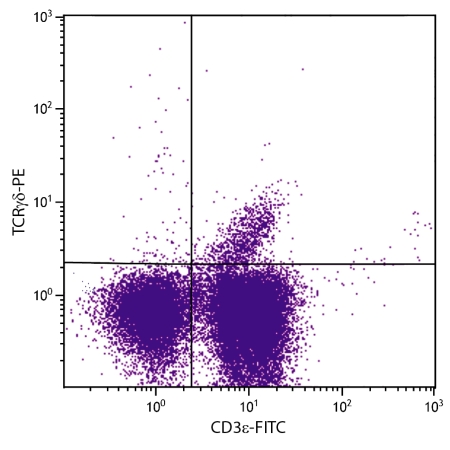
| Other Applications Image 1 Data | Amount Used: 3 ug/106 cells The T195 T-cell line was first incubated with purified hamster anti-mouse TCRγδ and then stained with mouse anti-hamster IgG-FITC. Large cells were gated and analyzed by flow cytometry. |
| Storage | - The purified (UNLB) antibody is supplied as 0.5 mg ofpurified immunoglobulin in 1.0 mL of 100 mM borate buffered saline, pH 8.2. No preservatives or amine- containingbuffer salts added. Store at 2- 8 C - The fluorescein (FITC) conjugate is supplied as 0.5 mg in 1.0 mL of PBS/NaN3. Store at 2- 8 C - The biotin (BIOT) conjugate is supplied as 0.5 mg in 1.0 mL of PBS/NaN3. Store at 2- 8 C - The R- phycoerythrin (R- PE) conjugate is supplied as 0.1 mg in 1.0 mL or 0.2 mg in 2.0 mL of PBS/NaN3 and astabilizing agent. Store at 2- 8 C. Do not freeze! - The Spectral Red (SPRD) conjugate is supplied as 0.1 mg in 1.0 mL of PBS/NaN3 and a stabilizing agent. Storeat 2- 8 C. Do not freeze! - The Alexa Fluor 488 (AF488) conjugate is supplied as 0.1mg in 0.2mL of PBS/NaN3. Store at 2- 8 C - The low endotoxin, azide- free (LE/AF) antibody is supplied as 0.5 mg purified immunoglobulin in 1.0 mL of PBS Aliquot and store at or below - 20 C - Protect conjugated forms from light. Aliquot and freeze the low endotoxin, azide- free product at - 20 C immediatelyupon receipt. Each reagent is stable for the period shown on the bottle label if stored as directed. |
| Reference | 1. Davis, M.M. 1990. Annu. Rev. Biochem. 59:475 2. Allison, J.P., and W.L. Havran. 1991. Annu. Rev. Immunol. 9:679 3. Klausner, R.D., and L.E. Samuelson. 1991. Cell 64:875 4. Dent, A.L., et al. 1990. Nature 343:714 5. Bluestone, J.A., et al. 1991. Immunol. Rev. 120:5 6. Houlden, B.A., et al. 1989. Cold Spring Harbor Symp. Quant. Biol. 54:45 7. Barrett, T.A., et al. 1991. Immunol. Res. 10:341 8. Hiromatsu, K., Y. yoskikai, G. Matsuzaki, S. Ohga, K. Muramori, K. Matsumoto, J.A. Bluestone, and K. Nomoto. 1992. J. Exp. Med 175:49 9. Belles, C., A.L. Kuhl, A.J. Donoghue, Y. Sano, R.L. O'Brien, W. Born, K. Bottomly, and S.R. Carding. 1996. J. Immunol. 156:4280. |
|---|---|
| Gene Symbol | TCRG, TCRD |
| Gene Full Name | T-cell surface glycoprotein CD3 delta chain |
| Alias Symbols | TCRGV1S1, TCRGV2S1, TCRGV3S1, TCRGV5S3 |
| NCBI Gene Id | 110067; 110066 |
| Description of Target | T cell receptors recognize foreign antigens which have been processed as small peptides and bound to major histocompatibility complex (MHC) molecules at the surface of antigen presenting cells (APC). Each T cell receptor is a dimer consisting of one alpha and one beta chain or one delta and one gamma chain. In a single cell, the T cell receptor loci are rearranged and expressed in the order delta, gamma, beta, and alpha. If both delta and gamma rearrangements produce functional chains, the cell expresses delta and gamma. If not, the cell proceeds to rearrange the beta and alpha loci. This region represents the germline organization of the T cell receptor gamma locus. The gamma locus includes V (variable), J (joining), and C (constant) segments. During T cell development, the gamma chain is synthesized by a recombination event at the DNA level joining a V segment with a J segment; the C segment is later joined by splicing at the RNA level. Recombination of many different V segments with several J segments provides a wide range of antigen recognition. Additional diversity is attained by junctional diversity, resulting from the random addition of nucleotides by terminal deoxynucleotidyltransferase. |