

PLK1 (Marker of Mitosis)(AZ44), Biotin conjugate, 0.1mg/mL

Katalog-Nummer BNCB3101-100
Size : 100uL
Marke : Biotium
PLK1 Monoclonal Mouse Antibody (AZ44)
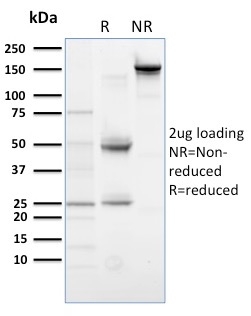
Product Description
Plk (for polo-like kinase) encodes a serine/threonine kinase that is closely related to polo and CDC5, genes that are required for passage through mitosis in Drosophila and Saccharomyces, respectively. Polo and Cdc5 both code for proteins that are involved in regulating the function of the mitotic spindle. Plk protein accumulates in the cell during the S and G2 phases of the cell cycle; Plk protein content and catalytic activity peak at the onset of mitosis, followed by a rapid reduction after mitosis. Plk expression is detectable in mitotically active tissues such as colon and placenta, as well as in tumors of various origins. It has also been suggested that Plk may serve as a marker of cell proliferation. Required for recovery after DNA damage checkpoint and entry into mitosis. Required for kinetochore localization of BUB1B. Phosphorylates SGOL1. Required for spindle pole localization of isoform 3 of SGOL1 and plays a role in regulating its centriole cohesion function. Phosphorylates BORA, and thereby promotes the degradation of BORA. Contributes to the regulation of AURKA function. Regulates TP53 stability through phosphorylation of TOPORS. Useful for confirming that extracts have maintained CSF status and have not yet been activated into interphase.
Primary antibodies are available purified, or with a selection of fluorescent CF® dyes and other labels. CF® dyes offer exceptional brightness and photostability. See the CF® Dye Brochure for more information. Note: Conjugates of blue fluorescent dyes like CF®405S and CF®405M are not recommended for detecting low abundance targets, because blue dyes have lower fluorescence and can give higher non-specific background than other dye colors.
Catalog number key for antibody number 3101, Anti-PLK1 (AZ44)
| Antibody # prefix | Conjugation | Ex/Em (nm) | Laser line | Detection channel | Dye Features |
|---|---|---|---|---|---|
| BNC04 | CF®405S | 404/431 | 405 | DAPI (microscopy), AF405 | CF®405S Features |
| BNC88 | CF®488A | 490/515 | 488 | GFP, FITC | CF®488A Features |
| BNC68 | CF®568 | 562/583 | 532, 561 | RFP, TRITC | CF®568 Features |
| BNC94 | CF®594 | 593/614 | 561 | Texas Red® | CF®594 Features |
| BNC40 | CF®640R | 642/662 | 633-640 | Cy®5 | CF®640R Features |
| BNC47 | CF®647 | 650/665 | 633-640 | Cy®5 | CF®647 Features |
| BNC74 | CF®740 | 742/767 | 633-685 | 775/50 | CF®740 Features |
| BNCB | Biotin | N/A | N/A | N/A | |
| BNUB | Purified | N/A | N/A | N/A | |
| BNUM | Purified, BSA-free | N/A | N/A | N/A |
Technology

Tech Tips

Product Attributes
Antibody number
Antibody reactivity (target)
Antibody type
Host species
Clonality
Clone
Isotype
Molecular weight
Synonyms
Human gene symbol
Entrez gene ID
SwissProt
Unigene
Immunogen
Antibody target cellular localization
Species reactivity
Expected antibody applications
Antibody application notes
Positive control
Shipping condition
Storage Conditions
Regulatory status
Antibody/conjugate formulation
Shelf life
Product origin
Documents, Protocols, SDS and COA

Datasheet
COA
Request the Certificate of AnalysisReferences
Note: References for this clone sold by other suppliers may be listed for expected applications.
Cell Cycle (2014) 13:11, 1727-1736. (IP, WB)