

Sabutoclax [1228108-65-3]

Katalog-Nummer T6650-1mg
Size : 1mg
Marke : TargetMol
Sabutoclax
(Synonyms: BI-97C1) Copy Product Info
Sabutoclax (BI-97C1)(BI-97C1) is a pan-Bcl-2 inhibitor, including Bcl-xL, Bcl-2, Mcl-1 and Bfl-1 with IC50 of 0.31 μM, 0.32 μM, 0.20 μM and 0.62 μM, respectively.
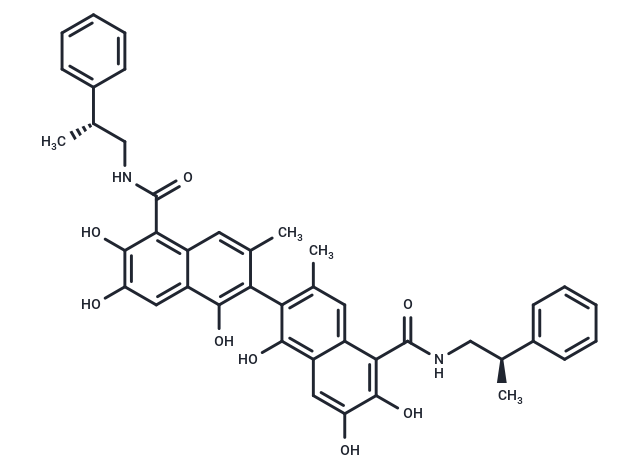
Cas No. 1228108-65-3
With extensive experience in compound synthesis, we can provide rapid custom synthesis services for this product according to your research needs.
For research use only—not for human use. No sales to individuals. Use as intended only.
Select Batch
Purity:99.3%
Appearance:Solid
Color:Yellow
COA HNMR ORP LCMS
Product Information
Bioactivity
Chemical Properties
Storage & Solubility Information
| Description | Sabutoclax (BI-97C1)(BI-97C1) is a pan-Bcl-2 inhibitor, including Bcl-xL, Bcl-2, Mcl-1 and Bfl-1 with IC50 of 0.31 μM, 0.32 μM, 0.20 μM and 0.62 μM, respectively. |
| Targets & IC50 | Bfl-1:0.62 μM, BCL-XL:0.31 μM, Bcl-2:0.32 μM, MCL1:0.2 μM |
| In vitro | Sabutoclax (0.001-10 μM; 72 hours) inhibits the growth of human prostate cancer and lung cancer cell lines[2]. Sabutoclax (0.01-1 μM; 24-48 hours) induces apoptosis in human diffuse large B-cell lymphoma cells[2]. Sabutoclax (0-15 μM; 48 hours) upregulates the levels of pro-apoptotic proteins in chemotherapy-resistant cells[1]. |
| In vivo | Sabutoclax (1-5 mg/kg; intraperitoneal injection; every two days for a total of 18 days) reduces the growth of M2182 tumors in nude mice[2]. |
| Synonyms | BI-97C1 |
| Kinase Assay | Competitive fluorescence polarization assays (FPA) : A Bak BH3 peptide (F-BakBH3) (GQVGRQLAIIGDDINR) is labeled at the N-terminus with fluorescein isothiocyanate (FITC) and purified by HPLC. For competitive binding assays, 100 nM GST-Bcl-XL ΔTM protein is preincubated with the tested compound at varying concentrations in 47.5 μL PBS (pH = 7.4) in 96-well black plates at room temperature for 10 min, and then 2.5 μL of 100 nM FITC-labeled Bak BH3 peptide is added to produce a final volume of 50 μL. The wild-type and mutant Bak BH3 peptides are included in each assay plate as positive and negative controls, respectively. After 30 min incubation at room temperature, the polarization values in millipolarization units are measured at excitation/emission wavelengths of 480/535 nm with a multilabel plate reader. IC50 is determined by fitting the experimental data to a sigmoidal dose-response nonlinear regression model. Data reported are mean of three independent experiments. Performance of Bcl-2 and Mcl-1FPA are similar. Briefly, 50 nM of GST-Bcl-2 or -Mcl-1are incubatedwith various concentrations of compound (4 and 11-14) for 2 min, and then 15 nM FITC-conjugated-Bim BH3 peptide is added in PBS buffer. Fluorescence polarization is measured after 10 min. |
| Cell Research | ATP-LITE assay(Only for Reference) |
| Molecular Weight | 700.78 |
| Formula | C42H40N2O8 |
| Cas No. | 1228108-65-3 |
| Smiles | O=C(C1=C2C=C(C)[C@]([C@]3=C(C)C=C4C(C(NC[C@H](C)C5=CC=CC=C5)=O)=C(O)C(O)=CC4=C3O)=C(O)C2=CC(O)=C1O)NC[C@H](C)C6=CC=CC=C6 |
| Relative Density. | 1.358 g/cm3 (Predicted) |
| Storage | Store at low temperature Powder: -20°C for 3 years | In solvent: -80°C for 1 year Shipping with blue ice/Shipping at ambient temperature. | ||||||||||||||||||||||||||||||||||||||||
| Solubility Information | H2O: < 1 mg/mL (insoluble or slightly soluble) Ethanol: 22 mg/mL (31.39 mM), Sonication is recommended. DMSO: 150 mg/mL (214.05 mM), Sonication is recommended.  | ||||||||||||||||||||||||||||||||||||||||
| In Vivo Formulation | 10% DMSO+90% Saline: < 10 mg/mL (14.27 mM), Lower concentrations may be soluble, but exact solubility limit is unknown. 10% DMSO+40% PEG300+5% Tween 80+45% Saline: 10 mg/mL (14.27 mM), Solution. Please add the solvents sequentially, clarifying the solution as much as possible before adding the next one. Dissolve by heating and/or sonication if necessary. Working solution is recommended to be prepared and used immediately. The formulation provided above is for reference purposes only. In vivo formulations may vary and should be modified based on specific experimental conditions. | ||||||||||||||||||||||||||||||||||||||||
Solution Preparation Table | |||||||||||||||||||||||||||||||||||||||||
Ethanol/DMSO
DMSO
Note : The dilution table applies only to solid products. For liquid products, please calculate the stock solution based on the stated concentration and/or density. | |||||||||||||||||||||||||||||||||||||||||