

SCH79797 dihydrochloride [1216720-69-2]

Katalog-Nummer T12870-10mg
Size : 10mg
Marke : TargetMol
SCH79797 dihydrochloride
Copy Product Info
SCH79797 dihydrochloride is an effective and selective antagonist of protease activated receptor 1 (PAR1) with an IC50 of 70 nM and a Ki of 35 nM. SCH79797 dihydrochloride has antiproliferative and pro-apoptotic effects.
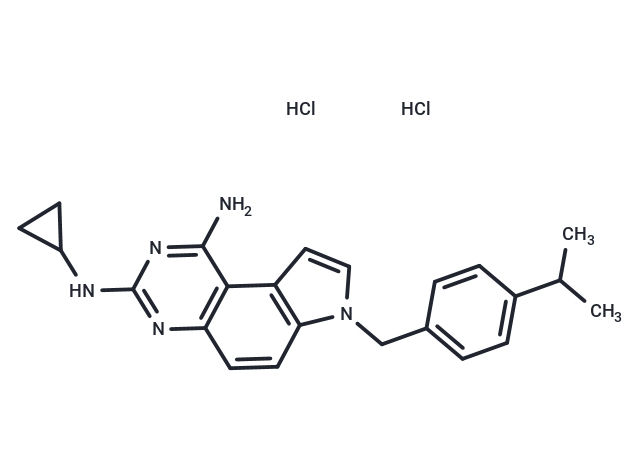
Cas No. 1216720-69-2
For research use only—not for human use. No sales to individuals. Use as intended only.
Select Batch
Purity:99.5%
Appearance:Solid
Color:White
COA LCMS HNMR
Product Introduction
Bioactivity
Chemical Properties
Storage & Solubility Information
| Description | SCH79797 dihydrochloride is an effective and selective antagonist of protease activated receptor 1 (PAR1) with an IC50 of 70 nM and a Ki of 35 nM. SCH79797 dihydrochloride has antiproliferative and pro-apoptotic effects. |
| In vitro | SCH79797 dihydrochloride inhibits thrombin-induced platelet aggregation with an IC50 of 3 μM. In NIH 3T3 cells, SCH79797 dihydrochloride inhibits serum-stimulated activation of p44/p42 mitogen-activated protein kinases (MAPK) at low concentrations and induces apoptosis at higher concentrations[1]. SCH79797 dihydrochloride inhibits high-affinity thrombin receptor-activating peptide ([3H]haTRAP) binding in a competitive manner. SCH79797 dihydrochloride inhibits α-thrombin- and haTRAP-induced aggregation of human platelets. Thrombin produces transient increases in cytosolic free Ca2+ concentration ([Ca2+]i) in hCASMC. SCH79797 dihydrochloride effectively inhibits this increase in [Ca2+]i. SCH79797 dihydrochloride completely inhibits Thrombin- and TK-stimulated [3H]thymidine incorporation [4]. |
| In vivo | In male Sprague Dawley rats, SCH79797 dihydrochloride (2.5 μg/kg, 10 μg/kg, 25 μg/kg, 50 μg/kg, 100 μg/kg, and 250 μg/kg; i.v.) reduces myocardial necrosis following I/R in the intact rat heart in two rat models of myocardial ischemia/reperfusion (I/R) injury immediately before or during ischemia[3]. |
| Molecular Weight | 444.4 |
| Formula | C23H27Cl2N5 |
| Cas No. | 1216720-69-2 |
| Smiles | Cl.Cl.CC(C)c1ccc(Cn2ccc3c2ccc2nc(NC4CC4)nc(N)c32)cc1 |
| Relative Density. | no data available |
| Storage | Powder: -20°C for 3 years | In solvent: -80°C for 1 year Shipping with blue ice/Shipping at ambient temperature. | ||||||||||||||||||||||||||||||||||||||||
| Solubility Information | Ethanol: 10 mg/mL (22.5 mM), Sonication and heating are recommended. DMSO: 50 mg/mL (112.51 mM), Sonication and heating are recommended.  | ||||||||||||||||||||||||||||||||||||||||
| In Vivo Formulation | 10% DMSO+90% Saline: 5 mg/mL (11.25 mM), Suspension. Please add the solvents sequentially, clarifying the solution as much as possible before adding the next one. Dissolve by heating and/or sonication if necessary. Working solution is recommended to be prepared and used immediately. The formulation provided above is for reference purposes only. In vivo formulations may vary and should be modified based on specific experimental conditions. | ||||||||||||||||||||||||||||||||||||||||
Solution Preparation Table | |||||||||||||||||||||||||||||||||||||||||
Ethanol/DMSO
DMSO
Note : The dilution table applies only to solid products. For liquid products, please calculate the stock solution based on the stated concentration and/or density. | |||||||||||||||||||||||||||||||||||||||||