

Semaglutide [910463-68-2]

Katalog-Nummer T19850-1mg
Size : 1mg
Marke : TargetMol
Semaglutide
Copy Product Info

Semaglutide is a long-acting, selective, competitive GLP-1R agonist and a long-acting analog of human glucagon-like peptide-1, exhibiting potent hypoglycemic, weight-loss, cardioprotective, and neuroprotective effects. Upon activation of the GLP-1R, semaglutide promotes insulin secretion, inhibits gastric emptying and appetite, while also enhancing autophagy and suppressing oxidative stress and apoptosis. Semaglutide also plays a role in regulating mitochondrial function and lipid metabolism. Semaglutide is being investigated for use in type 2 diabetes, obesity, Parkinson’s disease, metabolic and fatty liver diseases (MASLD), and other neurodegenerative and liver diseases, as well as in cancer research.
Cas No. 910463-68-2
With extensive experience in compound synthesis, we can provide rapid custom synthesis services for this product according to your research needs.
For research use only—not for human use. No sales to individuals. Use as intended only.
Select Batch
Purity:99.78%
Color:White
Product Information
Bioactivity
Chemical Properties
Storage & Solubility Information
| Description | Semaglutide is a long-acting, selective, competitive GLP-1R agonist and a long-acting analog of human glucagon-like peptide-1, exhibiting potent hypoglycemic, weight-loss, cardioprotective, and neuroprotective effects. Upon activation of the GLP-1R, semaglutide promotes insulin secretion, inhibits gastric emptying and appetite, while also enhancing autophagy and suppressing oxidative stress and apoptosis. Semaglutide also plays a role in regulating mitochondrial function and lipid metabolism. Semaglutide is being investigated for use in type 2 diabetes, obesity, Parkinson’s disease, metabolic and fatty liver diseases (MASLD), and other neurodegenerative and liver diseases, as well as in cancer research. |
| Targets & IC50 | GLP1 receptor:6.2 pM (EC50), albumin:27 µM |
| In vitro | Method: Cell viability was assessed using the MTT assay 24 hours after treating SH-SY5Y cells with 75 μM 6-OHDA and 1–100 nM Semaglutide. Result: 6-OHDA significantly reduced cell viability, while Semaglutide significantly reversed the damage. [2] |
| In vivo | Method: Mice made obese by a high-fat diet (DIO mice) were administered subcutaneous injections of Semaglutide (1, 3, 10, 30, 100 nmol/kg). Body weight, food intake, and body composition were measured 21 days later. Result: Semaglutide reduced body weight and food intake in a dose-dependent manner; the highest dose (100 nmol/kg) resulted in a 22% decrease in body weight (from 43.6 g to 34.8 g). [1] Method: A doxorubicin-induced (5 mg/kg/week, intraperitoneal injection for 4 weeks) cardiac toxicity model was established in C57/BL6J mice. Semaglutide (12 μg/kg/day, subcutaneous injection for 6 weeks) was administered as an intervention, and cardiac function was assessed via echocardiography and invasive hemodynamic monitoring. Result: Doxorubicin caused impaired cardiac function and elevated myocardial injury markers in mice. Semaglutide significantly improved cardiac function, reduced injury markers, and increased mouse survival rates. Furthermore, Semaglutide inhibited oxidative stress and repaired mitochondrial dysfunction. [3] Method: A Parkinson’s disease model was established in SD rats via 6-OHDA-induced unilateral medial forebrain bundle injury, followed by intraperitoneal administration of 25 nmol/kg Semaglutide (once every 2 days for a total of 31 days). Result: Semaglutide significantly improved neurological damage in the model rats. [4] |
| Molecular Weight | 4114 |
| Formula | C187H291N45O59 |
| Cas No. | 910463-68-2 |
| Smiles | CC[C@@H]([C@H](NC([C@@H](NC([C@@H](NC([C@@H](NC([C@@H](NC([C@@H](NC([C@@H](NC(CNC([C@@H](NC([C@@H](NC([C@@H](NC([C@@H](NC([C@@H](NC([C@@H](NC([C@@H](NC([C@@H](NC([C@@H](NC([C@@H](NC([C@@H](NC(CNC([C@@H](NC(C(C)(NC([C@@H](N)CC1=CN=CN1)=O)C)=O)CCC(O)=O)=O)=O)[C@H](O)C)=O)CC2=CC=CC=C2)=O)[C@H](O)C)=O)CO)=O)CC(O)=O)=O)C(C)C)=O)CO)=O)CO)=O)CC3=CC=C(O)C=C3)=O)CC(C)C)=O)CCC(O)=O)=O)=O)CCC(N)=O)=O)C)=O)C)=O)CCCCNC(COCCOCCNC(COCCOCCNC(CC[C@@H](NC(CCCCCCCCCCCCCCCCC(O)=O)=O)C(O)=O)=O)=O)=O)=O)CCC(O)=O)=O)CC4=CC=CC=C4)=O)C(N[C@H](C(N[C@H](C(N[C@H](C(N[C@H](C(N[C@H](C(NCC(N[C@H](C(NCC(O)=O)=O)CCCNC(N)=N)=O)=O)CCCNC(N)=N)=O)C(C)C)=O)CC(C)C)=O)CC5=CNC6=CC=CC=C65)=O)C)=O)C |
| Relative Density. | no data available |
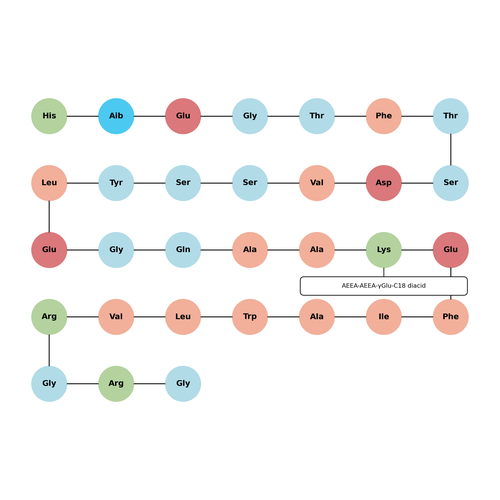
| Sequence | His-{Aib}-Glu-Gly-Thr-Phe-Thr-Ser-Asp-Val-Ser-Ser-Tyr-Leu-Glu-Gly-Gln-Ala-Ala-{Lys(AEEA-AEEA-γGlu-C18 diacid)}-Glu-Phe-Ile-Ala-Trp-Leu-Val-Arg-Gly-Arg-Gly |
| Sequence Short | HXEGTFTSDVSSYLEGQAAEEFIAWLVRGRG |
| Storage | Keep away from moisture,Store at low temperature, Pure form: -20°C for 3 years | In solvent: -80°C for 1 year Shipping with blue ice/Shipping at ambient temperature. | ||||||||||||||||||||
| Solubility Information | 0.1M NaOH: 41.14 mg/mL (10 mM), Sonication is recommended.  H2O: insoluble DMSO: slightly soluble, Sonication is recommended. 0.01 M HCl: 41.14 mg/mL (10 mM), Sonication is recommended. | ||||||||||||||||||||
Solution Preparation Table | |||||||||||||||||||||
0.1M NaOH/0.01 M HCl
Note : The dilution table applies only to solid products. For liquid products, please calculate the stock solution based on the stated concentration and/or density. | |||||||||||||||||||||