

Nilotinib [641571-10-0]

Katalog-Nummer T1524-100mg
Size : 100mg
Marke : TargetMol
Nilotinib
(Synonyms: Tasigna, AMN107) Copy Product Info

Nilotinib (AMN107) is a Bcr-Abl tyrosine kinase inhibitor with oral activity. Nilotinib has antitumor activity and may be used for the treatment of Imatinib-resistant chronic myelogenous leukemia (CML).
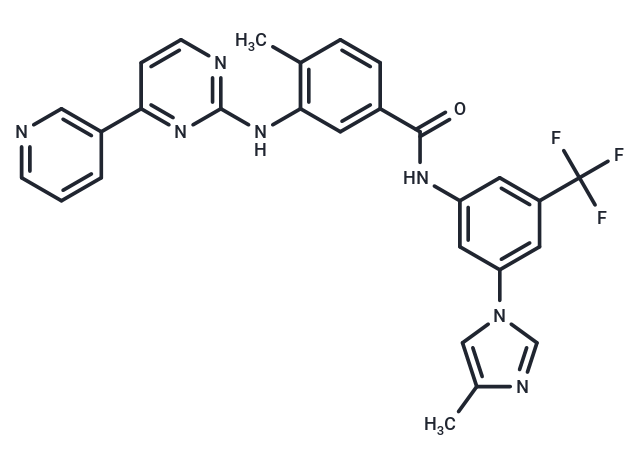
Cas No. 641571-10-0
With extensive experience in compound synthesis, we can provide rapid custom synthesis services for this product according to your research needs.
For research use only—not for human use. No sales to individuals. Use as intended only.
Select Batch
Purity:99.89%
Color:White
COA LCMS HNMR
Product Information
Bioactivity
Chemical Properties
Storage & Solubility Information
| Description | Nilotinib (AMN107) is a Bcr-Abl tyrosine kinase inhibitor with oral activity. Nilotinib has antitumor activity and may be used for the treatment of Imatinib-resistant chronic myelogenous leukemia (CML). |
| Targets & IC50 | Abl (WT):15 nM (cell free), Bcr-Abl:260 nM, K562 cells:0.015 μM, H9C2 cells:21.33 μM, A549 cells:6.63 μM, KBM5 cells:12 nM, KU812 cells:1.8 nM, Daoy cells:6 μM, K562 cells:0.0039 μM, BJ cells:12.8 μM, HCT116 cells:2.39 μM, BaF3 cells:0.003 μM, CHO cells:4.7 μM, HEK293 cells:0.5 μM, K562 cells:0.022 μM |
| In vitro | METHODS: Ba/F3 cells expressing wild-type or mutant Bcr-Abl were treated with Nilotinib for 72 h, and cell viability was measured by methanethiosulfonate-based viability assay. RESULTS: Nilotinib inhibited the growth of cells expressing wild-type Bcr-Abl with 20-fold higher potency than imatinib (IC50:13 vs. 260 nmol/L). Similar improvements were maintained in all imatinib-resistant mutants tested except T315I. [1] METHODS: Melanoma cell line D04 was treated with Nilotinib (0.1-10 µM) for 3 h. Target protein expression levels were examined by Western Blot. RESULTS: Nilotinib stimulated robust MEK and ERK phosphorylation at concentrations as low as 100 nM. [2] |
| In vivo | METHODS: To test the antitumor activity in vivo, Nilotinib (25 mg/kg) and PD184352 (25 mg/kg) were administered by gavage to Balb/cJ mice bearing Ba/F3 allografts of BCR-ABL or BCR-ABLT315I once daily for twenty days. RESULTS: Nilotinib strongly inhibited the growth of BCR-ABL tumors, but not PD184352, nor did PD184352 enhance the growth inhibitory activity of Nilotinib. In contrast, BCR-ABLT315I tumors were insensitive to both Nilotinib and PD184352, but these drugs synergistically inhibited tumor growth. [2] |
| Synonyms | Tasigna, AMN107 |
| Kinase Assay | Kinase assays using wild-type and mutant glutathione S-transferase (GST)–Abl fusion proteins (c-Abl amino acids 220-498) were done as described, with minor alterations. GST-Abl fusion proteins were released from glutathione-Sepharose beads before use; the concentration of ATP was 5 μmol/L. Immediately before use in kinase autophosphorylation and in vitro peptide substrate phosphorylation assays, GST-Abl kinase domain fusion proteins were treated with LAR tyrosine phosphatase according to the manufacturer's instructions. After 1-hour incubation at 30°C, LAR phosphatase was inactivated by addition of sodium vanadate (1 mmol/L). Immunoblot analysis comparing untreated GST-Abl kinase to dephosphorylated GST-Abl kinase was routinely done using phosphotyrosine-specific antibody 4G10 to confirm complete (>95%) dephosphorylation of tyrosine residues and c-Abl antibody CST 2862 to confirm equal loading of GST-Abl kinase. The inhibitor concentration ranges for IC50 determinations were 0 to 5,000 nmol/L (imatinib and AMN107) or 0 to 32 nmol/L (BMS-354825). The BMS-354825 concentration range was extended to 1,000 nmol/L for mutant T315I. These same inhibitor concentrations were used for the in vitro peptide substrate phosphorylation assays. The three inhibitors were tested over these same concentration ranges against GST-Src kinase and GST-Lyn kinase [1]. |
| Cell Research | Ba/F3 cell lines were plated in triplicate and incubated with escalating concentrations of imatinib, AMN107, or BMS-354825 for 72 hours. Proliferation was measured using a methanethiosulfonate-based viability assay. IC50 and IC90 values are reported as the mean of three independent experiments done in quadruplicate. The inhibitor concentration ranges for IC50 and IC90 determinations were 0 to 2,000 nmol/L (imatinib and AMN107) or 0 to 32 nmol/L (BMS-354825). The imatinib concentration range was extended to 6,400 nmol/L for mutants with IC50 >2,000 nmol/L. The BMS-354825 concentration range was extended to 200 nmol/L for mutant T315I [1]. |
| Animal Research | The GIST xenograft lines GK1X, GK2X and GK3X in nude mice were established from GIST patients as described in our previous study [10]. These xenograft lines were maintained by continual passage in BALB/cSLc-nu/nu mice. Mice bearing GK1X, GK2X and GK3X tumors (6–8 mice per group) were treated daily with vehicle or 40 mg/kg imatinib or nilotinib for 4 weeks. Tumor volume (TV) was determined from caliper measurements of tumor length (L) and width (w) according to the formula LW2/2. TV was determined every two to three days and on the day of evaluation. Mice were sacrificed and the percentage of tumor growth inhibition (TGI) was calculated as follows: TGI (%) ?=? [1– (mean of treatment group tumor volume on evaluation day – mean of treatment group tumor volume on day 1)/(mean of control group tumor volume on evaluation day – mean of control group tumor volume on day 1)]×100 [2]. |
| Molecular Weight | 529.52 |
| Formula | C28H22F3N7O |
| Cas No. | 641571-10-0 |
| Smiles | C(F)(F)(F)C=1C=C(C=C(NC(=O)C2=CC(NC=3N=C(C=CN3)C=4C=CC=NC4)=C(C)C=C2)C1)N5C=NC(C)=C5 |
| Relative Density. | 1.36 g/cm3 |
| Storage | Powder: -20°C for 3 years | In solvent: -80°C for 1 year Shipping with blue ice/Shipping at ambient temperature. | ||||||||||||||||||||||||||||||
| Solubility Information | H2O: < 1 mg/mL (insoluble or slightly soluble) Ethanol: < 1 mg/mL (insoluble or slightly soluble) DMSO: 41.7 mg/mL (78.75 mM), Sonication and heating are recommended.  | ||||||||||||||||||||||||||||||
| In Vivo Formulation | 10% DMSO+40% PEG300+5% Tween 80+45% Saline: 2.6 mg/mL (4.91 mM), Suspension. Please add the solvents sequentially, clarifying the solution as much as possible before adding the next one. Dissolve by heating and/or sonication if necessary. Working solution is recommended to be prepared and used immediately. The formulation provided above is for reference purposes only. In vivo formulations may vary and should be modified based on specific experimental conditions. | ||||||||||||||||||||||||||||||
Solution Preparation Table | |||||||||||||||||||||||||||||||
DMSO
Note : The dilution table applies only to solid products. For liquid products, please calculate the stock solution based on the stated concentration and/or density. | |||||||||||||||||||||||||||||||