

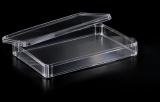
Single-well cell and tissue culture plates, also referred to as one-well plates, are large-format culture vessels designed to provide a single, expansive growth surface within a standard microplate footprint. Unlike multiwell plates, which compartmentalize cultures into discrete wells, single-well plates offer a continuous, uniform substrate that accommodates high-volume cell expansion, robotic screening, and applications requiring large surface areas for cell growth or colony isolation. Their design bridges the gap between traditional Petri dishes and multiwell microplates, combining the spacious growth environment of a dish with the standardized footprint and automation compatibility of a microplate.
Materials and Manufacturing
Single-well plates are typically manufactured from medical-grade, USP Class VI virgin polystyrene, selected for its optical clarity, chemical inertness, and biocompatibility. Production occurs under stringent cleanroom conditions, with quality management systems ensuring consistent tissue and cell culture performance. The growth surfaces are flat, of uniform thickness, and free from striation to maximize usable growth area and optical transparency for microscopic observation. The standard external dimensions conform to the ANSI/SBS microplate footprint, making these plates compatible with standard laboratory equipment and automated robotic handling systems.
Surface Treatments
Surface chemistry is a critical determinant of cell behavior in single-well plates. Non-treated plates retain the native hydrophobic character of polystyrene, minimizing protein adsorption and cell attachment; they are therefore suitable for suspension cultures, bacterial growth, colony isolation, and applications where cell attachment is not desired. Tissue-culture (TC)-treated plates undergo vacuum-gas plasma or corona discharge treatment, which introduces hydrophilic functional groups that promote serum-protein adsorption and integrin-mediated adhesion of common adherent cell lines. The TC-treated surface is negatively charged and hydrophilic, ensuring consistent cell attachment and growth. Advanced superhydrophilic treatments further improve attachment and spreading of cells that may adhere poorly due to phenotype, stressful culture conditions, or those that normally require additional biological coatings.
