

Adipophilin / Perilipin-2 (Marker of Obesity) (ADFP/1365), 0.2mg/mL

Katalog-Nummer BNUB1365-100
Size : 100uL
Marke : Biotium
Adipophilin / Perilipin-2 Monoclonal Mouse Antibody (ADFP/1365)
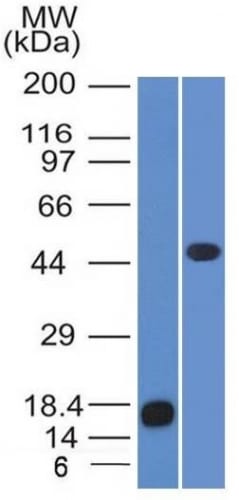 Western Blot of recombinant Adipophilin and Jurkat Cell Lysate using Adipophilin Mouse Monoclonal Antibody (ADFP/1365).
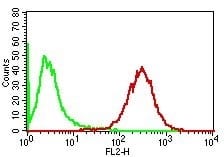 Flow Cytometry of human Adipophilin on PBMC. Green: Isotype Control; Red: Adipophilin Monoclonal Antibody (ADFP/1365).
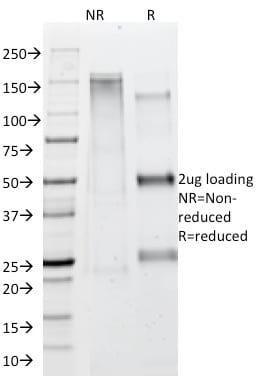 SDS-PAGE Analysis Purified Adipophilin Mouse Monoclonal Antibody (ADFP/1365). Confirmation of Purity and Integrity of Antibody.
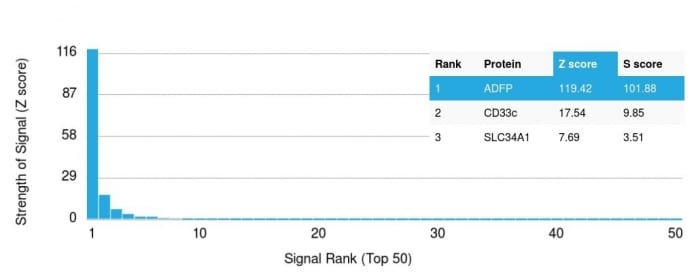 Analysis of Protein Array containing more than 19000 full-length human proteins using Adipophilin Mouse Monoclonal Antibody (ADFP/1365). Z- and S- Score: The Z-score represents the strength of a signal that a monoclonal antibody (MAb) (in combination with a fluorescently-tagged anti-IgG secondary antibody) produces when binding to a particular protein on the HuProtTM array. Z-scores are described in units of standard deviations (SD’s) above the mean value of all signals generated on that array. If targets on HuProtTM are arranged in descending order of the Z-score the S-score is the difference (also in units of SD’s) between the Z-score. S-score therefore represents the relative target specificity of a MAb to its intended target. A MAb is considered to specific to its intended target if the MAb has an S-score of at least 2.5. For example if a MAb binds to protein X with a Z-score of 43 and to protein Y with a Z-score of 14 then the S-score for the binding of that MAb to protein X is equal to 29.
Product Description
Perilipin-2, also known as Adipophilin, belongs to the perilipin family, members of which coat intracellular lipid storage droplets. This 48 kDa protein is associated with the lipid globule surface membrane material, and maybe involved in development and maintenance of adipose tissue. However, it is not restricted to adipocytes as previously thought, but is found in a wide range of cultured cell lines, including fibroblasts, endothelial and epithelial cells, and tissues, such as lactating mammary gland, adrenal cortex, Sertoli and Leydig cells, and hepatocytes in alcoholic liver cirrhosis, suggesting that it may serve as a marker of lipid accumulation in diverse cell types and diseases.
Primary antibodies are available purified, or with a selection of fluorescent CF® dyes and other labels. CF® dyes offer exceptional brightness and photostability. See the CF® Dye Brochure for more information. Note: Conjugates of blue fluorescent dyes like CF®405S and CF®405M are not recommended for detecting low abundance targets, because blue dyes have lower fluorescence and can give higher non-specific background than other dye colors.
Catalog number key for antibody number 1365, Anti-Adipophilin (ADFP/1365)
| Antibody # prefix | Conjugation | Ex/Em (nm) | Laser line | Detection channel | Dye Features |
|---|---|---|---|---|---|
| BNC04 | CF®405S | 404/431 | 405 | DAPI (microscopy), AF405 | CF®405S Features |
| BNC88 | CF®488A | 490/515 | 488 | GFP, FITC | CF®488A Features |
| BNC68 | CF®568 | 562/583 | 532, 561 | RFP, TRITC | CF®568 Features |
| BNC94 | CF®594 | 593/614 | 561 | Texas Red® | CF®594 Features |
| BNC40 | CF®640R | 642/662 | 633-640 | Cy®5 | CF®640R Features |
| BNC47 | CF®647 | 650/665 | 633-640 | Cy®5 | CF®647 Features |
| BNC74 | CF®740 | 742/767 | 633-685 | 775/50 | CF®740 Features |
| BNCB | Biotin | N/A | N/A | N/A | |
| BNUB | Purified | N/A | N/A | N/A | |
| BNUM | Purified, BSA-free | N/A | N/A | N/A |
Technology

