

Dog Interleukin 6,IL-6 ELISA Kit

Katalog-Nummer CSB-E11260c-10x96T
Size : 10x96T
Marke : Cusabio
 SDS
| Size | 96T,5×96T,10×96T |
Product Details
Target Name
interleukin 6 (interferon, beta 2)
Associated names
IL6Interleukin-6 ELISA Kit; IL-6 ELISA Kit
Abbreviation
Uniprot No.
Species
Canis lupus familiaris (Dog) (Canis familiaris)
Sample Types
serum, plasma, tissue homogenates
Detection Range
1.56 pg/mL-100 pg/mL
Sensitivity
0.39 pg/mL
Assay Time
1-5h
Sample Loading Volume
50-100ul
Detection Wavelength
450 nm
Research Area
Immunology
Assay Principle
quantitative
Measurement
Sandwich
Precision
| Intra-assay Precision (Precision within an assay): CV%<8% | ||||||
| Three samples of known concentration were tested twenty times on one plate to assess. | ||||||
| Inter-assay Precision (Precision between assays): CV%<10% | ||||||
| Three samples of known concentration were tested in twenty assays to assess. | ||||||
Linearity
| To assess the linearity of the assay, samples were spiked with high concentrations of dog IL-6 in various matrices and diluted with the Sample Diluent to produce samples with values within the dynamic range of the assay. | ||||||
| Sample | Serum(n=4) | |||||
| 1:1 | Average % | 84 | ||||
| Range % | 80-88 | |||||
| 1:2 | Average % | 95 | ||||
| Range % | 89-105 | |||||
| 1:4 | Average % | 100 | ||||
| Range % | 95-106 | |||||
| 1:8 | Average % | 93 | ||||
| Range % | 89-97 | |||||
Recovery
| The recovery of dog IL-6 spiked to levels throughout the range of the assay in various matrices was evaluated. Samples were diluted prior to assay as directed in the Sample Preparation section. | ||||||
| Sample Type | Average % Recovery | Range | ||||
| Serum (n=5) | 87 | 82-96 | ||||
| EDTA plasma (n=4) | 93 | 85-98 | ||||
Typical Data
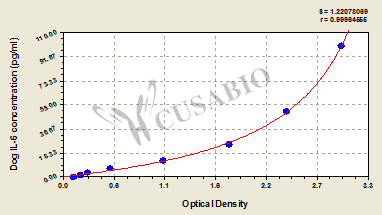
| These standard curves are provided for demonstration only. A standard curve should be generated for each set of samples assayed. | |||||||||||||||||||||||||||||||||||||||||||||||||||||||||||||||
| |||||||||||||||||||||||||||||||||||||||||||||||||||||||||||||||
ELISA Data Analysis
Troubleshooting
and FAQs
and FAQs
Storage
Store at 2-8°C. Please refer to protocol.
Shelf Life
6 months
Description
Interleukin 6 (IL-6) is a multifunctional cytokine that plays important roles in immune responses, inflammation, and hematopoiesis. Originally identified as a B-cell stimulatory factor, IL-6 regulates acute-phase responses, promotes T-cell activation, and influences the differentiation of various immune cell populations. Multiple cell types produce this cytokine, including macrophages, T-cells, endothelial cells, and fibroblasts in response to inflammatory stimuli. IL-6 signaling occurs through binding to its receptor complex, triggering downstream pathways that affect gene expression and...
Citations
- A Rajabi,BMC veterinary research,2023
- Effect of direct ultrasonic exposure on histopathology of ovaries, inflammatory and oxidative responses in dogs A Rajabi,/,2023
- MJ Lee,Applied Sciences,2022
- Salisu Buhari et al,The Scientific World JOURNAL,2012
- Buhari S et al,Scientific World Journal,2012
Customer Reviews and Q&A
There are currently no reviews for this product.
Target Background
Function
(From Uniprot)
(From Uniprot)
Cytokine with a wide variety of biological functions in immunity, tissue regeneration, and metabolism. Binds to IL6R, then the complex associates to the signaling subunit IL6ST/gp130 to trigger the intracellular IL6-signaling pathway. The interaction with the membrane-bound IL6R and IL6ST stimulates 'classic signaling', whereas the binding of IL6 and soluble IL6R to IL6ST stimulates 'trans-signaling'. Alternatively, 'cluster signaling' occurs when membrane-bound IL6:IL6R complexes on transmitter cells activate IL6ST receptors on neighboring receiver cells.; IL6 is a potent inducer of the...
Gene References into Functions
- An increase in ventricular dimension is accompanied by increases in AQP4 and IL-6 concentrations in the CSF of dogs with idiopathic communicating hydrocephalus. All were greatly reduced or normalised after shunt treatment. Therefore AQP4 and IL-6 in CSF can be indicators of ventriculomegaly, of cellular damage, and of improvement after the treatment of hydrocephalus.
- The results of this study suggest that IL-6 is a useful prognostic marker for canine critical care patients with acute internal disease.
- This diminished TNF-alpha, IL-6 and iNOS expression, and NO production was in parallel to the respective decreased NF-kappaB p65 protein nuclear translocation in the LPS-activated canine PBMCs pretreated with 25 microM and 50 microM propofol.
- Release of interleukin-6 and substance P may initiate proinflammatory effects leading to development of persistent pain in dogs with syringomyelia.
- The etiology of blindness in dogs with pituitary dependent hypercortisolism, including the role of adiponectin, interleukin 6, insulin, and nitric oxide, is reported.
- There was no association between IL6 variants and periodontal disease in dogs.
- These findings suggest that IL-6 secretion during acute urinary tract infection may serve a dual biological role by initiating the inflammatory response while also repairing urothelial defenses.
- Tumor-infiltrating lymphocytes isolated from regressing canine transmissible venereal tumor secrete high concentrations of IL-6 and antagonize the anti-lymphokine-activated killer activity of tumor cell transforming growth factor-beta 1.
- Plasma IL-6 concentration is predictive of outcome in canine systemic inflammatory response syndrome and sepsis and may be a valuable laboratory parameter for assessing critically ill dogs.
- Adipose tissue-derived mesenchymal stem cells expressed the mRNA of transforming growth factor beta (TGF-beta), IL-6, IL-8, CCL2, CCL5, VEGF,HGF, tissue inhibitor metalloproteinase-1/2, and cyclooxygenase-2 but not that of IL-10.
Subcellular Location
Secreted.
Protein Families
IL-6 superfamily
Database Links
KEGG:
STRING:
UniGene: