

Ondansetron [99614-02-5]

Katalog-Nummer T6615-200mg
Size : 200mg
Marke : TargetMol
Ondansetron
(Synonyms: SN 307, GR-C507/75, GR 38032F, GR 38032) Copy Product Info
Ondansetron (GR 38032) is a serotonin 5-HT3 receptor antagonist used mainly as an antiemetic.
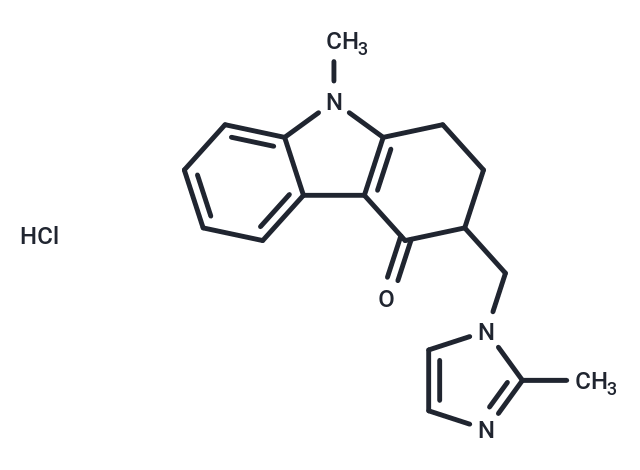
Cas No. 99614-02-5
For research use only—not for human use. No sales to individuals. Use as intended only.
Select Batch
Purity:99.92%
Appearance:Solid
Color:White
COA HNMR LCMS
Product Information
Ondansetron AI Summary
Ondansetron exhibits a variety of bioactivities primarily related to its high affinity for the 5-hydroxytryptamine 3 (5-HT3) receptor. It demonstrates potent antagonist activity against this receptor, with Ki values as low as 0.77 nM and IC50 values in the range of 1.4 to 1.95 nM in different assays. This compound effectively inhibits 5-HT3 receptor-induced responses, such as bradycardia and emesis, with significant efficacy in both in vitro and in vivo models. For instance, it exhibits an ID50 of 0.0036 mg/kg for inhibiting 5-HT-evoked reflex bradycardia in rats, and an ED50 of 0.008 mg/kg intravenously for reducing cisplatin-induced emetic episodes in ferrets and dogs. Additionally, Ondansetron has shown various degrees of inhibitory activity against other receptors and enzymes. It displays weak binding affinities for receptors such as dopamine D2, 5-HT1, and 5-HT2, with Ki values greater than 1000 nM. The compound also shows moderate effectiveness in inhibiting human liver transporters (e.g., OCT1, HERG, BSEP) and enzymes, with IC50 values ranging from 400 nM to greater than 135,000 nM. Furthermore, in pharmacokinetic evaluations, Ondansetron has an oral bioavailability of 79%, a volume of distribution at steady state (Vdss) of 1.8 L/kg, and demonstrates a hepatic clearance rate of 5.8 mL/min/kg. It also exhibits an unbound fraction of 0.27 in human plasma and a half-life (T1/2) of 3.4 hours after intravenous administration in humans. In terms of therapeutic relevance, Ondansetron has exhibited antiemetic properties and antidepressant-like activities in animal models, as well as minimal hepatotoxic effects. However, it has limited efficacy against specific viruses, including SARS-CoV-2, with antiviral assay results indicating low effectiveness. Overall, Ondansetron’s primary pharmacological action is as a potent antagonist of the 5-HT3 receptor, making it a potential candidate for treating conditions such as chemotherapy-induced nausea and vomiting, with additional relevance in various serotonin-related physiological functions..
Note: Summary generated by AI. Data source: ChEMBL 
Bioactivity
Chemical Properties
Storage & Solubility Information
| Description | Ondansetron (GR 38032) is a serotonin 5-HT3 receptor antagonist used mainly as an antiemetic. |
| Targets & IC50 | 5-HT:103 pM |
| Synonyms | SN 307, GR-C507/75, GR 38032F, GR 38032 |
| Molecular Weight | 293.36 |
| Formula | C18H19N3O |
| Cas No. | 99614-02-5 |
| Smiles | Cl.CN1C2=C(C3=CC=CC=C13)C(=O)C(CN1C=CN=C1C)CC2 |
| Relative Density. | 1.27 g/cm3 |
| Storage | Keep away from direct sunlight, Powder: -20°C for 3 years | In solvent: -80°C for 1 year Shipping with blue ice/Shipping at ambient temperature. | ||||||||||||||||||||
| Solubility Information | DMSO: 4.4 mg/mL (15 mM), Sonication is recommended.  | ||||||||||||||||||||
| In Vivo Formulation | 10% DMSO+40% PEG300+5% Tween 80+45% Saline: 1 mg/mL (3.41 mM), Sonication is recommended. 10% DMSO+90% Saline: 0.44 mg/mL (1.5 mM), Solution. Please add the solvents sequentially, clarifying the solution as much as possible before adding the next one. Dissolve by heating and/or sonication if necessary. Working solution is recommended to be prepared and used immediately. The formulation provided above is for reference purposes only. In vivo formulations may vary and should be modified based on specific experimental conditions. | ||||||||||||||||||||
Solution Preparation Table | |||||||||||||||||||||
DMSO
Note : The dilution table applies only to solid products. For liquid products, please calculate the stock solution based on the stated concentration and/or density. | |||||||||||||||||||||