

Recombinant Mouse Complement C1q subcomponent subunit A(C1qa) - E.coli

Katalog-Nummer CSB-EP003637MOa0-10ug
Size : 10ug
Marke : Cusabio
| Abbreviation | Recombinant Mouse C1qa protein |
| MSDS | |
| Image | |
Product Details
Purity
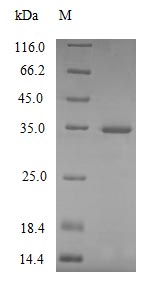
≥ 85% as determined by SDS-PAGE.
Target Names
Uniprot No.
Research Area
Immunology
Alternative Names
C1qaComplement C1q subcomponent subunit A
Species
Mus musculus (Mouse)
Source
E.coli
Expression Region
23-245aa
Target Protein Sequence
EDVCRAPNGKDGAPGNPGRPGRPGLKGERGEPGAAGIRTGIRGFKGDPGESGPPGKPGNVGLPGPSGPLGDSGPQGLKGVKGNPGNIRDQPRPAFSAIRQNPMTLGNVVIFDKVLTNQESPYQNHTGRFICAVPGFYYFNFQVISKWDLCLFIKSSSGGQPRDSLSFSNTNNKGLFQVLAGGTVLQLRRGDEVWIEKDPAKGRIYQGTEADSIFSGFLIFPSA
Note: The complete sequence may include tag sequence, target protein sequence, linker sequence and extra sequence that is translated with the protein sequence for the purpose(s) of secretion, stability, solubility, etc.
If the exact amino acid sequence of this recombinant protein is critical to your application, please explicitly request the full and complete sequence of this protein before ordering.
Note: The complete sequence may include tag sequence, target protein sequence, linker sequence and extra sequence that is translated with the protein sequence for the purpose(s) of secretion, stability, solubility, etc.
If the exact amino acid sequence of this recombinant protein is critical to your application, please explicitly request the full and complete sequence of this protein before ordering.
Mol. Weight
29.1 kDa
Protein Length
Full Length of Mature Protein
Tag Info
N-terminal 6xHis-tagged
Form
Liquid or Lyophilized powder
Note: We will preferentially ship the format that we have in stock, however, if you have any special requirement for the format, please remark your requirement when placing the order, we will prepare according to your demand.
Note: We will preferentially ship the format that we have in stock, however, if you have any special requirement for the format, please remark your requirement when placing the order, we will prepare according to your demand.
Buffer
If the delivery form is liquid, the default storage buffer is Tris/PBS-based buffer, 5%-50% glycerol.
Note: If you have any special requirement for the glycerol content, please remark when you place the order.
If the delivery form is lyophilized powder, the buffer before lyophilization is Tris/PBS-based buffer, 6% Trehalose.
Note: If you have any special requirement for the glycerol content, please remark when you place the order.
If the delivery form is lyophilized powder, the buffer before lyophilization is Tris/PBS-based buffer, 6% Trehalose.
Reconstitution
We recommend that this vial be briefly centrifuged prior to opening to bring the contents to the bottom. Please reconstitute protein in deionized sterile water to a concentration of 0.1-1.0 mg/mL.We recommend to add 5-50% of glycerol (final concentration) and aliquot for long-term storage at -20°C/-80°C. Our default final concentration of glycerol is 50%. Customers could use it as reference.
Troubleshooting and FAQs
Storage Condition
Store at -20°C/-80°C upon receipt, aliquoting is necessary for mutiple use. Avoid repeated freeze-thaw cycles.
Shelf Life
The shelf life is related to many factors, storage state, buffer ingredients, storage temperature and the stability of the protein itself.
Generally, the shelf life of liquid form is 6 months at -20°C/-80°C. The shelf life of lyophilized form is 12 months at -20°C/-80°C.
Generally, the shelf life of liquid form is 6 months at -20°C/-80°C. The shelf life of lyophilized form is 12 months at -20°C/-80°C.
Notes
Repeated freezing and thawing is not recommended. Store working aliquots at 4°C for up to one week.
Datasheet & COA
Please contact us to get it.
Citations
- J Nicke, A Goldspink, BK Fleischmann,Cell Communication and Signaling,2025
Customer Reviews and Q&A
■ Customer Reviews
There are currently no reviews for this product.
Target Background
Function
C1q associates with the proenzymes C1r and C1s to yield C1, the first component of the serum complement system. The collagen-like regions of C1q interact with the Ca(2+)-dependent C1r(2)C1s(2) proenzyme complex, and efficient activation of C1 takes place on interaction of the globular heads of C1q with the Fc regions of IgG or IgM antibody present in immune complexes.
Gene References into Functions
- C1qa(-/-) mice did not show any differences in photoreceptor loss or inflammation at 7 days compared to wild-type
- The results presented here demonstrate that the C1q expression in aged females experience a distinct difference in brain aging when compared to age-matched males, suggesting females undergo a higher level of microglial activation with age.
- this study shows that regulatory dendritic cells can mediate a potent direct anti-inflammatory activity via the expression and/or secretion of molecules such as C1q, independently of their capacity to expand the pool of regulatory T cells
- Data preliminarily suggest that complement C1q activity may aid in the clearance of the Toxoplasma gondii parasite from the central nervous system and in so doing, have consequences for the connectivity of neighboring cells and synapses
- analysis of molecular signaling and inflammatory responses during ingestion of atherogenic lipoproteins modulated by complement protein C1q
- C1q-/- mice manifest increased frequency of fetal resorption, reduced fetal weight, and smaller litter size when compared to their wild-type counterparts
- This study demonstrated that microglia, but not neurons or peripheral sources, are the dominant source of C1q in the brain.
- findings show that C1q rather than FcgammaRs controls the Ab-mediated Ag uptake and its presentation by spleen APC subsets to T cells
- Demonstrate local synthesis of complement proteins by both PDGFRbeta-positive pericytes and CD45-positive cells in kidney fibrosis.
- Deleting C1qa gene significantly reduces synaptic pruning by Grn(-/-) microglia and mitigates neurodegeneration, behavioral phenotypes, and premature mortality in Grn(-/-) mice; results uncover a previously unrecognized role of progranulin in suppressing aberrant microglia activation during aging.
- C1q level may be a surrogate of prediction marker representing neurodegenerative disease progress before developing behavioral impairment.
- developmental mechanisms of C1qa may be re-engaged during injury response
- that inhibition of C1 is sufficient to preserve dendritic and synaptic architecture
- These findings support a role for locally synthesized C1q in promoting tumor growth.
- C1q is involved in the pristane-mediated enhanced inflammatory response to TLR7 stimulation.
- C1q has a role in pulmonary vascular homeostasis and preventing injury to lung endothelium
- Data (including data from studies in mutant mice) suggest exercise prevents age-related neurovascular decline, up-regulation of C1qa, and down-regulation of astrocytic Apoe; this preventive effect of exercise does not occur in Apoe-deficient mice.
- critical role in activation of beta-catenin signalling in hypertensive arterial remodelling
- G allele in rs172378 risk factor for lupus nephritis in a homozygous status
- Data (including data on knockout mice) suggest, in absence of Trem2 (triggering receptor expressed on myeloid cells 2), pulmonary macrophages selectively produce elevated levels of C1q resulting in enhanced phagocytosis during pneumococcal pneumonia.
- Complement protein C1q promotes macrophage anti-inflammatory M2-like polarization during the clearance of atherogenic lipoproteins
- C1q was significantly reduced in newly diagnosed schizophrenic patients or schizophrenic patients on medication compared with the controls.
- C1q induction and global complement pathway activation do not contribute to ALS toxicity in mutant SOD1 mice.
- The structural abnormalities, together with increased numbers of excitatory synapses, likely contribute to epileptogenesis in C1q KO mice.
- C1q-induced LRP1B and GPR6 proteins expressed early in Alzheimer disease mouse models, are essential for the C1q-mediated protection against amyloid-beta neurotoxicity
- These findings suggest that C1q recognizes an alternative binding partner expressed by stressed retinal ganglion cells.
- Findings suggest the unexpected role of complement C1q in Wnt signal transduction and modulation of mammalian aging.
- Our data indicate that C1q could have a role in regulating platelet activation and associated leukocyte recruitment during vessel wall injury.
- Levels of C1q rise substantially in retinal tissues over the course of degeneration. in the absence of C1q, cone photoreceptor function and viability are significantly compromised.
- analysis of the molecular mechanisms for synchronized transcription of three complement C1q subunit genes (A, B and C) in dendritic cells and macrophages
- Leukocyte recruitment and C1q-hemolytic activity was restored to wild type levels when CD93 was expressed on either hematopoietic cells or nonhematopoietic cells in bone marrow chimeric mice
- C1q, a marker of microglial activation, is upregulated in the nigrostriatal system following subchronic 1-methyl-4-phenyl-1,2,3,6-tetrahydropyridine (MPTP); nigrostriatal dopaminergic injury is not affected by C1q in this model of Parkinson disease.
- Mice with a mutation in complement component 1a (C1qa) were protected from glaucoma.
- Complement 1q (C1q)-deficient mice lacking the classical complement pathway show significantly reduced survival and increased organ dysfunction, following cecal ligation and puncture when compared with control mice.
- C1q directly promotes neuronal survival, thereby demonstrating new interactions between immune proteins and neuronal cells that may facilitate neuroprotection.
- Ethanol activates the classical complement pathway via C1q binding to apoptotic cells in the liver and that C1q contributes to the pathogenesis of ethanol-induced liver injury.
- Complement protein C1q forms a complex with cytotoxic prion protein oligomers
- These results suggest that C1q and C3 facilitate the induction of intranasal tolerance.
- Bacterial titers of both Streptococcus pneumoniae serotype 6A and 14 in the middle ear lavage fluid samples from Bf/C2(-/)(-), Bf(-)(/)(-), and C1qa(-/)(-) mice were significantly higher than in samples from wild-type mice.
- C1q contributes to apoptotic cell clearance in vitro, but its genetic deletion has no effect on pulmonary apoptotic cell clearance in vivo.
- Elevated expression of splenic prion protein (PrP) may be dependent on C1q, since PrP up-regulation does not occur in spleens of C1q-deficient mice following treatment with preformed immune complexes or vesicular stomatitis virus.
- Evaluation using C1q-deficient mice shows that lung injury following gastrointestinal ischemia-reperfusion injury is independent of C1q and classical complement activation.
- alpha2beta1 integrin is a novel receptor for multiple collectins and the C1q complement protein
- The transmembrane lectin SIGN-R1 therefore contributes to innate resistance by an unusual C3 activation pathway.
- bacterial titers in the CNS were almost 12- and 20-fold higher in C1q- and C3-deficient-mice, respectively. Mean CSF leukocyte counts were reduced by 47 and 73% in C1q- and C3-deficient-mice, respectively
- The in vitro binding and activation of the human and mouse complement systems was analysed and the susceptibility to infection in complement-deficient mouse strains, was tested.
- C1q participates in scrapie prion protein PrP(Sc) uptake by conventional dendritic cells (cDCs), revealing a critical role for cDCs in initial prion capture, an event that takes place before the PrP(Sc) accumulation within the follicular DC network.
- IgM antibodies play a central role in protection against atherosclerosis; the mechanism appears to be at least partly independent of classical pathway complement activation by C1q
- ARRB2 acts to limit JNK/ERK activation and survival in macrophages.
Subcellular Location
Secreted.
Database Links
KEGG:
STRING:
UniGene: