
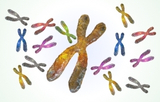
Chromosome Banding and Staining

Chromosome Banding and Staining

Chromosome banding and staining are foundational techniques in cytogenetics, enabling researchers and clinicians to visualize, identify, and analyze individual chromosomes for both basic research and diagnostic applications. These methods reveal unique banding patterns—alternating regions of light and dark—along the length of metaphase chromosomes after the application of various stains and treatments.

Principles of Chromosome Banding

Banding involves treating chromosomes with specific chemical agents or enzymes, followed by staining. These treatments produce regions (bands) with differential staining intensity, which correspond to variations in DNA sequence composition, chromatin structure, and protein content. The resulting banding patterns serve as chromosomal fingerprints for karyotyping, disease diagnosis, and evolutionary studies.

Key Banding and Staining Techniques

The most widely used chromosome banding and staining methods include:

  • G-banding: Giemsa stain (post trypsin or enzymatic digestion) targets AT-rich regions that stain dark. This is the standard for karyotyping and detects major structural and numerical abnormalities.
  • Q-banding: Quinacrine mustard (fluorescent dye) binds to AT-rich regions that fluoresce brightly. It was an early diagnostic tool that distinguishes the Y chromosome and satellite DNA.
  • C-banding: Uses Giemsa after barium hydroxide treatment to highlight constitutive heterochromatin, especially at centromeres, identifying regions like Yq.
  • R-banding: Employs heat or chemical treatment followed by Giemsa to stain GC-rich, gene-dense regions, which is helpful for analysis alongside G-banding.
  • NOR-banding: Silver stain (AgNOR) identifies nucleolar organizing regions containing rDNA gene clusters (on chromosomes 13, 14, 15, 21, 22).

Applications

  • Karyotyping: Banding techniques support construction of karyotypes, aiding in diagnosis of chromosomal disorders such as Down syndrome and cancer-associated anomalies.
  • Disease diagnosis and genetic counseling: Enables detection of deletions, duplications, translocations, and aneuploidies for accurate diagnostics and counseling.
  • Evolution and taxonomy: Banding patterns track chromosomal evolution and species relationships.
  • Gene mapping: Cytogenetic bands serve as reference points for localizing genes and identifying mutation breakpoints.


Chromosome banding and staining are critical components of cytogenetic analysis, offering a window into the structure, function, and pathology of the genome through their distinctive and reproducible patterns.

Frequently Asked Questions (FAQ)

How can I quickly find a banding and staining product?

To find a banding and staining product, use the search function by name, product code, supplier, brand or sub-category. You can also browse the product families listed on the page to identify an available product code, an alternative or an equivalent product.

Does CliniSciences stock several product codes in the banding and staining category?

Yes, CliniSciences distributes several product references in the banding and staining category, sourced from specialist suppliers. Depending on the product family, references may vary in terms of format, packaging, brand, supplier, technical specifications or availability.

Can I request a quote for banding and staining products?

Yes, you can request a quote for banding and staining products from the product page or by contacting CliniSciences (info@clinisciences.com). To help us process your enquiry, please provide, where possible, the product name, catalogue reference, required quantity, the supplier or brand you are looking for, and the country of delivery.

How can I find out if a banding and staining product is available to order?

The availability of a banding and staining product depends on the product code, supplier, packaging and country of delivery. For up-to-date information, please check the product details page or contact CliniSciences with the product code or name of the product you are looking for.

What should I do if I cannot find the banding and staining product I am looking for?

If the banding and staining product you are looking for does not appear in the catalogue, please contact CliniSciences with the available information: product name, reference number, supplier, brand, format or packaging. The team will be able to search for the reference number within its network of suppliers or suggest an available alternative.

Are all banding and staining products available under the same terms and conditions?

No. Ordering, delivery, storage and documentation conditions may vary depending on the product type, the supplier and the applicable regulations. Certain product codes may require specific approval, specialised transport, a safety data sheet or additional information prior to ordering.

Search result : 1072 product found

Refine your search :

RUO
CE/IVD
NEW
  • Unconjugated 326
  • Colloidal Gold 1
  • fish 8
  • bacteria 6
  • pig 2
  • fish 10
  • bacteria 8
  • Biochemicals
  • Buffers and reagents 331
  • IHC 23
  • Cell culture 5
  • WB 5
  • Microscopy 4
  • Dot blot 3
  • ELISA 3
  • Staining 1
APPLY FILTERS
REINITIALIZE


Cat#
Description
Cond.
Price Bef. VAT
NB-42-20858-25g
 25g 
NB-64-36525-100mg
 100mg 
NB-64-36525-50mg
 50mg 
NB-64-36525-25mg
 25mg 
NB-64-23426-500ug
 500ug 
NB-64-23426-10mg
 10mg 
NB-64-23426-1mg
 1mg 
NB-64-23426-5mg
 5mg 
NB-64-01103-500mg
 500mg 
NB-64-01103-100mg
 100mg 
New
NB-64-77983-25mg
 25mg 
NB-64-77983-100mg
 100mg 
New
NB-64-77983-50mg
 50mg 
New
NB-64-97280-1mL
 1mL 
New
NB-64-97282-1mL
 1mL 
    ‹
    ›