

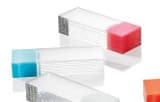
Microscope slides serve as the foundational substrate for histological, cytological, and pathological examinations, enabling high-resolution imaging of tissue sections, cells, and microorganisms under light, fluorescence, and polarizing microscopes. Crafted from high-clarity soda-lime or borosilicate glass, they ensure minimal autofluorescence and optical distortion. For researchers in histology, cytology, and biomedical analysis, selecting premium-quality slides guarantees consistent sample adhesion, uniform staining, and compatibility with automated scanners and whole-slide imaging (WSI) systems.
Types of Microscope Slides
Microscope slides are categorized according to surface treatment to optimize performance across different applications. Plain slides are suitable for basic bright-field microscopy, while frosted-end slides facilitate precise and durable labeling. Charged or poly-L-lysine (PLL) coated slides enhance electrostatic adhesion of tissue sections, preventing tissue loss during staining—particularly important for immunohistochemistry (IHC) and in situ hybridization (ISH). Adhesive slides with silane or aminoalkoxysilane coatings are ideal for cytology smears and frozen sections, providing strong adhesion during high-temperature antigen retrieval.
- Plain slides: for routine bright-field microscopy.
- Frosted-end slides: enable easy, durable labeling.
- Charged or PLL-coated slides:
- strengthen electrostatic adhesion.
- prevent section detachment.
- essential for IHC and ISH.
- Adhesive (silanized/aminoalkoxysilane) slides:
- ideal for smears and frozen sections.
- maintain adhesion during heat-induced epitope retrieval.
- Control slides:
- contain pre-stained positive or negative samples.
- support assay validation and QC compliance.
Materials and Quality Standards
Soda-lime glass remains the most widely used material due to its cost-effectiveness and hydrolytic resistance. Borosilicate glass provides superior chemical and thermal stability and exhibits lower autofluorescence, making it suitable for fluorescence microscopy. Pre-cleaned and autoclavable slides reduce contamination and ensure low background signals in sensitive applications such as fluorescence microscopy, cytogenetics, or palynology.
- Soda-lime glass: cost-effective, hydrolytic resistance.
- Borosilicate glass:
- higher thermal and chemical durability.
- lower autofluorescence for fluorescence imaging.
- Pre-cleaned, autoclavable slides:
- minimize contaminants.
- reduce background noise in sensitive assays.
Quality control protocols typically evaluate flatness, thickness uniformity, cleanliness, and tissue adhesion to ensure consistent and reliable performance across routine and advanced imaging workflows.