

Antioxidant Quantification, Aqueous Kit, Total, BioAssay™

Cat# A2298-46-1Kit
Size : 1Kit
Brand : US Biological
A2298-46 Antioxidant Quantification, Aqueous Kit, Total, BioAssay™
Shipping Temp
Blue IceStorage Temp
4°C/-70°CThis TAP assay allows the accurate measure a sample’s total antioxidant activity, which is the sum of the combined antioxidant activities of all of the samples constituents, including vitamins, proteins, glutathione, etc. This method can be used to quantify the antioxidant capacity for a wide range of biological fluids as well as foods and nutritional supplements.
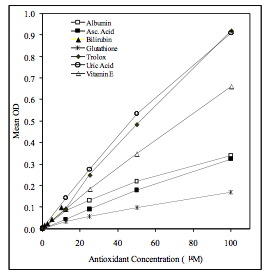
Oxidative stress is the condition in which a lack of balance exists between the oxidant stimuli and the various antioxidants (1). Oxidative stress appears to be involved in the pathogenesis of several diseases, including artherosclerosis (2), chronic inflammatory diseases (3), and cancer (4). Therefore, the body possesses several antioxidant systems that are very important for the prevention of oxidative stress (5). These antioxidant systems include enzymatic (prevalently, if not exclusively, intracellular) and non-enzymatic (both intra- and extracellular). Lipid soluble antioxidants (most importantly vitamin E) and water-soluble antioxidants (uric acid, vitamin C, bilirubin, thiols and gluthathione) are involved in these processes. Given the multiplicity of antioxidant pathways, their centrality in the prevention of oxidant stress, and the influences of lifestyle and nutritional supplements on an individual’s antioxidant capacity, it is important to be able to quantitatively measure the total antioxidant capacity or antioxidant power within biological specimens (6-11).
Principle of the Assay:
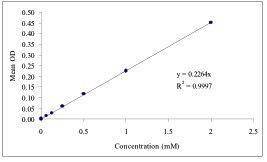
The reduction potential of the sample or standard effectively converts Cu+2 to Cu+1, thus changing the ion’s absorption characteristics. This reduced form of copper will selectively form a stable 2:1 complex with the chromogenic reagent with an absorption maximum at ~450 nm (12-16). A known concentration of Trolox is used to create a calibration curve, with the data being expressed as uM Trolox equivalents or in uM copper reducing equivalents.
Kit Components:
A2298-46A: DILUTION BUFFER, 1x60ml
A2298-46B: COPPER SOLUTION, 1x5ml
A2298-46C: STOP SOLUTION, 1x5ml
*A2298-46D: Trolox STANDARD, 1x1vial
A22298-46E: Microtiter Plate, 1x 96well
Storage and Stability:
Store *A2298-46D powder at 4°C, liquid at -70°C. Store other components at 4°C. Stable for at least 6 months. For maximum recovery of product, centrifuge the original vial prior to removing the cap.