

L-Thyroxine [51-48-9]

Cat# T0864-200mg
Size : 200mg
Brand : TargetMol
L-Thyroxine
(Synonyms: T4, NSC 36397, Levothyroxine) Copy Product Info
L-Thyroxine (NSC 36397) is the major hormone derived from the thyroid gland. L-Thyroxine (NSC 36397) is synthesized via the iodination of tyrosines (MONOIODOTYROSINE) and the coupling of iodotyrosines (DIIODOTYROSINE) in the THYROGLOBULIN. L-Thyroxine (NSC 36397) is released from thyroglobulin by proteolysis and secreted into the blood. L-Thyroxine (NSC 36397) is peripherally deiodinated to form TRIIODOTHYRONINE which exerts a broad spectrum of stimulatory effects on cell metabolism.
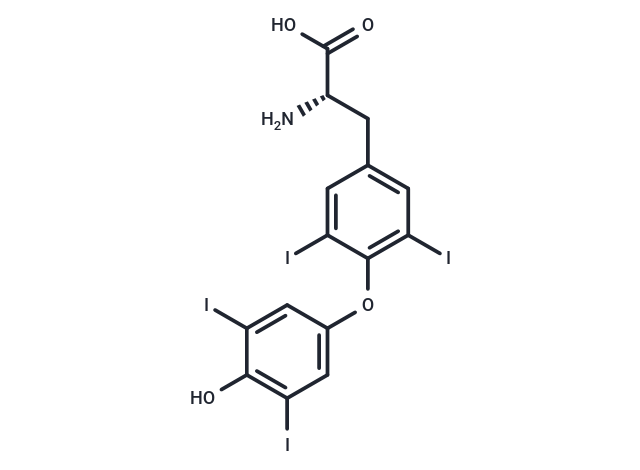
Cas No. 51-48-9
For research use only—not for human use. No sales to individuals. Use as intended only.
Select Batch
Purity:99.56%
COA LCMS HNMR
Product Information
L-Thyroxine AI Summary
L-Thyroxine exhibits a wide range of biological activities, with notable binding affinity and bioactivity across several assays. It has a relative binding affinity of 100.0 when compared to L-T4 in prealbumin binding assays and demonstrates a moderate to strong binding energy of 10.3 kCal mol-1. The compound shows potential in inhibiting TTR-mediated fibrillogenesis with an IC50 value of 10500 nM and demonstrates high activity in promoting angiogenesis, evident in fertilized chicken egg membranes and Matrigel plug assays. In transporter assays, L-Thyroxine acts as both an inhibitor and substrate, with varying Km values in different cell models, indicating interactions with multiple transporters like OATPs and OCT1. It also affects the uptake of thyroxine and triiodothyronine in Xenopus laevis oocytes. In terms of antiviral activities, it shows some inhibition against SARS-CoV-2 in different cell lines, although the effectiveness varies. Regarding enzymatic activity, L-Thyroxine does not exhibit significant activity towards human UGT enzymes but does show moderate inhibition towards human HDAC6. It also affects specific cell signaling pathways and receptors, including PPARgamma, RXRalpha, THRalpha, and THRbeta, and demonstrates selective inhibition towards certain viral entry mechanisms and enzymes like PDE4D. The compound indicates no observable liver toxicity in specific assays but displays moderate hepatotoxicity in others, suggesting nuanced interactions depending on context and conditions. The bioactivities of L-Thyroxine suggest potential therapeutic applications, but further research is needed to fully understand its mechanisms and effects..
Note: Summary generated by AI. Data source: ChEMBL 
Bioactivity
Chemical Properties
Storage & Solubility Information
| Description | L-Thyroxine (NSC 36397) is the major hormone derived from the thyroid gland. L-Thyroxine (NSC 36397) is synthesized via the iodination of tyrosines (MONOIODOTYROSINE) and the coupling of iodotyrosines (DIIODOTYROSINE) in the THYROGLOBULIN. L-Thyroxine (NSC 36397) is released from thyroglobulin by proteolysis and secreted into the blood. L-Thyroxine (NSC 36397) is peripherally deiodinated to form TRIIODOTHYRONINE which exerts a broad spectrum of stimulatory effects on cell metabolism. |
| Synonyms | T4, NSC 36397, Levothyroxine |
| Molecular Weight | 776.87 |
| Formula | C15H11I4NO4 |
| Cas No. | 51-48-9 |
| Smiles | N[C@@H](Cc1cc(I)c(Oc2cc(I)c(O)c(I)c2)c(I)c1)C(O)=O |
| Relative Density. | 2.635g/cm3 |
| Storage | Keep away from direct sunlight,Store under nitrogen Pure form: -20°C for 3 years | In solvent: -80°C for 1 year Shipping with blue ice/Shipping at ambient temperature. | |||||||||||||||||||||||||||||||||||
| Solubility Information | H2O: < 1 mg/mL (insoluble or slightly soluble) Ethanol: < 1 mg/mL (insoluble or slightly soluble) DMSO: 93 mg/mL (119.71 mM), Sonication is recommended. | |||||||||||||||||||||||||||||||||||
| In Vivo Formulation | 10% DMSO+40% PEG300+5% Tween 80+45% Saline: 3.3 mg/mL (4.25 mM), Sonication is recommended. Please add the solvents sequentially, clarifying the solution as much as possible before adding the next one. Dissolve by heating and/or sonication if necessary. Working solution is recommended to be prepared and used immediately. The formulation provided above is for reference purposes only. In vivo formulations may vary and should be modified based on specific experimental conditions. | |||||||||||||||||||||||||||||||||||
Solution Preparation Table | ||||||||||||||||||||||||||||||||||||
DMSO
Note : The dilution table applies only to solid products. For liquid products, please calculate the stock solution based on the stated concentration and/or density. | ||||||||||||||||||||||||||||||||||||