


The RayBiotech Lactate Dehydrogenase Activity Assay Kit offers a user-friendly, reliable, and highly sensitive method for quantifying LDH activity in plasma, serum, cell lysates, and other biological fluid samples.
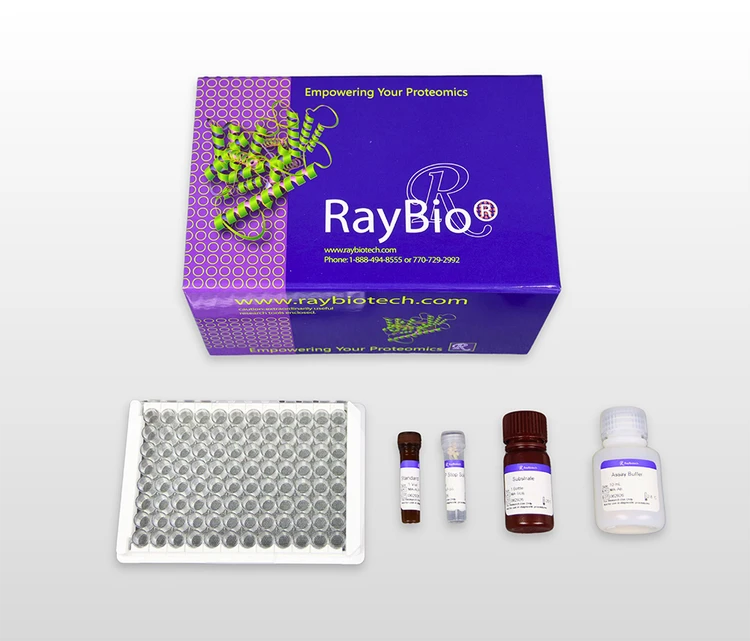
Lactate Dehydrogenase Activity Assay Kit (Colorimetric)
Lactate Dehydrogenase Activity Assay Kit (Colorimetric)
Contact Us for Bulk Request
Product Description
Specifications
| Size | 1 Plate Kit, 2 Plate Kit, 5 Plate Kit |
| Compatible Sample Types | Cell Culture Supernatants, Plasma, Serum, Tissue Lysates, Cell Lysates |
| Quantitative/Semi-Quantitative | Quantitative |
| Solid Support | 96-well Microplate |
| Method Of Detection | Colorimetric |
| Research Area | Cardiovascular Disease, Cancer, Energy Metabolism, Necrosis |
| Shipping Type | Blue ice |
| Storage | 2-8°C |
Related Products
L-lactate Assay Kit (Colorimetric)
As low as $399.00
Introduction
Lactate dehydrogenase (LDH) is a crucial enzyme in the anaerobic metabolic pathway, catalyzing the reversible conversion of lactate to pyruvate while reducing NAD+ to NADH and vice versa. LDH is ubiquitously present in various body tissues. Elevated LDH levels in the bloodstream can result from diverse conditions, including liver disease, anemia, heart attack, bone fracture, muscle trauma, cancer, and infection. LDH is also a general marker of tissue turnover, reflecting normal metabolic processes.
The RayBio® Lactate Dehydrogenase Activity Assay Kit offers a user-friendly, reliable, and highly sensitive method for quantifying LDH activity in plasma, serum, cell lysates, and other biological fluid samples. In this assay, LDH facilitates the oxidation of lactate into pyruvate while concurrently reducing NAD to NADH. The rate of NAD reduction can be quantified by monitoring the increase in absorbance at 340nm. This rate of absorbance change is directly proportional to the LDH activity within the sample.
Kit Components
| Component | Size / Description |
|---|---|
| Microplates | A 96-well (12 strips x 8 wells) plate |
| Sample Buffer | 10 ml |
| Assay Buffer | 20 ml |
| Enzyme Mix Solution | 20 ml |
| Lactate Dehydrogenase (LDH) Positive Control | 1 Vial (10 ul) |
Additional Materials Required
- Microplate reader capable of measuring absorbance at 340 nm at 37°C
- Precision pipettes to deliver 2 µl to 1 ml volumes
- Multi-channel pipettes to deliver 20 μl to 200 μl volumes
- Tubes to prepare sample dilutions
- Incubator at 37°C.
- 50 ml conical tubes
Assay Procedure Summary
Positive control, sample and Sample Buffer (used as a blank) should be assayed in duplicate or triplicate. A freshly prepared positive control should be used each time the assay is performed.
- Set up a microplate reader or a microplate incubator at 37°C.
- Prepare Working Solution (See Reagent Preparation, section A), and incubate it at 37°C for five minutes.
- Prepare Positive Control (See Reagent Preparation, section B).
- Pipette 10 μL of sample, Sample Buffer (as the blank) and Positive Control into each well of the 96-well plate.
- Transfer 200 μL of pre-warmed Working Solution into each well (it is recommended to use a multi-channel pipette), mix and incubate at 37°C for 30 seconds.
- After 30 seconds, read and record absorbance at 340nm (A1 Reading). Continue Incubating at 37°C for one minute.
- After exactly one minute, read and record absorbance at 340nm (A2 Reading).
documents
citations
Advancing Human iPSC-Derived Cardiomyocyte Hypoxia Resistance for Cardiac Regenerative Therapies through a Systematic Assessment of In Vitro Conditioning
- Species:
- Human
- Sample Type:
- Engineered cardiac tissues (ECTs)
- Year:
- 2024
- Journal Name:
- International Journal of Molecular Sciences
- PubMed ID:
- 39273573
ACADL suppresses PD-L1 expression to prevent cancer immune evasion by targeting Hippo/YAP signaling in lung adenocarcinoma
- Year:
- 2023
- Journal Name:
- Medical Oncology
Nanotoxicologic Effects of PLGA Nanoparticles Formulated with a Cell-Penetrating Peptide: Searching for a Safe pDNA Delivery System for the Lungs
- Species:
- Human
- Sample Type:
- Cell Culture Supernatant (cell culture supernatant A549 and Beas-2B)
- Year:
- 2019
- Journal Name:
- Pharmaceutics
- PubMed ID:
- 30609825