


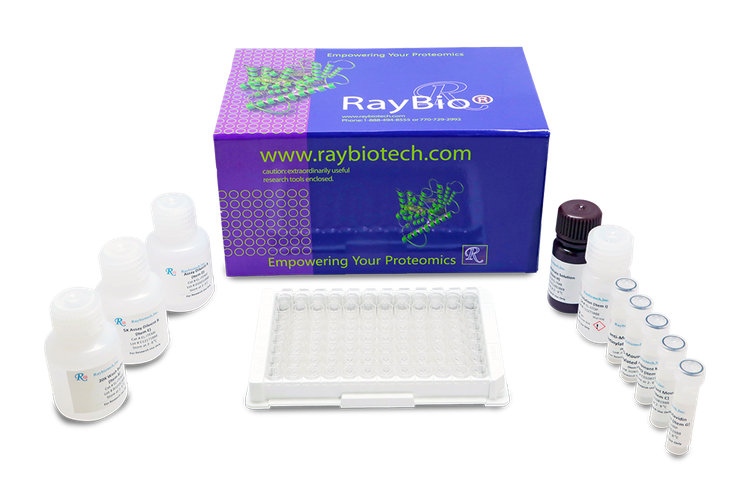
The RayBio® Alpha-MSH Enzyme Immunoassay (EIA) Kit is an in vitro quantitative assay for detecting human, mouse, or rat melanocyte-stimulating hormone alpha based on the competitive ELISA principle. The immunoassy is optimized for serum, plasma and cell culture media.

Alpha-MSH ELISA Kit
Alpha-MSH ELISA Kit
Contact Us for Bulk Request
Product Description
Specifications
| Size | 1 Plate Kit, 2 Plate Kit, 5 Plate Kit |
| Species | Human, Mouse, Rat |
| Sensitivity | 20.5 pg/ml |
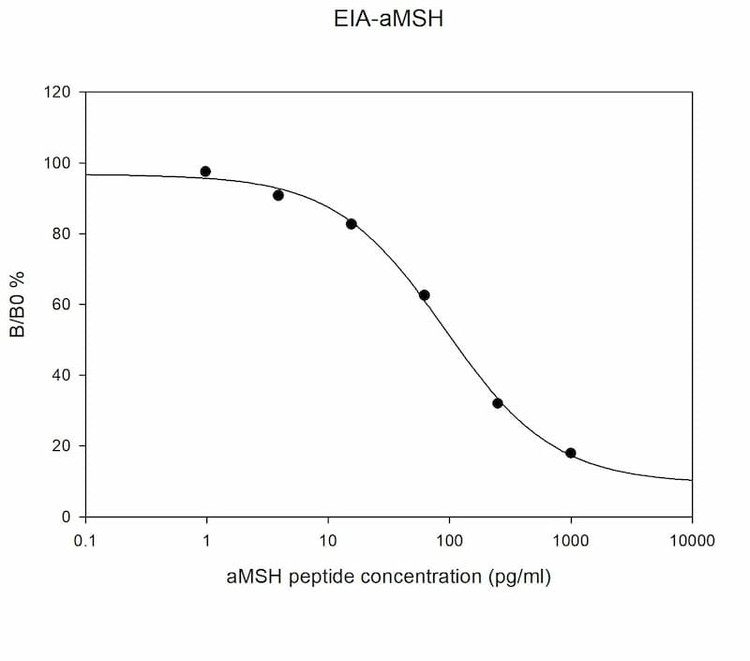
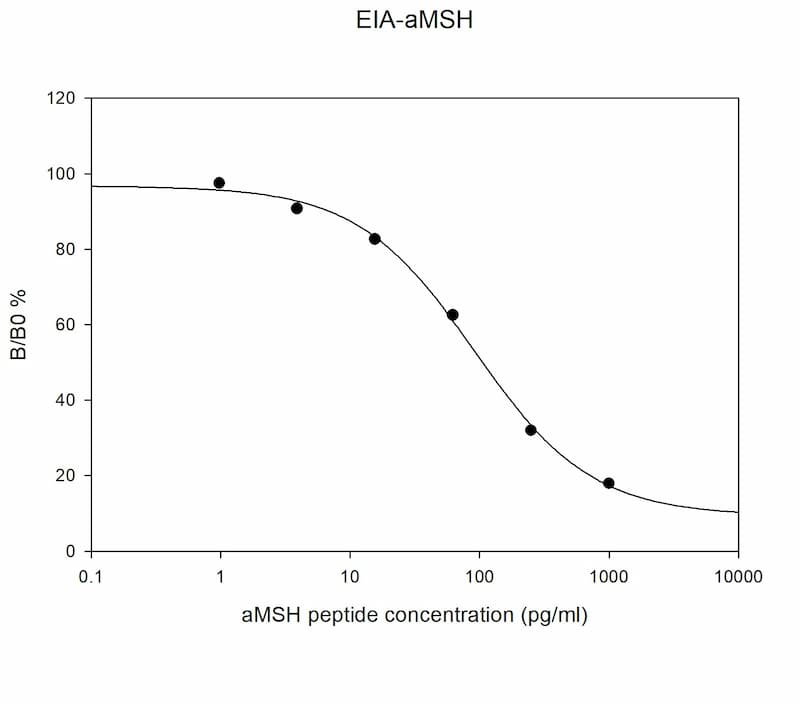
| Detection Range | 0.98-1,000 pg/ml |
| Specificity | This EIA kit is designed to detect human mouse, and rat Alpha-Melanocytestimulating hormone. |
| Compatible Sample Types | Plasma, Serum |
| Recommended Dilution (Serum/Plasma) | Human: 4X / Mouse: 8X / Rat: 8X |
| Accession Number | O95630 |
| Gene Id | 10617 |
| Gene Symbols | STAMBP, AMSH |
| Protein Name / Synonyms | alpha-melanocyte stimulating hormone (a-MSH/ aMSH) |
| Quantitative/Semi-Quantitative | Quantitative |
| Solid Support | 96-well Microplate |
| Design Principle | Competition-based |
| Method Of Detection | Colorimetric |
| Research Area | Cardiovascular Disease, Endocrine |
| Shipping Type | Blue ice |
| Storage | -20°C |
Introduction
Alpha-Melanocyte-stimulating hormone (alpha-MSH), a proteolyic cleavage product from ACTH (1-13), is an endogenous peptide hormone and neuropeptide of the melanocortin family. It is a non-selective full agonist of the melanocortin receptors MC1, MC3, MC4, and MC5, but not MC2. Alpha-MSH is important for pigmentation primarily of the hair and skin. It also plays a role in feeding behavior, energy homeostasis, sexual activity, and protection against ischemia and reperfusion injury.
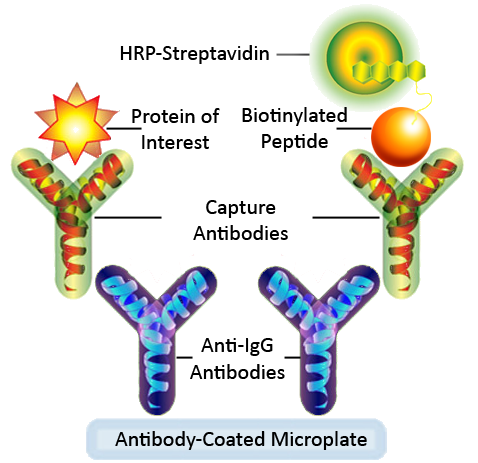
In this assay, a biotinylated Alpha-MSH peptide is spiked into the samples and standards. The samples and standards are then added to the plate, where the biotinylated Alpha-MSH peptide competes with endogenous (unlabeled) Alpha-MSH for binding to the anti-Alpha-MSH antibody. After a wash step, any bound biotinylated Alpha-MSH then interacts with horseradish peroxidase (HRP)- streptavidin, which catalyzes a color development reaction. The intensity of the colorimetric signal is directly proportional to the amount of captured biotinylated Alpha-MSH peptide and inversely proportional to the amount of endogenous Alpha- MSH in the standard or samples. A standard curve of known concentration of Alpha-MSH peptide can be established and the concentration of Alpha-MSH peptide in the samples can be calculated accordingly.
Product Features
- Strip plates and additional reagents allow for use in multiple experiments
- Quantitative protein detection
- Establishes normal range
- The best products for confirmation of antibody array data
Typical Data
Kit Components
- Pre-Coated 96-well Strip Microplate
- Wash Buffer
- Standard Peptide
- Assay Diluent(s)
- Biotinylated Peptide
- HRP-Streptavidin
- TMB One-Step Substrate
- Stop Solution
- Assay Diagram
- Positive Control Sample
- Capture Antibody
- User Manual
Additional Materials Required
- Distilled or deionized water
- Precision pipettes to deliver 2 µl to 1 ml volumes
- Adjustable 1-25 ml pipettes for reagent preparation
- 100 ml and 1 liter graduated cylinders
- Tubes to prepare standard and sample dilutions
- Orbital shaker
- Aluminum foil
- Saran Wrap
- Absorbent paper
- Microplate reader capable of measuring absorbance at 450 nm
- SigmaPlot software (or other software that can perform four-parameter logistic regression models)
Assay Procedure Summary
- Prepare all reagents, samples and standards as instructed.
- Add 100 µl detection antibody to each well.
- Incubate 1.5 h at RT or O/N at 4°C.
- Add 100 µl standard or sample to each well.
- Incubate 2.5 h at RT.
- Add 100 µl prepared streptavidin solution.
- Incubate 45 min at RT.
- Add 100 µl TMB One-Step Substrate Reagent to each well.
- Incubate 30 min at RT.
- Add 50 µl Stop Solution to each well.
- Read plate at 450 nm immediately.
Storage/Stability
Standard, Biotinylated Alpha-MSH peptide, and Positive Control should be stored at -20°C after arrival. Avoid multiple freeze-thaws. The remaining kit components may be stored at 4°C. Opened Microplate Wells and antibody (Item N) may be stored for up to 1 month at 2°C to 8°C. Return unused wells to the pouch containing desiccant pack and reseal along entire edge.