


The L-lactate Colorimetric Assay Kit provides a simple, reproducible, and sensitive tool of measuring L-lactate concentration in plasma, serum, cell lysates, urine and other biological liquid samples.
L-lactate Assay Kit (Colorimetric)
L-lactate Assay Kit (Colorimetric)
Contact Us for Bulk Request
Product Description
Specifications
| Size | 1 Plate Kit, 2 Plate Kit, 5 Plate Kit |
| Compatible Sample Types | Cell Culture Supernatants, Plasma, Serum, Tissue Lysates, Cell Lysates, Urine |
| Quantitative/Semi-Quantitative | Quantitative |
| Solid Support | 96-well Microplate |
| Method Of Detection | Colorimetric |
| Research Area | Cancer, Oxidative Stress, Energy Metabolism, Glycolysis & Lipid Metabolism |
| Shipping Type | Blue ice |
| Storage | 2-8°C |
Related Products
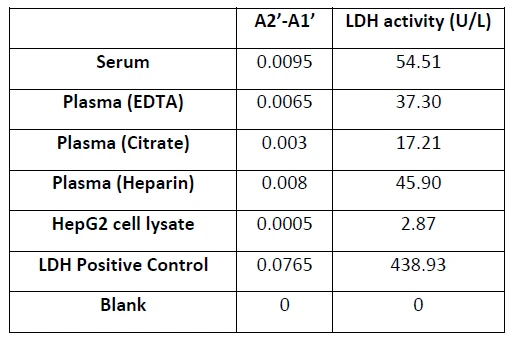
Lactate Dehydrogenase Activity Assay Kit (Colorimetric)
As low as $349.00
Introduction
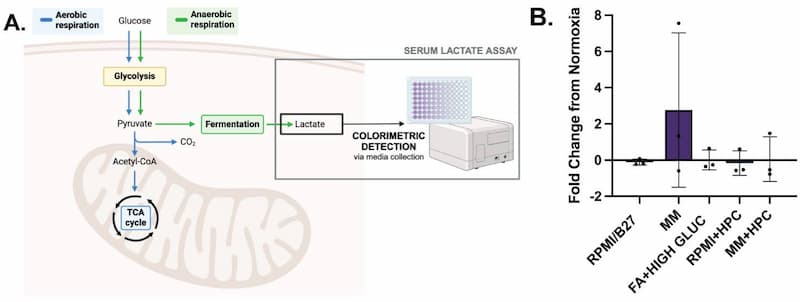
Lactate is an intermediary product of carbohydrate metabolism and exists in the human body as two optical isomers: L-lactate and D-lactate. L-lactate is produced from pyruvate during anaerobic glycolysis and is present in blood at concentrations 100 times greater than D-lactate. Its concentration in the blood is dependent on the liver’s metabolic rate, and its production by the erythrocytes and muscle cells. L-lactate has often been used as a physiological indicator for stress. Its determination in serum is very important in the diagnosis and medical management of various diseases, such as tissue hypoxia, diabetes, circulatory failure, and hematological disorders.
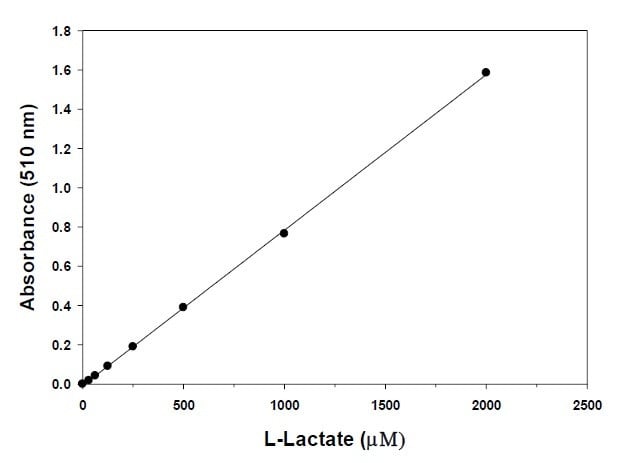
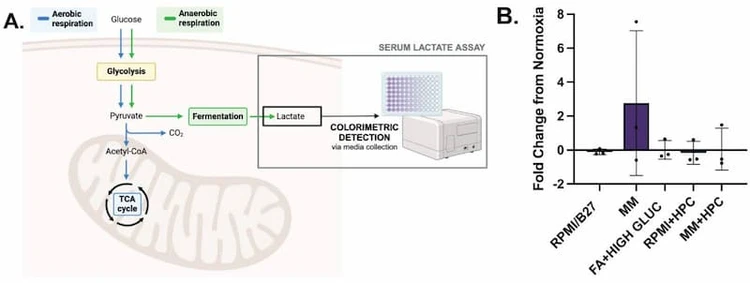
The RayBiotech L-lactate Colorimetric Assay Kit provides a simple, reproducible, and sensitive tool of measuring L-lactate concentration in plasma, serum, cell lysates, urine and other biological liquid samples. This assay employs a coupled enzymatic reaction system that combines multiple steps. Initially, lactate oxidase catalyzes the oxidation of L-lactate to pyruvate and hydrogen peroxide (H2O2). Peroxidase then catalyzes the reaction of hydrogen peroxide with the Colorimetric Probe to form a pink colored product. The optical density measured at 510nm is directly proportional to the concentration of L-lactate present in the sample.
Typical Data
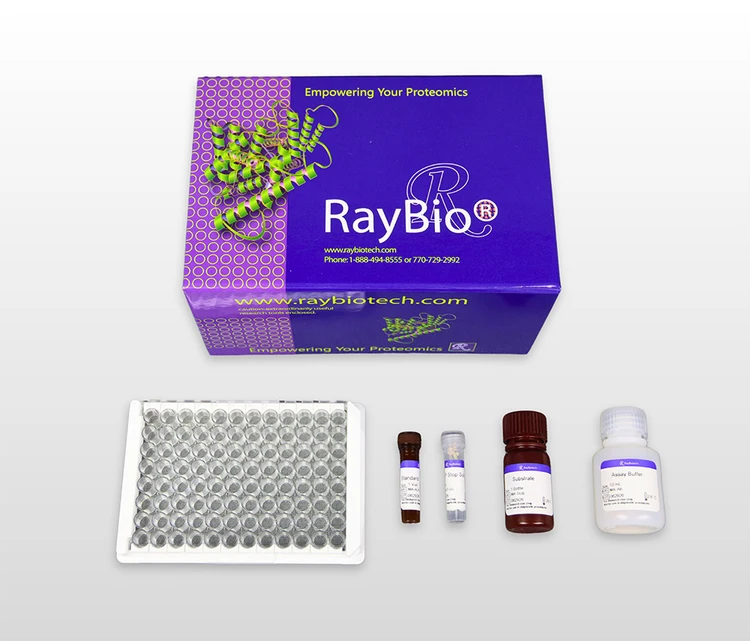
Kit Components
| Component | Size / Description |
|---|---|
| Microplates | A 96-well plate |
| Sample Buffer | 10 mL |
| L-lactate Standard | 1 vial |
| Enzyme Mix | 1vial |
| Enzyme Buffer | 25 mL |
| Colorimetric Probe | 2 vials |
Additional Materials Required
- Microplate reader capable of measuring absorbance at 510 nm
- Precision pipettes to deliver 2 ul to 1 ml volumes
- Tubes to prepare sample dilutions
- Incubator at 37°C
- 50 ml conical tubes
Assay Procedure Summary
Each L-lactate standard and sample should be assayed in duplicate or triplicate. A freshly prepared standard curve should be used each time the assay is performed.
- Add 5 μL of the diluted L-lactate Standards or samples to the 96-well microtiter plate.
- Initiate the reaction by adding 200 μL Working Solution (See “Reagent Preparation”) to each well.
- Cover with the plate cover. Carefully shake the plate for a few seconds to mix.
- Incubate the plate for 5 minutes at 37°C.
- Measure the absorbance at 510nm using a plate reader.
citations
Aging kidney is associated with metabolic rewiring and epigenetic reprogramming
- Sample Type:
- Urine
- Year:
- 2026
- Journal Name:
- Geroscience
- PubMed ID:
- 41498907
Haematococcus pluvialis extract YHC-T-2414 mitigates exercise- induced fatigue by promoting antioxidant defense and mitochondrial biogenesis
- Species:
- Mouse
- Sample Type:
- Serum (ICR mice, exercise fatigue model)
- Year:
- 2026
- Journal Name:
- Frontiers in Nutrition
- PubMed ID:
- 42656621
Intestinal adaptations increase basolateral intestinal glucose uptake and glycolysis in a mouse model of cystic fibrosis
- Year:
- 2026
- Journal Name:
- Am J Physiol Gastrointest Liver Physiol
- PubMed ID:
- 41364542
Obesity Risk Factors Promote Metabolic Reprogramming and Viral Infection in Airways with Type 1 High Inflammation
- Species:
- Human
- Sample Type:
- Cell Culture Supernatant (tracheobronchial epithelial cells)
- Year:
- 2025
- Journal Name:
- Biomolecules
- PubMed ID:
- 41008536