


The Catalase Activity Assay Kit provides a user-friendly, reproducible, rapid, and highly sensitive method for measuring catalase activity in various biological liquid samples, including plasma, serum, and cell lysates.
Catalase Activity Assay Kit (Colorimetric)
Catalase Activity Assay Kit (Colorimetric)
Contact Us for Bulk Request
Product Description
Specifications
| Size | 1 Plate Kit, 2 Plate Kit, 5 Plate Kit |
| Compatible Sample Types | Cell Culture Supernatants, Plasma, Serum, Tissue Lysates, Cell Lysates |
| Quantitative/Semi-Quantitative | Quantitative |
| Solid Support | 96-well Microplate |
| Method Of Detection | Colorimetric |
| Research Area | Oxidative Stress, Ferroptosis, Aging |
| Shipping Type | Blue ice |
| Storage | 2-8°C |
Related Products
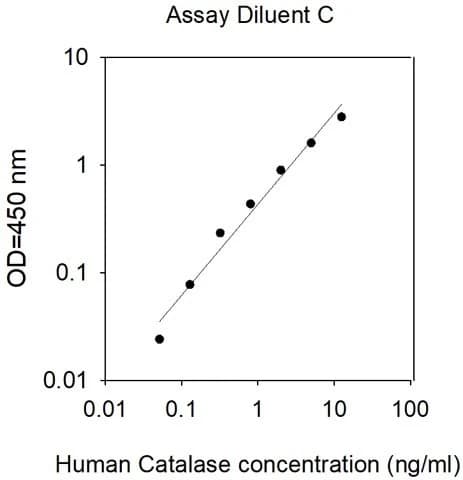
Human Catalase ELISA Kit
As low as $499.00
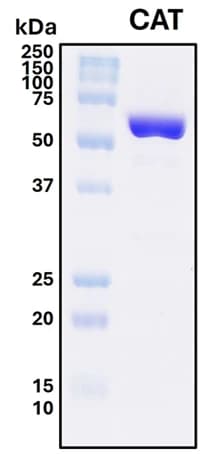
Recombinant Human Catalase (CAT) Protein
As low as $308.00
Introduction
Catalase is a ubiquitous antioxidant enzyme found in both mammalian and non-mammalian aerobic cells with a cytochrome system. Its primary function is to facilitate the decomposition of hydrogen peroxide (H2O2) into water and oxygen. Hydrogen peroxide can be highly detrimental to cells, as its accumulation can cause oxidative damage to crucial cellular components like DNA, proteins, and lipids, ultimately leading to mutagenesis and cell death. Catalase plays a vital role in safeguarding cells against this oxidative damage, and its involvement in oxidative stress-related diseases has been extensively studied.
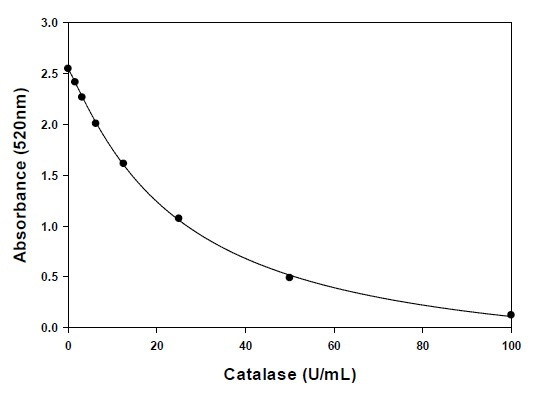
The RayBio® Catalase Activity Assay Kit provides a user-friendly, reproducible, rapid, and highly sensitive method for measuring catalase activity in various biological liquid samples, including plasma, serum, and cell lysates. This assay comprises two sequential reactions. Initially, catalase efficiently breaks down hydrogen peroxide (H2O2) into water and oxygen. Following this, sodium azide is introduced to halt catalase activity. In the subsequent reaction, any residual H2O2 in the mixture participates in a coupling reaction involving a Colorimetric Probe and a Horseradish Peroxidase (HRP) catalyst. The resulting coupling product is then measured at 520nm, allowing for a precise quantification of the remaining hydrogen peroxide in the reaction mixture. This assay effectively evaluates catalase activity.
Kit Components
| Component | Size / Description |
|---|---|
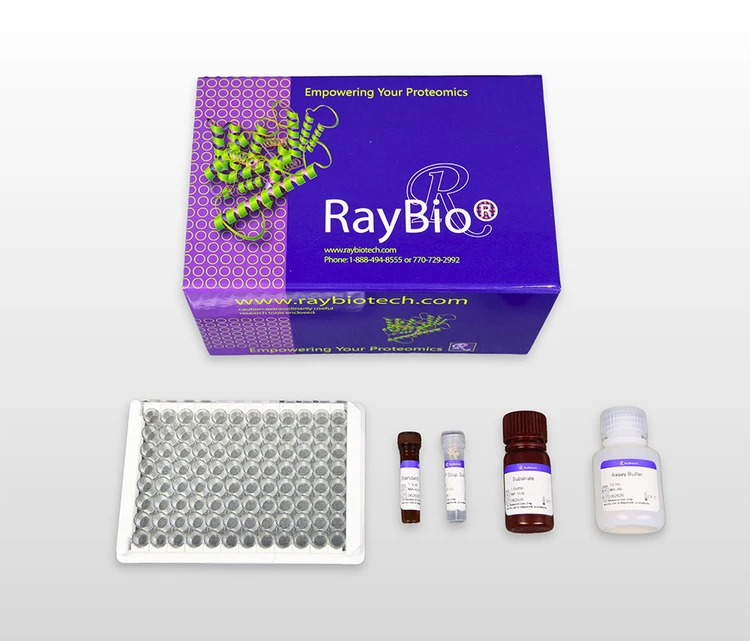
| Microplate | A 96-well (12 strips x 8 wells) plate |
| Sample Buffer | 10 ml |
| Assay Buffer | 25 ml |
| Hydrogen Peroxide | 1 amber vial (100 μl of 8.82M) |
| Catalase Quencher | 10 ml (amber bottle) |
| Catalase Standard | 2 vials (10 μl of 124,000 U/mL) |
| Horseradish Peroxidase Concentrate | 2 amber vials (Lyophilized) |
| Colorimetric Probe | 2 amber vials (Lyophilized) |
Additional Materials Required
- Microplate reader capable of measuring absorbance at 520 nm
- Precision pipettes to deliver 2 µl to 1 ml volumes
- Multi-channel pipettes to deliver 20 μl to 200 μl volumes
- Tubes to prepare sample dilutions
- 50 ml conical tubes
Assay Procedure Summary
Each catalase standard and samples should be assayed in duplicate or triplicate. A freshly prepared standard curve should be used each time the assay is performed.
- Add 20 μL of the diluted Catalase Standards or unknown samples to a 96-well microtiter plate.
- Add 30 μL of the Hydrogen Peroxide Working Solution (1mM) to each well (Use multi-channel pipettes if possible). Mix thoroughly and incubate at room temperature for exactly 1 minute.
- Stop the reaction by adding 50 μL of the Catalase Quencher into each well and mix thoroughly for 5 minutes.
- Add 150 μL of the Chromogenic Working Solution to each well. Incubate the plate at room temperature for 15 minutes gently mixing. Note: Perform this step within 15 minutes after stopping the enzymatic reaction (Step 3).
- Measure the absorbance at 520nm using a plate reader.
citations
SSEA3 and CD105 positivity are associated with the treatment potency of human neural crest-derived nasal turbinate stem cells for Alzheimer's disease
- Year:
- 2026
- Journal Name:
- Translational Neurodegeneration
- PubMed ID:
- 41772709
Prunus africana (Hook. F.) methanol bark extract ameliorates inflammatory activity and oxidative stress in asthmatic Wistar rats with diabetes mellitus
- Species:
- Rat
- Sample Type:
- Serum (STZ-diabetic, citric acid asthma rats)
- Year:
- 2026
- Journal Name:
- F1000Research
Repositioning Perindopril for Mitigation of Methotrexate-Induced Hepatotoxicity in Rats
- Species:
- Rat
- Sample Type:
- Cell Culture Supernatant (hepatic tissue homogenate supernatant)
- Year:
- 2025
- Journal Name:
- Pharmaceuticals
- PubMed ID:
- 40143135
Alabi, O.A., Afelumo, O.M., Oladipupo, F.O. et al. Safety assessment of three common food additives: the reproductive, oxidative and enzymatic perspective. Discov Toxicol 1, 8 (2024).
- Year:
- 2024
- Journal Name:
- Discover Toxicology
Assessment of dietary spirulina supplementation on growth performance, nutrient digestibility, and intestinal health in lipopolysaccharide-challenged weanling pigs
- Species:
- Porcine
- Sample Type:
- Serum (LPS-challenged weanling pigs)
- Year:
- 2025
- Journal Name:
- Journal of Animal Science
- PubMed ID:
- 41014498
SARS-CoV-2 infections elicit higher levels of original antigenic sin antibodies compared with SARS-CoV-2 mRNA vaccinations
- Year:
- 2022
- Journal Name:
- Cell Rep
- PubMed ID:
- 36261003