


RayBio® Human/Mouse/Rat Cholecystokinin EIA Kit optimized for serum and cell culture medium.. Competition-based ELISA on a 96-well strip plate.
Best Seller
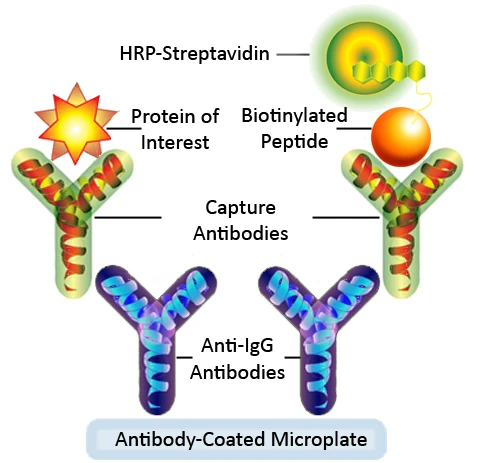

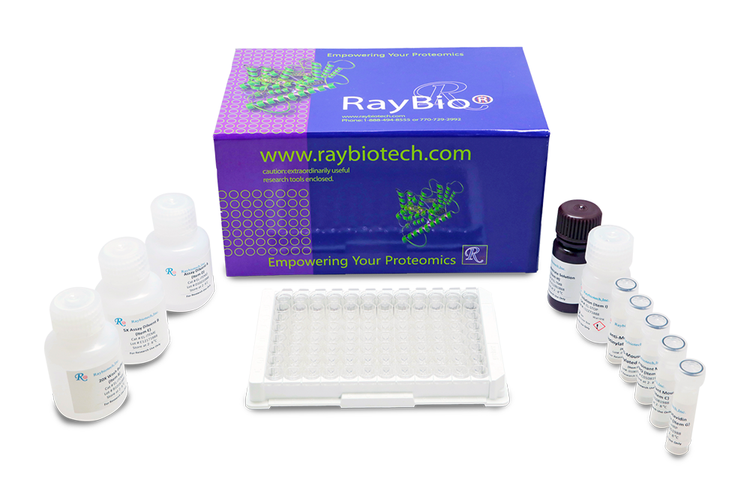
CCK ELISA Kit
CCK ELISA Kit
Contact Us for Bulk Request
Product Description
Specifications
| Size | 1 Plate Kit, 2 Plate Kit, 5 Plate Kit |
| Species | Human, Mouse, Rat |
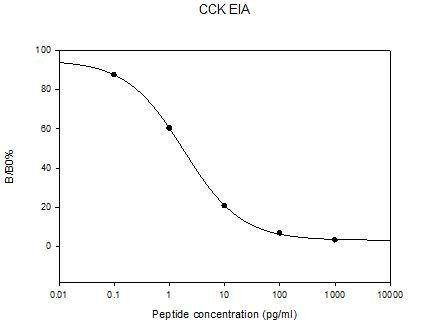
| Sensitivity | 0.2 pg/ml |
| Detection Range | 0.1-1,000 pg/ml |
| Specificity | Cross Reactivity: This EIA kit shows no cross-reactivity with any of the cytokines tested: Ghrelin, Nesfatin, NPY and APC. |
| Compatible Sample Types | Plasma, Serum |
| Recommended Dilution (Serum/Plasma) | Human: 4X / Mouse: 4X / Rat: 2X |
| Accession Number | P06307 |
| Gene Id | 885 |
| Gene Symbols | CCK |
| Protein Name / Synonyms | Cholecystokinin (CCK) [Cleaved into: Cholecystokinin-58 (CCK58) Cholecystokinin-58 desnonopeptide ((1-49)-CCK58) Cholecystokinin-39 (CCK39) Cholecystokinin-33 (CCK33) Cholecystokinin-25 (CCK25) Cholecystokinin-18 (CCK18) Cholecystokinin-12 (CCK12) Cholecystokinin-8 (CCK8) Cholecystokinin-7 (CCK7) Cholecystokinin-5 (CCK5)] |
| Quantitative/Semi-Quantitative | Quantitative |
| Solid Support | 96-well Microplate |
| Design Principle | Competition-based |
| Method Of Detection | Colorimetric |
| Research Area | Obesity & Metabolic Disease |
| Shipping Type | Blue ice |
| Storage | -20°C |
Related Products
Anti-CCK (aa 94-106) Antibody
As low as $41.60
Introduction
Cholecystokinin (CCK) is a peptide hormone of the gastrointestinal system responsible for stimulating the digestion of fat and protein. It is synthesized by I-cells in the mucosal epithelium of the small intestine and secreted in the duodenum, and causes the release of digestive enzymes from the pancreas and bile from the gallbladder.
CCK is a family of hormones identified by number of amino acids depending on post-translational modification of preprocholecystokinin, including CCK58, CCK33 and CCK8. CCK is very similar in structure to another peptide hormone gastrin. They share five identical amino acids at their C-termini.
CCK mediates a number of physiological processes, including digestion and satiety. Secretion of CCK by the duodenal and intestinal mucosa is stimulated by fat- or protein-rich chyme entering the duodenum. It then inhibits gastric emptying and gastric acid secretion and mediates digestion in the duodenum. It stimulates the acinar cells of the pancreas to release water and ions and stimulates the secretion of a juice rich in pancreatic digestive enzymes, hence the old name pancreozymin. Together these enzymes catalyze the digestion of fat, protein, and carbohydrates. Thus, as the levels of the substances that stimulated the release of CCK drop, the concentration of the hormone drops as well. The release of CCK is also inhibited by somatostatin.
CCK also causes the increased production of hepatic bile, and stimulates the contraction of the gall bladder and the relaxation of the Sphincter of Oddi (Glisson's sphincter), resulting in the delivery of bile into the duodenal part of the small intestine. Bile salts form amphipathic micelles that emulsify fats, aiding in their digestion and absorption.
CCK is a family of hormones identified by number of amino acids depending on post-translational modification of preprocholecystokinin, including CCK58, CCK33 and CCK8. CCK is very similar in structure to another peptide hormone gastrin. They share five identical amino acids at their C-termini.
CCK mediates a number of physiological processes, including digestion and satiety. Secretion of CCK by the duodenal and intestinal mucosa is stimulated by fat- or protein-rich chyme entering the duodenum. It then inhibits gastric emptying and gastric acid secretion and mediates digestion in the duodenum. It stimulates the acinar cells of the pancreas to release water and ions and stimulates the secretion of a juice rich in pancreatic digestive enzymes, hence the old name pancreozymin. Together these enzymes catalyze the digestion of fat, protein, and carbohydrates. Thus, as the levels of the substances that stimulated the release of CCK drop, the concentration of the hormone drops as well. The release of CCK is also inhibited by somatostatin.
CCK also causes the increased production of hepatic bile, and stimulates the contraction of the gall bladder and the relaxation of the Sphincter of Oddi (Glisson's sphincter), resulting in the delivery of bile into the duodenal part of the small intestine. Bile salts form amphipathic micelles that emulsify fats, aiding in their digestion and absorption.
Product Features
- Strip plates and additional reagents allow for use in multiple experiments
- Quantitative protein detection
- Establishes normal range
- The best products for confirmation of antibody array data
Application Notes
Kit Components
- Pre-Coated 96-well Strip Microplate
- Wash Buffer
- Standard Peptide
- Assay Diluent(s)
- Biotinylated Peptide
- HRP-Streptavidin
- TMB One-Step Substrate
- Stop Solution
- Assay Diagram
- Positive Control Sample
- Capture Antibody
- User Manual
Other Materials Required
- Distilled or deionized water
- Precision pipettes to deliver 2 µl to 1 ml volumes
- Adjustable 1-25 ml pipettes for reagent preparation
- 100 ml and 1 liter graduated cylinders
- Tubes to prepare standard and sample dilutions
- Orbital shaker
- Aluminum foil
- Saran Wrap
- Absorbent paper
- Microplate reader capable of measuring absorbance at 450nm
- SigmaPlot software (or other software that can perform four-parameter logistic regression models)
Protocol Outline
Storage/Stability
Standard, Biotinylated CCK peptide, and Positive Control should be stored at -20°C after arrival. Avoid multiple freeze-thaws. The remaining kit components may be stored at 4°C. Opened Microplate Wells and antibody (Item N) may be stored for up to 1 month at 2° to 8°C. Return unused wells to the pouch containing desiccant pack and reseal along entire edge.
citations
CCK2R regulates METH-induced CPP acquisition within VTA-BLA-BNST circuit in male mice
- Species:
- Mouse
- Sample Type:
- Cell Culture Supernatant (supernatant aCSF from BLA-containing brain slices)
- Year:
- 2026
- Journal Name:
- Translational Psychiatry
- PubMed ID:
- 41888094
A food-sensitive olfactory circuit drives anticipatory satiety
- Species:
- Mouse
- Sample Type:
- Cell Culture Supernatant (blood clotted, supernatant)
- Year:
- 2025
- Journal Name:
- Nature Metabolism
- PubMed ID:
- 40500386
Effect of sweeteners and sweetness enhancers on weight management and gut microbiota composition in individuals with overweight or obesity: the SWEET study
- Species:
- Human
- Sample Type:
- Plasma (plasma EDTA)
- Year:
- 2025
- Journal Name:
- Nature Metabolism
- PubMed ID:
- 41057614
Fat sensory cues in early life program central response to food and obesity
- Species:
- Mouse
- Sample Type:
- Serum (dams and refed female mice)
- Year:
- 2025
- Journal Name:
- Nature Metabolism
- PubMed ID:
- 41326798
Cholecystokinin ameliorates cognitive impairment via inhibiting microglia phagocytosis of excitatory synapses in sepsis-associated encephalopathy mice
- Species:
- Mouse
- Sample Type:
- Other / Unspecified (mouse hippocampus)
- Year:
- 2025
- Journal Name:
- Journal of Neuroinflammation
- PubMed ID:
- 41024113
The impact of obesity on appetite regulation during nutritional ketosis
- Species:
- Human
- Sample Type:
- Serum (postprandial serum)
- Year:
- 2026
- Journal Name:
- Scientific Reports
Sodium oligomannate activates the enteroendocrine-vagal afferent pathways in APP/PS1 mice
- Year:
- 2024
- Journal Name:
- Acta Pharmacologica Sinica
- PubMed ID:
- 38702501
Reduced liver mitochondrial energy metabolism impairs food intake regulation following gastric preloads and fasting
- Species:
- Mouse
- Sample Type:
- Plasma (90 min after oral ensure gavage)
- Year:
- 2025
- Journal Name:
- Molecular Metabolism
- PubMed ID:
- 40368160
Cholecystokinin inhibits myotube fusion and may contribute to sarcopenia: Evidence from clinical and C2C12 myoblast studies
- Species:
- Human
- Sample Type:
- Serum
- Year:
- 2026
- Journal Name:
- Journal of the Chinese Medical Association : JCMA
- PubMed ID:
- 41430742
Enteric capsuled protein reduced food intake and inhibited high-fat diet-induced weight gain in mice
- Species:
- Mouse
- Sample Type:
- Whole Blood (peripheral blood enteric hormone levels)
- Year:
- 2025
- Journal Name:
- Endocrine journal
- PubMed ID:
- 40603112
