

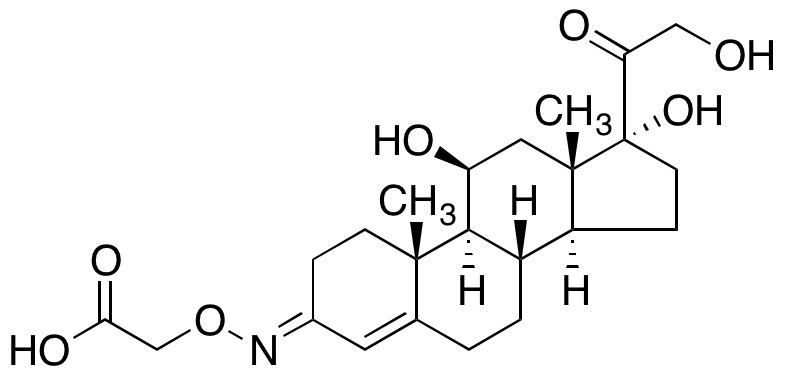
Cortisol 3-CMO (Hydrocortisone 3-CMO) [43188-86-9]

Cat# H9010-25mg
Size : 25mg
Marca : US Biological
H9010 Cortisol 3-CMO (Hydrocortisone 3-CMO)
Grade
Molecular Biology GradeShipping Temp
RTStorage Temp
-20°CHydrocortisone 3-(O-Carboxymethyl)oxime as a model steroid, coupled with bovine serum albumin (F-3-O-CMO-BSA) was used as immunogen to raise the antiserum in New Zealand white rabbits;
Also, it is derived from Hydrocortisone, which is a topical corticosteroid (1), more specifically a glucocorticoid, produced by the zona fasciculata of the adrenal gland (2). Cortisol is released in response to stress and a low level of blood glucocorticoids. Its primary functions are to increase blood sugar through gluconeogenesis (3); suppress the immune system; and aid in fat, protein and carbohydrate metabolism.
Synonyms:
2-[[[(11β)-11,17,21-Trihydroxy-20-oxopregn-4-en-3-ylidene]amino]oxy]acetic Acid; Cortisol 3-(O-Carboxymethyl)oxime; Cortisol 3-(Carboxymethyloxime); [[[(11β)-11,17,21-Trihydroxy-20-oxopregn-4-en-3-ylidene]amino]oxy]acetic Acid
CAS No:
43188-86-9
Molecular Formula:
C₂₃H₃₃NO₇
Molecular Weight:
435.51
Purity:
≥98% by TLC
Appearance:
Supplied as small white needles
Solubility:
Soluble in most organic solvents. Insoluble in water.
Specific Rotation:
+179° (Methanol)
Melting Point:
205.7-215.3°
TLC Conditions:
Dichloromethane: Absolute Methanol: Acetic Acid 22:2:1: Visualized with UV and p/TSA iodine; Single Spot: Rf=0.38, 0.30.
Mixture of Isomers E & Z:
50/50
Storage and Stability:
May be stored at RT for short-term only. Long-term storage is recommended at -20°C. For maximum recovery of product, centrifuge the original vial prior to removing the cap.
Note:
Hydrocortisone-3-CMO is not classified as an anabolic steroid.