

KU-55933 [587871-26-9]

Cat# M1801-50mg
Size : 50mg
Marca : AbMole Bioscience
All AbMole products are for research use only, cannot be used for human consumption.
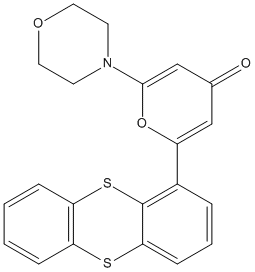
KU55933
Quality Control & Documentation
Biological Activity
KU-55933 is a cell-permeable, potent, selective and ATP-competitive inhibitor of ATM (Ataxia telangiectasia mutated), a serine/threonine protein kinase, that exhibits an IC50 of 13 nmol/L and a Ki of 2.2 nmol/L. KU-55933 shows specificity with respect to inhibition of other phosphatidylinositol 3'-kinase-like kinases. Cellular inhibition of ATM by KU-55933 was demonstrated by the ablation of ionizing radiation-dependent phosphorylation of a range of ATM targets, including p53, gammaH2AX, NBS1, and SMC1. KU-55933 did not show inhibition of UV light DNA damage induced cellular phosphorylation events. Exposure of cells to KU-55933 resulted in a significant sensitization to the cytotoxic effects of ionizing radiation and to the DNA double-strand break-inducing chemotherapeutic agents, etoposide, doxorubicin, and camptothecin. Inhibition of ATM by KU-55933 also caused a loss of ionizing radiation-induced cell cycle arrest. By contrast, KU-55933 did not potentiate the cytotoxic effects of ionizing radiation on ataxia-telangiectasia cells, nor did it affect their cell cycle profile after DNA damage. We conclude that KU-55933 is a novel, specific, and potent inhibitor of the ATM kinase.
Product Citations
-

Cellular Signalling. 2024 Jul 26.
Early inhibition of the ATM/p53 pathway reduces the susceptibility to atrial fibrillation and atrial remodeling following acute myocardial infarction
KU-55933 purchased from AbMole
Customer Product Validations & Biological Datas
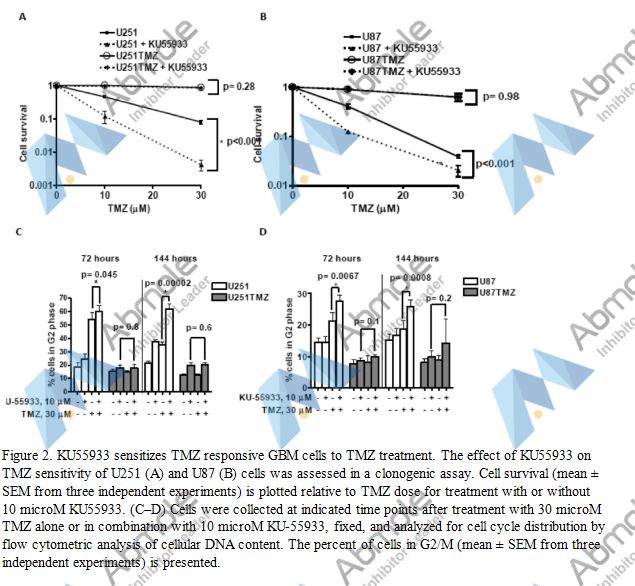 | Source | J Neurooncol (2012). Figure 2. KU-55933 |
| Method | clonogenic assay | |
| Cell Lines | U251 and U87 malignant glioma cell lines | |
| Concentrations | 10 microM | |
| Incubation Time | 24 hours or 72 hours | |
| Results | U87 cells also were sensitized by KU-55933 treatment, although the extent of sensitization was less profound |
Protocol (for reference only)
| Cell Experiment | |
|---|---|
| Cell lines | LU1205 and WM35 cells |
| Preparation method | Apoptosis studies. Cells were exposed to soluble TRAIL (50 ng/mL) alone or in combination with cycloheximide (2 μg/mL). Different variants of combined treatment were used, including γ-irradiation (5 Gy), in the presence or absence of specific inhibitors of signaling pathways followed by TRAIL treatment. Apoptosis was then assessed by quantifying the percentage of hypodiploid nuclei using fluorescence-activated cell sorting analysis. |
| Concentrations | 10 μM |
| Incubation time | 48 h |
| Animal Experiment | |
|---|---|
| Animal models | LU1205 cells Human melanoma transplant in nude mice. |
| Formulation | DMSO |
| Dosages | 10 μM |
| Administration | |
Chemical Information
| Molecular Weight | 395.49 |
| Formula | C21H17NO3S2 |
| CAS Number | 587871-26-9 |
| Solubility (25°C) | DMSO 39 mg/mL |
| Storage | Powder -20°C 3 years ; 4°C 2 years In solvent -80°C 6 months ; -20°C 1 month |
References
[1] Ivanov VN, et al. Cancer Res. Inhibition of ataxia telangiectasia mutated kinase activity enhances TRAIL-mediated apoptosis in human melanoma cells.