

Panobinostat [404950-80-7]

Cat# T2383-50mg
Size : 50mg
Marca : TargetMol
Panobinostat
(Synonyms: NVP-LBH589, LBH589) Copy Product Info

Panobinostat (NVP-LBH589) is a broad-spectrum HDAC inhibitor (IC50=5 nM) with oral activity and non-selectivity. Panobinostat has antitumor activity and induces apoptosis and autophagy.
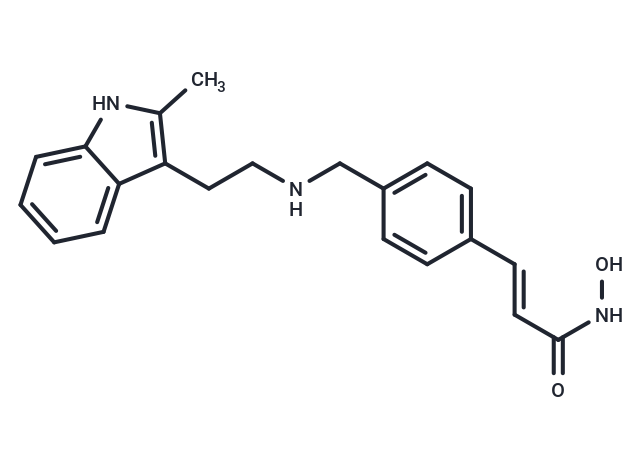
Cas No. 404950-80-7
For research use only—not for human use. No sales to individuals. Use as intended only.
Select Batch
Purity:99.81%
Color:White to Yellow
COA HNMR LCMS
Product Information
Bioactivity
Chemical Properties
Storage & Solubility Information
| Description | Panobinostat (NVP-LBH589) is a broad-spectrum HDAC inhibitor (IC50=5 nM) with oral activity and non-selectivity. Panobinostat has antitumor activity and induces apoptosis and autophagy. |
| Targets & IC50 | HDAC1-9:3-61 nM, HDAC (Reh cells):20 nM, HDAC8:248 nM, HDAC (MOLT-4 cells):5 nM |
| In vitro | Method: Thirty-seven lung cancer cell lines were treated with Panobinostat (0-800 nmol/L) for 48-72 h, and cell viability was measured using the MTT. Result: Panobinostat showed potent antiproliferative activity and cytotoxicity against human and mouse lung cancer cell lines. [1] Method: Human ALL cells MOLT-4 and Reh were treated with Panobinostat (10-100 nM) for 24-72 h. Apoptosis was detected by Flow Cytometry. Result: Panobinostat induced apoptosis in MOLT-4 and Reh cells in a time- and dose-dependent manner. [2] |
| In vivo | Method: To detect anti-tumor activity in vivo, Panobinostat (20 mg/kg) was intraperitoneally injected five times per week for two weeks into SCID mice bearing human SCLC tumors H526, BKT, RG1, or H69. Result: Panobinostat significantly slowed down the in vivo growth of tumors derived from SCLC cells and induced remission. [1] Method: To investigate the potential for enhanced recovery of motor function after stroke, Panobinostat (3-10 mg/kg) was administered intraperitoneally to CD-1 mice with stroke every two days for ten days. Result: Neither physical exercise nor the combination of Panobinostat substantially affected motor recovery in mice after stroke.Panobinostat treatment coupled with limited physical rehabilitation is unlikely to provide a therapeutic modality for stroke survivors with motor dysfunction. [3] |
| Synonyms | NVP-LBH589, LBH589 |
| Cell Research | Blasts from peripheral blood of 2 patients and from bone marrow of 4 patients were isolated with Ficoll-Hypaque, put in culture at a density of 500?000 cells/mL with RPMI-1640 medium containing 10% fetal bovine serum and 50 units/mL penicillin and streptomycin, and treated with different doses of LBH589 (0-100 μM) for up to 48 hours [1]. |
| Animal Research | AE17 and TC-1 cancer cells (1 × 10^6 cells) were injected into the flanks of adult female C57Bl/6 mice and severe combined immunodeficiency (SCID) mice. M30 (10 × 10^6 cells), A549 (5 × 10^6 cells), H69 (2.5 × 10^6 cells), BK-T (6.5 × 10^6), H526 (10 × 10^6), and RG1 (10 × 10^6) cells were also injected, but in the presence of matrigel (BD Biosciences), into the flanks of SCID mice. There were 5 to 10 mice in each treatment group. The experiments with the A549 and H69 cell lines were repeated to ensure the statistical consistency of the results. Experiments were terminated when the tumors in the control mice had grown to a size that threatened the quality of life of the mice. When tumors reached 100 to 500 mm3, panobinostat was administered via i.p. injections (10–20 mg/kg) on a daily schedule (5-days-on, 2-days-off regimen) for the entire duration of the experiment. Control mice received i.p. injections with dextrose 5% in water ("vehicle treatment"). Every tumor was measured with a caliper at least twice weekly. For evaluation of the effects of combination therapy on SCLC-derived tumors, SCID mice with H69 tumors were administered panobinostat as described above. Three days after the initiation of panobinostat, and again 1 wk later, etoposide (40 mg/kg) was administered i.p [3]. |
| Molecular Weight | 349.4262 |
| Formula | C21H23N3O2 |
| Cas No. | 404950-80-7 |
| Smiles | CC1=C(CCNCC2=CC=C(\C=C\C(=O)NO)C=C2)C2=CC=CC=C2N1 |
| Relative Density. | 1.241 g/cm3 (Predicted) |
| Storage | Pure form: -20°C for 3 years | In solvent: -80°C for 1 year Shipping with blue ice/Shipping at ambient temperature. | |||||||||||||||||||||||||||||||||||
| Solubility Information | H2O: < 1 mg/mL (insoluble or slightly soluble) Ethanol: < 1 mg/mL (insoluble or slightly soluble) DMSO: 247.50 mg/mL (708.30 mM), Sonication is recommended.  | |||||||||||||||||||||||||||||||||||
| In Vivo Formulation | 10% DMSO+40% PEG300+5% Tween 80+45% Saline: 6.40 mg/mL (18.32 mM), Solution. Please add the solvents sequentially, clarifying the solution as much as possible before adding the next one. Dissolve by heating and/or sonication if necessary. Working solution is recommended to be prepared and used immediately. The formulation provided above is for reference purposes only. In vivo formulations may vary and should be modified based on specific experimental conditions. | |||||||||||||||||||||||||||||||||||
Solution Preparation Table | ||||||||||||||||||||||||||||||||||||
DMSO
Note : The dilution table applies only to solid products. For liquid products, please calculate the stock solution based on the stated concentration and/or density. | ||||||||||||||||||||||||||||||||||||