

Ponatinib [943319-70-8]

Cat# T2372-10mg
Size : 10mg
Marca : TargetMol
Ponatinib
(Synonyms: AP24534) Copy Product Info

Ponatinib (AP24534) is an orally available, multitargeted kinase inhibitor with IC50 values of 0.37 nM (Abl), 1.1 nM (PDGFRα), 1.5 nM (VEGFR2), 2.2 nM (FGFR1), and 5.4 nM (Src).
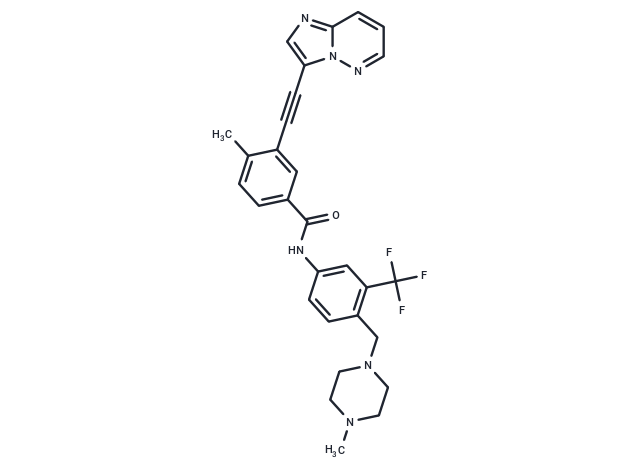
Cas No. 943319-70-8
With extensive experience in compound synthesis, we can provide rapid custom synthesis services for this product according to your research needs.
For research use only—not for human use. No sales to individuals. Use as intended only.
Select Batch
Purity:99.60%
Color:White to Yellow
COA HNMR LCMS
Product Information
Bioactivity
Chemical Properties
Storage & Solubility Information
| Description | Ponatinib (AP24534) is an orally available, multitargeted kinase inhibitor with IC50 values of 0.37 nM (Abl), 1.1 nM (PDGFRα), 1.5 nM (VEGFR2), 2.2 nM (FGFR1), and 5.4 nM (Src). |
| Targets & IC50 | VEGFR2:1.5 nM (cell free), Lyn:0.24 nM (cell free), Abl:0.37 nM (cell free), c-Kit:12.5 nM, PDGFRα:1.1 nM (cell free), c-Src:5.4 nM (cell free), FGFR1:2.2 nM (cell free) |
| In vitro | Ponatinib (AP24534) potently inhibited native ABL (IC50: 0.37 nM), ABL T315I (IC50: 2.0 nM), and other clinically important ABL kinase domain mutants (IC50: 0.30–0.44 nM). AP24534 also inhibited SRC (IC50: 5.4 nM) and members of the VEGFR, FGFR, and PDGFR families of receptor tyrosine kinases. AP24534 did not inhibit Aurora kinase family members, nor did it inhibit the insulin receptor or CDK2/Cyclin E. AP24534 potently inhibited proliferation of Ba/F3 cells expressing native BCR-ABL (IC50: 0.5 nM). All BCR-ABL mutants tested remained sensitive to AP24534 (IC50: 0.5–36 nM) including BCR-ABLT315I (IC50: 11 nM) [1]. Treatment with ponatinib efficiently inhibited the growth of CMPs expressing Hes1 with F/P, F/P-T674I, or F/P-D842V with an IC50 of 0.15 nM, 0.35 nM, or 1.71 nM, respectively. In accordance, ponatinib dose-dependently suppressed the activation of F/P and its downstream STAT5 and ERK in these cytokine-independent cells [2]. Ponatinib potently inhibits receptor phosphorylation and cellular proliferation with IC50 values comparable to those required for inhibition of BCR-ABL (0.3 to 20 nmol/L) [3]. |
| In vivo | Daily oral treatment with 2.5 or 5 mg/kg AP24534 for 19 days prolonged median survival to 27.5 and 30 days, respectively. In a xenograft model of Ba/F3 BCR-ABLT315I cells, tumor growth was inhibited by AP24534 in a dose-dependent manner compared to vehicle-treated mice, with significant suppression of tumor growth upon daily oral dosing at 10 and 30 mg/kg. Daily oral dosing of 50 mg/kg AP24534 caused significant tumor regression, with a 96% reduction in mean tumor volume at the final measurement compared to the start of treatment [1]. Ponatinib (1–25 mg/kg, p.o.) was administered orally, once daily for 28 days, to mice bearing MV4-11 xenografts. ponatinib potently inhibited tumor growth in a dose-dependent manner. Administration of 1 mg/kg led to significant inhibition of tumor growth (TGI = 46%) and doses of 2.5 mg/kg or greater resulted in tumor regression. Dosing with 10 or 25 mg/kg led to complete and durable tumor regression [3]. |
| Synonyms | AP24534 |
| Kinase Assay | AP24534 was profiled against >100 kinases by Reaction Biology Corporation using the Kinase Hotspot assay, which utilizes 10 μM [33P]-ATP, recombinant kinase domain, peptide substrate, and a range of 10 concentrations of inhibitor to establish an IC50 value [1]. |
| Cell Research | Ba/F3 cell lines were distributed in 96-well plates (4 × 10^3 cells/well) and incubated with escalating concentrations of AP24534 for 72 hr. The inhibitor ranges used were: 0–625 nM for cells expressing BCR-ABL and 0–10,000 nM for BCR-ABL negative cells. Proliferation was measured using an MTS-based viability assay. IC50 values are reported as the mean of three independent experiments performed in quadruplicate. For cell proliferation experiments with CML or normal primary cells, mononuclear cells were plated in 96-well plates (5 × 10^4 cells/well) over graded concentrations of AP24534 (0–1000 nM) in RPMI supplemented with 10% FBS, L-glutamine, penicillin/streptomycin, and 100 μM β-mercaptoethanol. Following a 72 hr incubation, cell viability was assessed by subjecting cells to an MTS assay. All values were normalized to the control wells with no drug [1]. |
| Animal Research | Briefly, tumor xenografts were established by the subcutaneous implantation of MV4-11 cells (1 × 10^7 in 50% Matrigel) into the right flank of female CB.17 severe combined immunodeficient mice and dosing was initiated when the average tumor volume reached approximately 200 mm^3. Ponatinib was formulated in aqueous 25 mmol/L citrate buffer (pH = 2.75) and mice were dosed orally once daily for 4 weeks. The tumors were measured in 2 dimensions (length and width) with a caliper in millimeters. Tumor volume (mm3) was calculated with the following formula: tumor volume = (length × width^2)/2. Tumor growth inhibition (TGI) was calculated as follows: TGI = (1 ? ΔT/ΔC) × 100, where ΔT stands for mean tumor volume change of each treatment group and ΔC for mean tumor volume change of control group. The tumor volume data were collected and analyzed with a 1-way ANOVA test to determine the overall difference among groups. Each ponatinib treatment group was further compared to the vehicle control group for statistical significance using Dunnett's Multiple Comparison Test. A P-value less than 0.05 was considered to be statistically significant and a P-value less than 0.01 to be highly statistically significant [3]. |
| Molecular Weight | 532.56 |
| Formula | C29H27F3N6O |
| Cas No. | 943319-70-8 |
| Smiles | C(#CC1=CC(C(NC2=CC(C(F)(F)F)=C(CN3CCN(C)CC3)C=C2)=O)=CC=C1C)C=4N5C(=NC4)C=CC=N5 |
| Relative Density. | 1.292 g/cm3 |
| Storage | Powder: -20°C for 3 years | In solvent: -80°C for 1 year Shipping with blue ice/Shipping at ambient temperature. | |||||||||||||||||||||||||
| Solubility Information | Ethanol: 26.6 mg/mL (49.95 mM), Sonication is recommended. DMSO: 25 mg/mL (46.94 mM), Sonication and heating are recommended.  H2O: < 1 mg/mL (insoluble) | |||||||||||||||||||||||||
| In Vivo Formulation | 10% DMSO+40% PEG300+5% Tween 80+45% Saline: 5.33 mg/mL (10.01 mM), Suspension. Please add the solvents sequentially, clarifying the solution as much as possible before adding the next one. Dissolve by heating and/or sonication if necessary. Working solution is recommended to be prepared and used immediately. The formulation provided above is for reference purposes only. In vivo formulations may vary and should be modified based on specific experimental conditions. | |||||||||||||||||||||||||
Solution Preparation Table | ||||||||||||||||||||||||||
DMSO/Ethanol
Note : The dilution table applies only to solid products. For liquid products, please calculate the stock solution based on the stated concentration and/or density. | ||||||||||||||||||||||||||