
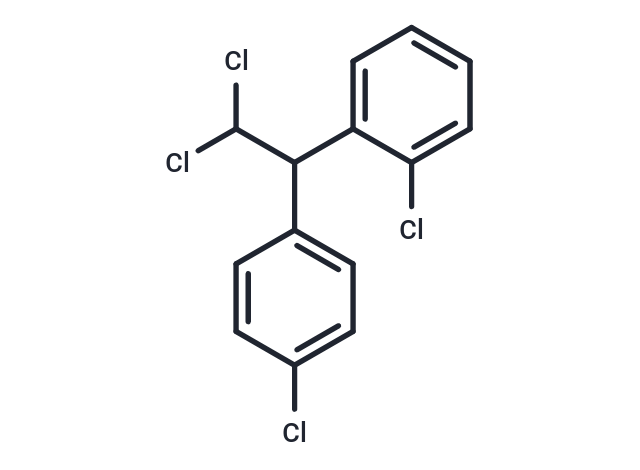
Mitotane [53-19-0]
Cat# T1199-50mg
Size : 50mg
Marca : TargetMol
Mitotane
(Synonyms: o,p'-DDD, NCI-C04933, Mitotan, 2,4′-DDD) Copy Product InfoMitotane (NCI-C04933) is a derivative of the insecticide DICHLORODIPHENYLDICHLOROETHANE that specifically inhibits cells of the adrenal cortex and their production of hormones. It is used to treat adrenocortical tumors and causes CNS damage, but no bone marrow depression.
Select Batch
Purity:99.96%
Appearance:Solid
Color:White
COA HNMR HPLC
Product Introduction
Mitotane AI Summary
Mitotane displays a high octanol-water partition coefficient with a log P value of 6.0, indicating significant lipophilicity and likely high membrane permeability. The compound exhibits a diverse range of bioactivities, presenting potency in numerous assays targeting various biological pathways. These include modulation of Lamin A splicing, JMJD2E inhibition, hypoxia response induction, mitochondrial division and fusion modulation, thyroid stimulating hormone receptor activation, TDP1 inhibition, mitochondrial channel activity inhibition, retinoid X receptor alpha signaling activation, inhibition of DNA re-replication, and inhibition of tumor cell line growth, indicating extensive pharmacological potential. It also binds to and modulates several receptors and transporters, including adenosine A3, alpha-2A adrenergic, and various serotonin receptors and transporters, with moderate to high affinity (IC50/Ki values in the nM range). Despite this extensive bioactivity, Mitotane shows no induction of drug-induced liver injury, as indicated by a DILIps prediction score of 0.0 for various hepatic conditions, though some reports suggest moderate liver toxicity. Further, it shows inhibitory activity against human BSEP and OATP1B1 and OATP1B3 transfected CHO cells. Its hepatobiliary transporter interactions suggest significant effects on bile acid and drug transport. Additionally, it has demonstrated antiviral activity against SARS-CoV-2, albeit with variable efficacy. The compound is an inhibitor of human HDAC6, showing mild inhibition in enzymatic assays. It also induces CYP3A4, significantly reducing midazolam AUC by 94%, which highlights its role in drug metabolism. In receptor binding assays, it displays affinity towards multiple receptors (e.g., NR3C1, CNR1, AR, NR1I2, PGR), suggesting agonist or antagonist activity depending on the context. Collectively, Mitotane stands out due to its wide spectrum of bioactivity, high lipophilicity, selective receptor interactions, antiviral potential, and specific enzymatic inhibition, with varied implications for pharmacological development and therapeutic application..
Note: Summary generated by AI. Data source: ChEMBL 
Bioactivity
Chemical Properties
Storage & Solubility Information
| Description | Mitotane (NCI-C04933) is a derivative of the insecticide DICHLORODIPHENYLDICHLOROETHANE that specifically inhibits cells of the adrenal cortex and their production of hormones. It is used to treat adrenocortical tumors and causes CNS damage, but no bone marrow depression. |
| In vitro | 10-40 μM Mitotane inhibited basal and cAMP-induced cortisol secretion but did not cause cell death.Mitotane inhibited basal expression of StAR and P450scc proteins.40 μM Mitotane significantly reduced mRNA expression of StAR, CYP11A1 and CYP21.In H295R cells, the mRNA expression of StAR, CYP11A1 and CYP21 was significantly reduced by Mitotane. In H295R cells, Mitotane in combination with gemcitabine showed antagonistic effects and interfered with gemcitabine-mediated S-phase inhibition of the cell cycle.Mitotane inhibited the expression and secretion of thyroid stimulating hormone (TSH), blocked TSH response to thyrotropin-releasing hormone (THRH), decreased cell viability, and induced apoptosis in the mouse TalphaT1 cell line.Mitotane inhibited the expression and secretion of pituitary thyrotropin secretory hormone (PTHS) and induced apoptosis in the pituitary thyrotropin secretory hormone (PSH) cells. Mitotane induced adrenocortical necrosis, mitochondrial membrane damage, and irreversible binding of the protein CYP in pituitary thyrotropin-secreting mouse cells, without interfering with thyroid hormones, and directly reduced secretory activity and cell viability. |
| In vivo | 10-40 μM Mitotane inhibited basal and cAMP-induced cortisol secretion but did not cause cell death.Mitotane inhibited basal expression of StAR and P450scc proteins.40 μM Mitotane significantly reduced mRNA expression of StAR, CYP11A1 and CYP21.In H295R cells, the mRNA expression of StAR, CYP11A1 and CYP21 was significantly reduced by Mitotane. In H295R cells, Mitotane in combination with gemcitabine showed antagonistic effects and interfered with gemcitabine-mediated S-phase inhibition of the cell cycle.Mitotane inhibited the expression and secretion of thyroid stimulating hormone (TSH), blocked TSH response to thyrotropin-releasing hormone (THRH), decreased cell viability, and induced apoptosis in the mouse TalphaT1 cell line.Mitotane inhibited the expression and secretion of pituitary thyrotropin secretory hormone (PTHS) and induced apoptosis in the pituitary thyrotropin secretory hormone (PSH) cells. Mitotane induced adrenocortical necrosis, mitochondrial membrane damage, and irreversible binding of the protein CYP in pituitary thyrotropin-secreting mouse cells, without interfering with thyroid hormones, and directly reduced secretory activity and cell viability. |
| Synonyms | o,p'-DDD, NCI-C04933, Mitotan, 2,4′-DDD |
| Molecular Weight | 320.04 |
| Formula | C14H10Cl4 |
| Cas No. | 53-19-0 |
| Smiles | ClC(Cl)C(c1ccc(Cl)cc1)c1ccccc1Cl |
| Relative Density. | 1.372 g/cm3 |
| Storage | Store under nitrogen Powder: -20°C for 3 years | In solvent: -80°C for 1 year Shipping with blue ice/Shipping at ambient temperature. | |||||||||||||||||||||||||||||||||||
| Solubility Information | H2O: < 1 mg/mL (insoluble or slightly soluble) DMSO: 250 mg/mL (781.15 mM), Sonication is recommended. ![]() Ethanol: 60 mg/mL (187.48 mM), Sonication is recommended. | |||||||||||||||||||||||||||||||||||
| In Vivo Formulation | 10% DMSO+90% Saline: 10 mg/mL (31.25 mM), Suspension. ![]() 10% DMSO+40% PEG300+5% Tween 80+45% Saline: 2 mg/mL (6.25 mM), Sonication is recommended. Please add the solvents sequentially, clarifying the solution as much as possible before adding the next one. Dissolve by heating and/or sonication if necessary. Working solution is recommended to be prepared and used immediately. The formulation provided above is for reference purposes only. In vivo formulations may vary and should be modified based on specific experimental conditions. | |||||||||||||||||||||||||||||||||||
Solution Preparation Table | ||||||||||||||||||||||||||||||||||||
Ethanol/DMSO
Note : The dilution table applies only to solid products. For liquid products, please calculate the stock solution based on the stated concentration and/or density. | ||||||||||||||||||||||||||||||||||||


