
Cd3e Antibody

Cat# OAEE00792
Size : 0.1mg(C100)
Marca : Aviva Systems Biology
| Datasheets/Manuals | Printable datasheet for Cd3e Antibody |
|---|
| Predicted Species Reactivity | Mouse |
|---|---|
| Product Format | Phosphate buffered saline (PBS), pH 7.4, 15 mM sodium azide |
| Clonality | Monoclonal |
| Clone | 145-2C11 |
| Isotype | IgG |
| Host | Hamster |
| Conjugation | PerCP |
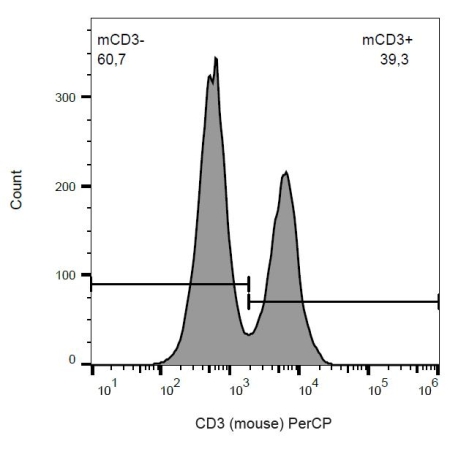
| Application | FC |
| Reconstitution and Storage | 2°C to 8°C |
| Immunogen | Mouse BM10-37 cytotoxic T lymphocytes |
| Purification | Purified by size-exclusion chromatography |
| Concentration | 0.5 mg/ml |
| Specificity | The Armenian hamster monoclonal antibody 145-2C11 reacts with mouse CD3 (epsilon subunit). This antibody is commonly used as a phenotypic marker for mouse T cells. |
| Formulation | PerCP |
| Storage Buffer | Phosphate buffered saline (PBS) with 15 mM sodium azide, approx. pH 7.4 |
| Reference | Tilley SL, Jaradat M, Stapleton C, Dixon D, Hua X, Erikson CJ, McCaskill JG, Chason KD, Liao G, Jania L, Koller BH, Jetten AM: Retinoid-related orphan receptor gamma controls immunoglobulin production and Th1/Th2 cytokine balance in the adaptive immune response to allergen. J Immunol. 2007 Mar 1;178(5):3208-18. Han WR, Murray-Segal LJ, Gershenzon A, Zhang JG, Hodder AN, Pietersz GA, Mottram PL: Idarubicin-145-2C11-F(ab')2 promotes peripheral tolerance and reduces chronic vascular disease in mouse cardiac allografts. Transpl Immunol. 1999 Dec;7(4):207-13. Kearse KP: Calnexin associates with monomeric and oligomeric (disulfide-linked) CD3delta proteins in murine T lymphocytes. J Biol Chem. 1998 Jun 5;273(23):14152-7. Henrickson M, Reid J, Bellet JS, Sawchuk SS, Hirsch R: Comparison of in vivo efficacy and mechanism of action of antimurine monoclonalantibodies directed against TCR alpha beta (H57-597) and CD3 (145-2C11). Transplantation. 1995 Oct 27;60(8):828-35. Kinnaert P, Pradier O, Bournonville B, Habrant C, Goldman M, Van Geertruyden N: Role of CD18-dependent and CD18-independent mechanisms in the increased leukocyte adhesiveness and in the variations of circulating white blood cell populations induced by anti-CD3 monoclonal antibodies. Transpl Int. 1996;9(4):386-91. Vossen AC, Tibbe GJ, Kroos MJ, van de Winkel JG, Benner R, Savelkoul HF: Fc receptor binding of anti-CD3 monoclonal antibodies is not essential for immunosuppression, but triggers cytokine-related side effects. Eur J Immunol. 1995 Jun;25(6):1492-6. Jacobs H, Vandeputte D, Tolkamp L, de Vries E, Borst J, Berns A: CD3 components at the surface of pro-T cells can mediate pre-T cell development in vivo. Eur J Immunol. 1994 Apr;24(4):934-9. Salvadori S, Gansbacher B, Pizzimenti AM, Zier KS: Abnormal signal transduction by T cells of mice with parental tumors is not seen in mice bearing IL-2-secreting tumors. J Immunol. 1994 Dec 1;153(11):5176-82. Payer E, Elbe A, Stingl G: Circulating CD3+/T cell receptor V gamma 3+ fetal murine thymocytes home to the skin and give rise to proliferating dendritic epidermal T cells. J Immunol. 1991 Apr 15;146(8):2536-43. Samelson LE, O'Shea JJ, Luong H, Ross P, Urdahl KB, Klausner RD, Bluestone J: T cell antigen receptor phosphorylation induced by an anti-receptor antibody. J Immunol. 1987 Oct 15;139(8):2708-14. Leo O, Foo M, Sachs DH, Samelson LE, Bluestone JA: Identification of a monoclonal antibody specific for a murine T3 polypeptide. Proc Natl Acad Sci U S A. 1987 Mar;84(5):1374-8. |
|---|---|
| Gene Symbol | Cd3e |
| Gene Full Name | CD3 antigen, epsilon polypeptide |
| Alias Symbols | AI504783, CD3, CD3epsilon, T-cell surface antigen T3/Leu-4 epsilon chain, T-cell surface glycoprotein CD3 epsilon chain, T3e. |
| NCBI Gene Id | 12501 |
| Protein Name | T-cell surface glycoprotein CD3 epsilon chain |
| Description of Target | Part of the TCR-CD3 complex present on T-lymphocyte cell surface that plays an essential role in adaptive immune response. When antigen presenting cells (APCs) activate T-cell receptor (TCR), TCR-mediated signals are transmitted across the cell membrane by the CD3 chains CD3D, CD3E, CD3G and CD3Z. All CD3 chains contain immunoreceptor tyrosine-based activation motifs (ITAMs) in their cytoplasmic domain. Upon TCR engagement, these motifs become phosphorylated by Src family protein tyrosine kinases LCK and FYN, resulting in the activation of downstream signaling pathways. In addition of this role of signal transduction in T-cell activation, CD3E plays an essential role in correct T-cell developement (PubMed:19956738, PubMed:24899501). Participates also in internalization and cell surface down-regulation of TCR-CD3 complexes via endocytosis sequences present in CD3E cytosolic region. |
| Uniprot ID | P22646 |
| Protein Accession # | NP_031674.1; XP_006510029.1 |
| Nucleotide Accession # | NM_007648.4; XM_006509966.2 |