

Clinisciences > Human TLR2 Antibody : APC
Human TLR2 Antibody : APC

Cat# OASB01312
Size : 100tests
Marca : Aviva Systems Biology
Human TLR2 Antibody : APC (OASB01312)
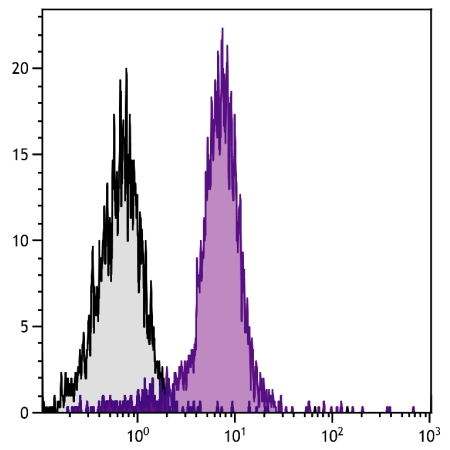
| Datasheets/Manuals | Printable datasheet for Human TLR2 Antibody : APC (OASB01312) |
|---|
| Tested Species Reactivity | Human |
|---|---|
| Predicted Species Reactivity | Human |
| Clonality | Monoclonal |
| Clone | 2B4A1 |
| Isotype | IgG2a |
| Host | Mouse |
| Conjugation | APC |
| Application | FC |
| Additional Information | Description: The Toll-like receptor (TLR) family is comprised of type I transmembrane proteins characterized by an extracellular leucine-rich domain and a cytoplasmic tail that contains a conserved region call the Toll/IL-1 (TIR) domain. First discovered in Drosophila, TLRs recognize specific molecular patterns that are present in microbial components and respond to these components in order eliminate or limit invading microbes. TLR2 recognizes and is activated by components from a broad variety of microorganisms including lipoproteins from Gram-negative and Gram-positive bacteria, lipoteichoic acid from Gram-positive bacteria, lipoarabinomannan from mycobacteria, and zymosan from yeast. TLR2 has been reported to functionally associate with TLR1 and TLR6 in order to recognize various lipopeptides. |
| Reconstitution and Storage | Store at 2-8C |
| Immunogen | Recombinant TLR2 |
| Concentration | Lot specific |
| Specificity | TLR2 |
| Characterization | To insure lot- to- lot consistency, each batch of product is tested by flow cytometry to conform with thecharacteristics of a standard reference reagent. |
| Warning | Reagents contain sodium azide. Sodium azide is very toxic if ingested or inhaled. Avoid contact withskin, eyes, or clothing. Wear eye or face protection when handling. If skin or eye contact occurs, washwith copious amounts of water. If ingested or inhaled, contact a physician immediately. Sodium azideyields toxic hydrazoic acid under acidic conditions. Dilute azide- containing compounds in running waterbefore discarding to avoid accumulation of potentially explosive deposits in lead or copper plumbing. |
| Dilution | Flow Cytometry: Purified antibody Fluorescein conjugate Biotin conjugate R-phycoerythrin conjugate Allophycocyanin conjugate 1ug/106 10uL/106 1ug/106 10uL/106 10uL/106 |
| Application Info | Flow cytometry |
| Other Applications Data | Since applications vary, you should determine the optimum workingdilution of the product that is appropriate for your specific need. |
| Storage | - The purified antibody (UNLB) is supplied as 0.1 mg purified immunoglobulin in 0.2 mL of 100 mMborate buffered saline, pH 8.2. No preservatives or amine- containing buffer salts added. Store at 2- 8 C - The fluorescein (FITC) conjugate is supplied as 100 tests in 1.0 mL of PBS/NaN3. Store at 2- 8 C - The biotin (BIOT) conjugate is supplied as 0.1 mg in 0.2 mL of PBS/NaN3. Store at 2- 8 C - The R- phycoerythrin (R- PE) and allophycocyanin (APC) conjugates are supplied as 100 tests in 1.0mL of PBS/NaN3 and a stabilizing agent. Store at 2- 8 C. Do not freeze! - The low endotoxin, azide- free (LE/AF) antibody is supplied as 0.1 mg purified immunoglobulin in 0.2 mLof PBS. Aliquot and store at or below - 20 C - With the exception of the low endotoxin, azide- free product, the vials should be stored at 2- 8 C. Aliquotand freeze the low endotoxin, azide- free product at - 20 C immediately upon receipt. Each reagent isstable for the period shown on the bottle label if stored as directed. |
| Reference | 1. Takeuchi, O., T. Kawai, P.F. Mühlradt, M. Morr, J.D. Radolf, A. Zychlinsky, K. Takeda, and S. Akira. 2001. Int. Immunol. 13:933 2. Schwandner, R., R. Dziarski, H. Wesche, M. Rothe, and C.J. Kirschning. 1999. J. Biol. Chem. 274:17406 3. Campos, M.A., I.C. Almeida, O. Takeuchi, S. Akira, E.P. Valente, D.O. Procópio, L.R. Travassos, J.A. Smith, D.T. Golenbock, and R.T Gazzinelli. 2001. J. Immunol. 167:416 4. Aliprantis, A.O., R. Yang, D.S. Weiss, P. Godowski, and A. Zychlinsky. 2000. EMBO J. 19:3325 5. Wyllie, D.H., E. Kiss- Toth, A. Visintin, S.C. Smith, S. Boussouf, D.M. Segal, G.W. Duff, and S.K. Dower. 2000. J. Immunol. 165:7125 6. Hirschfeld, M., C.J. Kirschning, R. Schwandner, H. Wesche, J.H. Weis, R.M. Wooten, and J.J. Weis. 1999. J. Immunol. 163:2382 7. Lien, E., T.J. Sellati, A. Yoshimura, T.H. Flo, G. Rawadi, R.W. Finberg, J.D. Carroll, T. Espevik, R.R. Ingalls, J.D. Radolf, and D.T Golenbock. 1999. J. Biol. Chem. 274:33419 8. Aliprantis, A.O., R. Yang, M. R. Mark, S. Suggett, B. Devaux, J.D. Radolf, G.R. Klimpel, P. Godowski, and A. Zychlinsky. 1999. Science285:736 9. Yoshimura, A., E. Lien, R.R. Ingalls, E. Tuomanen, R. Dziarski, and D. Golenbock. 1999. J. Immunol. 163:1 10. Opitz, B., N.W. Schröder, I. Spreitzer, K.S. Michelsen, C. J. Kirschning, W. Hallatschek, U. Zähringer, T. Hartung, U.B. Göbel, and R.R Schumann. 2001. J. Biol. Chem. 276:22041 11. Hajjar, A.M., D.S. O'Mahony, A. Ozinsky, D.M. Underhill, A. Aderem, S.J. Klebanoff, and C.B. Wilson. 2001. J. Immunol. 166:15 12. Massari, P., P. Henneke, Y. Ho, E. Latz, D.T. Golenbock, and L.M. Wetzler. 2002. J. Immunol. 168:1533 13. Takeuchi, O., K. Hoshino, T. Kawai, H. Sanjo, H. Takada, T. Ogawa, K. Takeda, and S. Akira. 1999. Immunity 11:443 14. Means, T.K., S. Wang, E. Lien, A. Yoshimura, D.T. Golenbock, and M.J. Fenton. 1999. J. Immunol. 163:3920 15. Underhill, D.M., A. Ozinsky, A.M. Hajjar, A. Stevens, C.B. Wilson, M. Bassetti, and A. Aderem. 1999. Nature 401:811 16. Alexopoulou, L., V. Thomas, M. Schnare, Y. Lobet, J. Anguita, R.T. Schoen, R. Medzhitov, E. Fikrig, and R. A. Flavell. 2002. Nat. Med 8:878. |
|---|---|
| Gene Symbol | TLR2 |
| Gene Full Name | Toll-like receptor 2 |
| Alias Symbols | TIL4, CD282 |
| NCBI Gene Id | 7097; 448807 |
| Protein Name | toll-like receptor 2 |
| Description of Target | The protein encoded by this gene is a member of the Toll-like receptor (TLR) family which plays a fundamental role in pathogen recognition and activation of innate immunity. TLRs are highly conserved from Drosophila to humans and share structural and functional similarities. This protein is a cell-surface protein that can form heterodimers with other TLR family members to recognize conserved molecules derived from microorganisms known as pathogen-associated molecular patterns (PAMPs). Activation of TLRs by PAMPs leads to an up-regulation of signaling pathways to modulate the host's inflammatory response. This gene is also thought to promote apoptosis in response to bacterial lipoproteins. This gene has been implicated in the pathogenesis of several autoimmune diseases. Alternative splicing results in multiple transcript variants. |
| Uniprot ID | O60603, Q689D1 |
| Protein Accession # | NP_001305716.1 |
| Nucleotide Accession # | NM_001318787.1 |
Protein interactions
| Name | # of Products |
|---|---|
| CD14 | 98 |
| HMGB1 | 209 |
| HRAS | 211 |
| HSP90B1 | 141 |
| IRAK1 | 192 |
| LY96 | 43 |
| MAPK8IP3 | 143 |
| MYD88 | 146 |
| PIK3R1 | 517 |
| RAC1 | 285 |
| RIPK2 | 139 |
| SFTPA1 | 34 |
| TICAM1 | 97 |
| TIRAP | 122 |
| TLR1 | 73 |
| TLR10 | 60 |
| TLR2 | 123 |
| TLR6 | 31 |
| TOLLIP | 123 |
| TRIP6 | 94 |
Biological pathways
| Name | # of Products |
|---|---|
| Cellular response to diacyl bacterial lipopeptide | 27 |
| Cellular response to lipoteichoic acid | 78 |
| Cellular response to triacyl bacterial lipopeptide | 32 |
| Detection of diacyl bacterial lipopeptide | 27 |
| Detection of triacyl bacterial lipopeptide | 32 |
| I-kappaB phosphorylation | 65 |
| Induction of apoptosis | 395 |
| Inflammatory response | 911 |
| Innate immune response | 905 |
| MyD88-dependent toll-like receptor signaling pathway | 331 |
| Positive regulation of chemokine production | 128 |
| Positive regulation of inflammatory response | 172 |
| Positive regulation of interferon-beta production | 86 |
| Positive regulation of interleukin-12 production | 171 |
| Positive regulation of interleukin-18 production | 38 |
| Positive regulation of interleukin-6 production | 149 |
| Positive regulation of interleukin-8 production | 127 |
| Positive regulation of NF-kappaB import into nucleus | 114 |
| Positive regulation of NF-kappaB transcription factor activity | 346 |
| Positive regulation of nitric-oxide synthase biosynthetic process | 110 |
| Positive regulation of toll-like receptor signaling pathway | 47 |
| Positive regulation of transcription from RNA polymerase II promoter | 1210 |
| Positive regulation of tumor necrosis factor production | 168 |
| Positive regulation of Wnt receptor signaling pathway | 52 |
| Toll signaling pathway | 369 |
| Toll-like receptor 1 signaling pathway | 309 |
| Toll-like receptor 2 signaling pathway | 309 |
| Toll-like receptor 4 signaling pathway | 330 |
Biological process
| Name | # of Products |
|---|---|
| Cellular response to bacterial lipopeptide | 7 |
| Cellular response to diacyl bacterial lipopeptide | 3 |
| Cellular response to lipoteichoic acid | 15 |
| Cellular response to triacyl bacterial lipopeptide | 3 |
| Detection of diacyl bacterial lipopeptide | 3 |
| Detection of triacyl bacterial lipopeptide | 3 |
| I-kappaB phosphorylation | 14 |
| Immune response | 404 |
| Induction of apoptosis | 226 |
| Innate immune response | 300 |
| Lipopolysaccharide-mediated signaling pathway | 48 |
| MyD88-dependent toll-like receptor signaling pathway | 65 |
| Pattern recognition receptor signaling pathway | 9 |
| Positive regulation of chemokine production | 34 |
| Positive regulation of inflammatory response | 57 |
| Positive regulation of interferon-beta production | 19 |
| Positive regulation of interleukin-12 production | 39 |
| Positive regulation of interleukin-18 production | 5 |
| Positive regulation of interleukin-6 production | 63 |
| Positive regulation of interleukin-8 production | 33 |
| Positive regulation of NF-kappaB import into nucleus | 30 |
| Positive regulation of NF-kappaB transcription factor activity | 135 |
| Positive regulation of nitric-oxide synthase biosynthetic process | 21 |
| Positive regulation of toll-like receptor signaling pathway | 6 |
| Positive regulation of transcription from RNA polymerase II promoter | 968 |
| Positive regulation of tumor necrosis factor production | 64 |
| Positive regulation of Wnt receptor signaling pathway | 21 |
| Signal transduction | 1058 |
| Toll signaling pathway | 66 |
| Toll-like receptor 1 signaling pathway | 59 |
| Toll-like receptor 2 signaling pathway | 61 |
| Toll-like receptor 4 signaling pathway | 64 |
| Toll-like receptor signaling pathway | 71 |
Cellular components
| Name | # of Products |
|---|---|
| Cell surface | 369 |
| Cytoplasm | 4549 |
| Integral to plasma membrane | 817 |
| Intracellular | 1678 |
| Plasma membrane | 2678 |
| Toll-like receptor 1-Toll-like receptor 2 protein complex | 3 |
Protein function
| Name | # of Products |
|---|---|
| Gram-positive bacterial cell surface binding | 79 |
| Lipopolysaccharide receptor activity | 47 |
| Pattern recognition receptor activity | 49 |
| Peptidoglycan binding | 42 |
| Protein binding | 12191 |
| Protein heterodimerization activity | 1132 |
| Receptor activity | 3624 |
| Transmembrane signaling receptor activity | 687 |
| Triacyl lipopeptide binding | 30 |
-
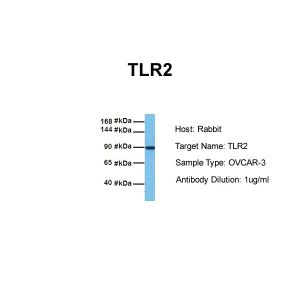 TLR2 Antibody - C-terminal region (ARP30551_P050)Catalog #: ARP30551_P050Species Tested: HumanApplication: IF, IHC-FFPE, WBFormat: Liquid. Purified antibody supplied in 1x PBS buffer with 0.09% (w/v) sodium azide and 2% sucrose.
 -
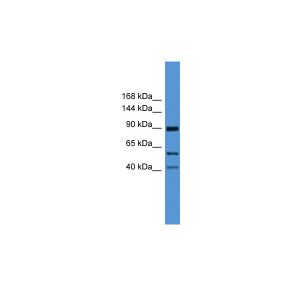 TLR2 Antibody - middle region (ARP59036_P050)Catalog #: ARP59036_P050Species Tested: HumanApplication: IF, WBFormat: Liquid. Purified antibody supplied in 1x PBS buffer with 0.09% (w/v) sodium azide and 2% sucrose.
 -
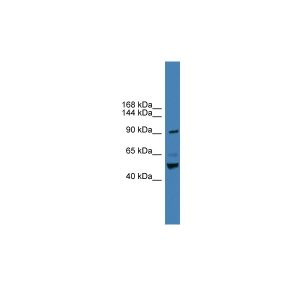 TLR2 Antibody - N-terminal region (ARP59037_P050)Catalog #: ARP59037_P050Species Tested: HumanApplication: IHC, WB, IFFormat: Liquid. Purified antibody supplied in 1x PBS buffer with 0.09% (w/v) sodium azide and 2% sucrose.
 -
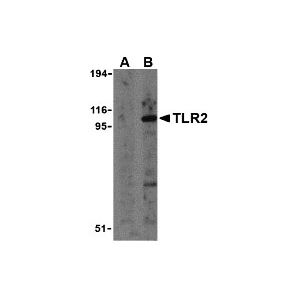 TLR2 Antibody (OAPB00192)Catalog #: OAPB00192Conjugation: UnconjugatedApplication: ELISA, IF, IHC-P, WBFormat: Liquid. TLR2 Antibody is supplied in PBS containing 0.02% sodium azide.
 -
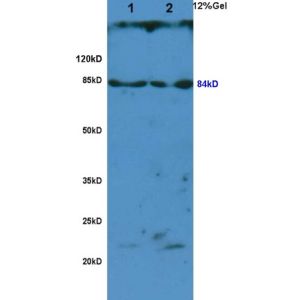 TLR2 Antibody (OABF00382)Catalog #: OABF00382Conjugation: UnconjugatedApplication: FC, IFFormat: Liquid. Aqueous buffered solution containing 1% BSA, 50% glycerol and 0.09% sodium azide.