

Anti-Alpha-actin-3 Antibody

Referentie MBS820899-0,2mL
Formaat : 0.2mL
Merk : MyBiosource
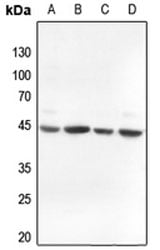
Western blot analysis of Alpha-actin-3 expression in Hela (A), H446 (B), mouse lung (C), rat lung (D) whole cell lysates.
(Predicted band size: 41 kD; Observed band size: 42 kD)
(Predicted band size: 41 kD; Observed band size: 42 kD)
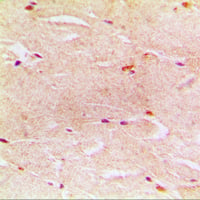
Immunohistochemical analysis of Alpha-actin-3 staining in human muscle formalin fixed paraffin embedded tissue section. The section was pre-treated using heat mediated antigen retrieval with sodium citrate buffer (pH 6.0). The section was then incubated with the antibody at room temperature and detected using an HRP conjugated compact polymer system. DAB was used as the chromogen. The section was then counterstained with haematoxylin and mounted with DPX.
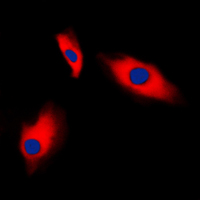
Immunofluorescent analysis of Alpha-actin-3 staining in HeLa cells. Formalin-fixed cells were permeabilized with 0.1% Triton X-100 in TBS for 5-10 minutes and blocked with 3% BSA-PBS for 30 minutes at room temperature. Cells were probed with the primary antibody in 3% BSA-PBS and incubated overnight at 4 degree C in a humidified chamber. Cells were washed with PBST and incubated with a DyLight 594-conjugated secondary antibody (red) in PBS at room temperature in the dark. DAPI was used to stain the cell nuclei (blue).
Alpha-Actin-3 (ACTG2) Antibody – Rabbit Polyclonal
For Research Use Only. Not for use in diagnostic procedures. Catalog #: MBS820899MBS820899 is an antibody targeting ACTG2. Also known as Anti-Alpha-actin-3 Antibody. Reactive in Human, Mouse, Rat, Bovine, Chicken, Rabbit. Host: Rabbit. Rabbit polyclonal antibody to Alpha-actin-3 More details
Product Overview
Online Datasheet in PDFProduct Name
Alpha-actin-3 (ACTG2), Polyclonal Antibody
Full Product Name
Anti-Alpha-actin-3 Antibody
Product Gene Name
anti-ACTG2 antibody
Product Synonym Names
ACTA3; ACTL3; ACTSG; Actin, gamma-enteric smooth muscle; Gamma-2-actin; Smooth muscle gamma-actin
Clonality
Polyclonal
Host
Rabbit
Species Reactivity
Human, Mouse, Rat, Bovine, Chicken, Rabbit
Form/Format
Liquid in 0.42% Potassium phosphate, 0.87% Sodium chloride, pH 7.3, 30% glycerol, and 0.01% sodium azide.
Purity/Purification
The antibody was purified by immunogen affinity chromatography.
Specificity
Recognizes endogenous levels of Alpha-actin-3 protein.
Preparation and Storage
Upon receipt aliquot and store at -20 degree C for one year. Avoid freeze/thaw cycles.
Antibody/Peptide Pairs
Alpha-actin-3 peptide (MBS823516) is used for blocking the activity of Alpha-actin-3 antibody (MBS820899)
Applications Tested/Suitable for anti-ACTG2 antibody
Western Blot (WB), Immunohistochemistry (IHC), Immunofluorescence (IF), Immunocytochemistry (ICC)
Application Notes for anti-ACTG2 antibody
WB: (1/500 - 1/1000)
IHC: (1/100 - 1/200)
IF/ICC: (1/100 - 1/500)
IHC: (1/100 - 1/200)
IF/ICC: (1/100 - 1/500)
Immunohistochemistry (IHC) of anti-ACTG2 antibody
Immunohistochemical analysis of Alpha-actin-3 staining in human muscle formalin fixed paraffin embedded tissue section. The section was pre-treated using heat mediated antigen retrieval with sodium citrate buffer (pH 6.0). The section was then incubated with the antibody at room temperature and detected using an HRP conjugated compact polymer system. DAB was used as the chromogen. The section was then counterstained with haematoxylin and mounted with DPX.
Immunofluorescence (IF) of anti-ACTG2 antibody
Immunofluorescent analysis of Alpha-actin-3 staining in HeLa cells. Formalin-fixed cells were permeabilized with 0.1% Triton X-100 in TBS for 5-10 minutes and blocked with 3% BSA-PBS for 30 minutes at room temperature. Cells were probed with the primary antibody in 3% BSA-PBS and incubated overnight at 4 degree C in a humidified chamber. Cells were washed with PBST and incubated with a DyLight 594-conjugated secondary antibody (red) in PBS at room temperature in the dark. DAPI was used to stain the cell nuclei (blue).
Other Notes
Small volumes of anti-ACTG2 antibody vial(s) may occasionally become entrapped in the seal of the product vial during shipment and storage. If necessary, briefly centrifuge the vial on a tabletop centrifuge to dislodge any liquid in the container`s cap. Certain products may require to ship with dry ice and additional dry ice fee may apply.
Additional Details
NCBI/Uniprot data below describe general gene information for ACTG2. It may not necessarily be applicable to this product.
NCBI Official Full Name
actin, gamma-enteric smooth muscle isoform 2
NCBI Official Synonym Full Names
actin, gamma 2, smooth muscle, enteric
NCBI Official Symbol
ACTG2
NCBI Official Synonym Symbols
ACT; ACTE; VSCM; ACTA3; ACTL3; ACTSG
UniProt Protein Name
Actin, gamma-enteric smooth muscle
UniProt Synonym Protein Names
Alpha-actin-3; Gamma-2-actin; Smooth muscle gamma-actin
Protein Family
Actin
UniProt Gene Name
ACTG2
UniProt Synonym Gene Names
ACTA3; ACTL3; ACTSG
UniProt Entry Name
ACTH_HUMAN
NCBI Protein Information
actin, gamma-enteric smooth muscle; alpha-actin-3; actin-like protein
NCBI Summary for ACTG2
Actins are highly conserved proteins that are involved in various types of cell motility and in the maintenance of the cytoskeleton. Three types of actins, alpha, beta and gamma, have been identified in vertebrates. Alpha actins are found in muscle tissues and are a major constituent of the contractile apparatus. The beta and gamma actins co-exist in most cell types as components of the cytoskeleton and as mediators of internal cell motility. This gene encodes actin gamma 2; a smooth muscle actin found in enteric tissues. Alternative splicing results in multiple transcript variants encoding distinct isoforms. Based on similarity to peptide cleavage of related actins, the mature protein of this gene is formed by removal of two N-terminal peptides.[provided by RefSeq, Dec 2010]
Show more UniProt Comments for ACTG2
ACTG2: Actins are highly conserved proteins that are involved in various types of cell motility and are ubiquitously expressed in all eukaryotic cells. Polymerization of globular actin (G-actin) leads to a structural filament (F-actin) in the form of a two-stranded helix. Each actin can bind to 4 others. Belongs to the actin family.
Protein type: Contractile; Cytoskeletal; Motility/polarity/chemotaxis
Chromosomal Location of Human Ortholog: 2p13.1
Cellular Component: extracellular space; cytoskeleton; cytosol
Molecular Function: ATP binding
Biological Process: muscle contraction
Disease: Visceral Myopathy
Show more Protein type: Contractile; Cytoskeletal; Motility/polarity/chemotaxis
Chromosomal Location of Human Ortholog: 2p13.1
Cellular Component: extracellular space; cytoskeleton; cytosol
Molecular Function: ATP binding
Biological Process: muscle contraction
Disease: Visceral Myopathy
Precautions
All of MyBioSource's Products are for scientific laboratory research purposes and are not for diagnostic, therapeutics, prophylactic or in vivo use. Through your purchase, you expressly represent and warrant to MyBioSource that you will properly test and use any Products purchased from MyBioSource in accordance with industry standards. MyBioSource and its authorized distributors reserve the right to refuse to process any order where we reasonably believe that the intended use will fall outside of our acceptable guidelines.
Disclaimer
While every efforts were made to ensure the accuracy of the information provided in this datasheet, MyBioSource will not be liable for any omissions or errors contained herein. MyBioSource reserves the right to make changes to this datasheet at any time without prior notice.
It is the responsibility of the customer to report product performance issues to MyBioSource within 30 days of receipt of the product. Please visit our Terms & Conditions page for more information.
It is the responsibility of the customer to report product performance issues to MyBioSource within 30 days of receipt of the product. Please visit our Terms & Conditions page for more information.
Product Note
Select online data sheet information is drawn from bioinformatics databases, occasionally resulting in ambiguous or non-relevant product information. It is the responsibility of the customer to review, verify, and evaluate the information to make sure it matches their requirements before purchasing the kit. Our ELISA Kit assays are dynamic research tools and sometimes they may be updated and improved. If the format of this assay is important to you then please request the current manual or contact our technical support team with a presales inquiry before placing an order. We will confirm the current details of the assay. We cannot guarantee the sample manual posted online is the most current manual, it is intended to serve as an example only. Please refer to the instructions For Use provided with the assay kit for precise details.
Product PubMed Publications
Products associated with anti-ACTG2 antibody
| Reference Product | PubMed Publications |
|---|---|
| ACTA2 antibody | >2 publications with ACTG2 and ACTA2 |
| TAGLN antibody | >2 publications with ACTG2 and TAGLN |
| CNN1 antibody | >2 publications with ACTG2 and CNN1 |
| MYH11 antibody | >1 publications with ACTG2 and MYH11 |
Pathways associated with anti-ACTG2 antibody
| Products by Pathway | Pathway Diagram |
|---|---|
| Muscle Contraction Pathway antibodies | Muscle Contraction Pathway Diagram |
| Smooth Muscle Contraction Pathway antibodies | Smooth Muscle Contraction Pathway Diagram |
| Vascular Smooth Muscle Contraction Pathway antibodies | Vascular Smooth Muscle Contraction Pathway Diagram |
| Vascular Smooth Muscle Contraction Pathway antibodies | Vascular Smooth Muscle Contraction Pathway Diagram |
Diseases associated with anti-ACTG2 antibody
| Disease Name | Pubmed Publications |
|---|---|
| Adenocarcinoma Antibodies | >3 publications with ACTG2 and Adenocarcinoma |
| Liver Neoplasms Antibodies | >3 publications with ACTG2 and Liver Neoplasms |
| Neoplasm Metastasis Antibodies | >3 publications with ACTG2 and Neoplasm Metastasis |
| Megacystis microcolon intestinal hypoperistalsis syndrome Antibodies | >3 publications with ACTG2 and Megacystis microcolon intestinal hypoperistalsis syndrome |
| Liver Diseases Antibodies | >2 publications with ACTG2 and Liver Diseases |
| Anemia Antibodies | >1 publications with ACTG2 and Anemia |
| Disease Models, Animal Antibodies | >1 publications with ACTG2 and Disease Models, Animal |
| Lung Neoplasms Antibodies | >1 publications with ACTG2 and Lung Neoplasms |
| Carcinoma, Hepatocellular Antibodies | >1 publications with ACTG2 and Carcinoma, Hepatocellular |
| Neoplasms, Experimental Antibodies | >1 publications with ACTG2 and Neoplasms, Experimental |
Organs/Tissues associated with anti-ACTG2 antibody
| Organ/Tissue Name | Pubmed Publications |
|---|---|
| Muscle Antibodies | >11 publications with ACTG2 and Muscle |
| Bladder Antibodies | >3 publications with ACTG2 and Bladder |
| Lung Antibodies | >3 publications with ACTG2 and Lung |
| Liver Antibodies | >3 publications with ACTG2 and Liver |
| Intestine Antibodies | >3 publications with ACTG2 and Intestine |
| Connective Tissue Antibodies | >2 publications with ACTG2 and Connective Tissue |
| Kidney Antibodies | >1 publications with ACTG2 and Kidney |
| Pancreas Antibodies | >1 publications with ACTG2 and Pancreas |
| Embryonic Tissue Antibodies | >1 publications with ACTG2 and Embryonic Tissue |
| Testis Antibodies | >1 publications with ACTG2 and Testis |