

CD299 Protein, Human, Recombinant (hFc)

Referentie NB-64-56204-500ug
Formaat : 500ug
Merk : Neo Biotech
Remove All
CD299 Protein, Human, Recombinant (hFc)
(Synonyms: MGC47866, MGC129964, L-SIGN, LSIGN, HP10347, DC-SIGNR, DCSIGNR, DC-SIGN2, C-type lectin domain family 4 member M, CLEC4M, CD299, CD209L) Copy Product InfoSynonyms: MGC47866, MGC129964, L-SIGN, LSIGN, HP10347, DC-SIGNR, DCSIGNR, DC-SIGN2, C-type lectin domain family 4 member M, CLEC4M, CD299, CD209L
Catalog No. TMPY-01032 Copy Product Info
CD299 Protein, Human, Recombinant (hFc) is expressed in HEK293 mammalian cells with hFc tag. The predicted molecular weight is 65 kDa and the accession number is Q9H2X3-1.
For research use only—not for human use. No sales to individuals. Use as intended only.
Select Batch
Purity:92.8%
Appearance:Lyophilized powder
Color:White
Contact us for more batch information
Product Information
Bioactivity
Chemical Properties
Storage & Solubility Information
| Bioactivity | Activity testing is in progress. It is theoretically active, but we cannot guarantee it. If you require protein activity, we recommend choosing the eukaryotic expression version first. |
| Description | CD299 Protein, Human, Recombinant (hFc) is expressed in HEK293 mammalian cells with hFc tag. The predicted molecular weight is 65 kDa and the accession number is Q9H2X3-1. |
| Species | Human |
| Expression System | HEK293 Cells |
| Tag | N-hFc |
| Accession Number | Q9H2X3-1 |
| Construction | A DNA sequence encoding the extracellular domain (Ser 78-Glu 399) of human DC-SIGNR (NP_055072.3) was fused with the Fc region of human IgG1 at the N-terminus. Predicted N terminal: Glu 20 |
| Protein Purity | > 90 % as determined by SDS-PAGE 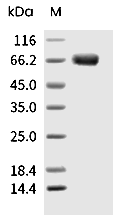 |
| Endotoxin | < 1.0 EU/μg of the protein as determined by the LAL method. |
| Formulation | Lyophilized from a solution filtered through a 0.22 μm filter, containing PBS, pH 7.4. Typically, a mixture containing 5% to 8% trehalose, mannitol, and 0.01% Tween 80 is incorporated as a protective agent before lyophilization. |
| Reconstitution | Reconstituted with sterile deionized water to 0.1 mg/mL. Reconstitution conditions may vary depending on the lot. |
| Synonyms | MGC47866, MGC129964, L-SIGN, LSIGN, HP10347, DC-SIGNR, DCSIGNR, DC-SIGN2, C-type lectin domain family 4 member M, CLEC4M, CD299, CD209L |
| Research Background | C-type lectin domain family 4, member M, also known as DC-SIGNR and CLEC4M, is a type II integral membrane protein that is 77% amino acid identical to DC-SIGN, an HIV gp120-binding protein. Though the encoded gene located in the same chromosome, DC-SIGN is expressed solely on dendritic cells, while DC-SIGNR is predominantly found in liver sinusoidal endothelial cells and lymph node, as well as placental endothelium. DC-SIGNR exists as a homotetramer, and the tandem repeat domain, also called neck domain, mediates oligomerization. DC-SIGNR is regarded as a pathogen-recognition receptor involved in peripheral immune surveillance in liver, and probably mediates the endocytosis of pathogens which are subsequently degraded in lysosomal compartments. DC-SIGNR appears to selectively recognize and bind many viral surface glycoproteins containing high mannose N-linked oligosaccharides in a calcium-dependent manner, including HIV-1 gp120, HIV-2 gp120, SIV gp120, ebolavirus glycoproteins, HCV E2, and human SARS coronavirus protein S, as well as the cellular adhesion protein ICAM3. DC-SIGNR has been thought to play an important role in establishing HIV infection by enhancing trans-infection of CD4(+)T cells in the regional lymph nodes. It may affect susceptibility to HIV infection by a mechanism that is different in females and males. DC-SIGNR can bind to hepatitis C virus (HCV), and its polymorphism might affect HCV loads supporting the concept that DC-SIGNR contributes to HCV replication efficacy. |
| Molecular Weight | 65 kDa (predicted); 65.83 kDa (reducing condition, due to glycosylation) |
| Shipping | In general, lyophilized powders are shipped with blue ice, while solutions are shipped with dry ice. |
| Storage | It is recommended to store recombinant proteins at -20°C to -80°C for future use. Lyophilized powders can be stably stored for over 12 months, while liquid products can be stored for 6-12 months at -80°C. For reconstituted protein solutions, the solution can be stored at -20°C to -80°C for at least 3 months. Please avoid multiple freeze-thaw cycles and store products in aliquots. |
Calculator
Dose Conversion
Keywords
MGC-47866MGC-129964MGC 47866MGC 129964HP-10347HP 10347CD-299CD 299
Preview
Related Tags: CD299 Protein, Human, Recombinant (hFc) chemical structure | CD299 Protein, Human, Recombinant (hFc) molecular weight
Generate Quote
Catalog No.: Cas No.:
Add
| Size | Quantity | Unit Price | Amount | Operation |
|---|
Generate Quote