Clinisciences > CDKN1A Antibody - N-terminal region
CDKN1A Antibody - N-terminal region
Referentie ARP30198_P050
Formaat : 100ul
Merk : Aviva Systems Biology
CDKN1A Antibody - N-terminal region (ARP30198_P050)
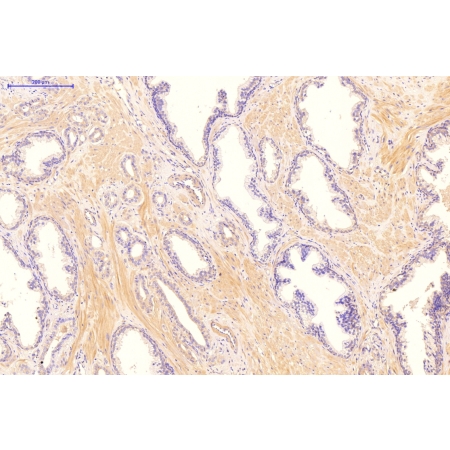
| Datasheets/Manuals | Printable datasheet for anti-CDKN1A (ARP30198_P050) antibody |
|---|
| Tested Species Reactivity | Human |
|---|---|
| Predicted Species Reactivity | Human, Mouse, Rat, Cow, Dog, Guinea Pig, Horse, Pig, Rabbit, Sheep |
| Product Format | Liquid. Purified antibody supplied in 1x PBS buffer with 0.09% (w/v) sodium azide and 2% sucrose. |
| Clonality | Polyclonal |
| Host | Rabbit |
| Application | IHC |
| Reconstitution and Storage | For short term use, store at 2-8C up to 1 week. For long term storage, store at -20C in small aliquots to prevent freeze-thaw cycles. |
| Immunogen | The immunogen is a synthetic peptide directed towards the N-terminal region of Human CDKN1A |
| Purification | Affinity Purified |
| Predicted Homology Based on Immunogen Sequence | Cow: 100%; Dog: 92%; Guinea Pig: 92%; Horse: 83%; Human: 100%; Mouse: 92%; Pig: 100%; Rabbit: 92%; Rat: 100%; Sheep: 100%; |
| Peptide Sequence | Synthetic peptide located within the following region: KACRRLFGPVDSEQLSRDCDALMAGCIQEARERWNFDFVTETPLEGDFAW |
| Concentration | 0.5 mg/ml |
| Blocking Peptide | For anti-CDKN1A (ARP30198_P050) antibody is Catalog # AAP30198 |
| Gene Symbol | CDKN1A |
|---|---|
| Gene Full Name | cyclin-dependent kinase inhibitor 1A (p21, Cip1) |
| Alias Symbols | P21, CIP1, SDI1, WAF1, CAP20, CDKN1, MDA-6, p21CIP1 |
| NCBI Gene Id | 1026 |
| Protein Name | Cyclin-dependent kinase inhibitor 1 |
| Description of Target | This gene encodes a potent cyclin-dependent kinase inhibitor. The encoded protein binds to and inhibits the activity of cyclin-CDK2 or -CDK4 complexes, and thus functions as a regulator of cell cycle progression at G1. The expression of this gene is tightly controlled by the tumor suppressor protein p53, through which this protein mediates the p53-dependent cell cycle G1 phase arrest in response to a variety of stress stimuli. This protein can interact with proliferating cell nuclear antigen (PCNA), a DNA polymerase accessory factor, and plays a regulatory role in S phase DNA replication and DNA damage repair. This protein was reported to be specifically cleaved by CASP3-like caspases, which thus leads to a dramatic activation of CDK2, and may be instrumental in the execution of apoptosis following caspase activation. Multiple alternatively spliced variants have been found for this gene. |
| Uniprot ID | Q6FI05 |
| Protein Accession # | NP_510867 |
| Nucleotide Accession # | NM_078467 |
| Protein Size (# AA) | 164 |
| Molecular Weight | 18kDa |
| Protein Interactions | CCND1; PCNA; KRT31; TRIM54; TEX11; IKZF3; UBC; TRAF1; TCF4; SKP2; CCND3; CCND2; PHKG2; PHKA1; NCL; HSPA9; HSPA8; HSPA5; HSPA2; HSPA1A; HNRNPA2B1; CDK2; CDK5; CDK4; CDK3; CDC20; CCNE1; CCNB1; CCNA2; CAMK2D; ABR; GIGYF2; ANKRD17; UBR4; SNRNP200; FBXO21; PUF |
Protein interactions
| Name | # of Products |
|---|---|
| A1BG | 11 |
| A2M | 261 |
| ACTB | 306 |
| ALAS1 | 16 |
| ANGPT2 | 8 |
| APLP1 | 86 |
| ATP5B | 75 |
| ATP6V1A | 9 |
| BAG6 | 225 |
| CCNB1 | 173 |
| CDK1 | 487 |
| CENPB | 34 |
| CHGB | 46 |
| CLEC3B | 68 |
| COL4A5 | 57 |
| CPNE2 | 22 |
| CPNE6 | 25 |
| CTSB | 172 |
| DYNC1I1 | 44 |
| EEF1A1 | 227 |
| FKBPL | 14 |
| HSP90AA1 | 525 |
| MLL4 | 51 |
| NFE2L2 | 86 |
| PCNA | 402 |
| PDE4DIP | 33 |
| S | 41 |
| SETDB1 | 252 |
| SUMO3 | 154 |
| TLE1 | 178 |
| TMSB4X | 36 |
| TP53 | 1010 |
| TUBA1A | 138 |
| TUBB2B | 16 |
| TUBB3 | 74 |
| UBE2D1 | 194 |
| UNC119 | 185 |
| USP4 | 80 |
| VIM | 324 |
| ZBTB16 | 145 |
| ZNF135 | 13 |
| ZNF431 | 9 |
Biological pathways
| Name | # of Products |
|---|---|
| Cell cycle arrest | 360 |
| Cellular response to extracellular stimulus | 7 |
| Cellular response to ionizing radiation | 33 |
| DNA damage response, signal transduction by p53 class mediator resulting in cell cycle arrest | 135 |
| G1 phase of mitotic cell cycle | 94 |
| G1/S transition of mitotic cell cycle | 322 |
| G2/M transition of mitotic cell cycle | 206 |
| Induction of apoptosis by intracellular signals | 137 |
| Negative regulation of cell growth | 201 |
| Negative regulation of cell proliferation | 554 |
| Positive regulation of fibroblast proliferation | 119 |
| Positive regulation of reactive oxygen species metabolic process | 55 |
| Ras protein signal transduction | 211 |
| S phase of mitotic cell cycle | 263 |
| Stress-induced premature senescence | 3 |
Biological process
| Name | # of Products |
|---|---|
| Cell cycle | 355 |
| Cell cycle arrest | 142 |
| Cell cycle checkpoint | 112 |
| Cellular response to extracellular stimulus | 17 |
| Cellular response to ionizing radiation | 19 |
| Cellular senescence | 11 |
| DNA damage response, signal transduction by p53 class mediator resulting in cell cycle arrest | 61 |
| G1 phase of mitotic cell cycle | 39 |
| G1/S transition of mitotic cell cycle | 139 |
| G2/M transition of mitotic cell cycle | 93 |
| Induction of apoptosis by intracellular signals | 47 |
| Mitotic cell cycle | 251 |
| Negative regulation of apoptotic process | 356 |
| Negative regulation of cell growth | 119 |
| Negative regulation of cell proliferation | 375 |
| Negative regulation of cyclin-dependent protein kinase activity | 19 |
| Negative regulation of gene expression | 70 |
| Negative regulation of phosphorylation | 25 |
| Organ regeneration | 59 |
| Phosphorylation | 101 |
| Positive regulation of anti-apoptosis | 53 |
| Positive regulation of B cell proliferation | 66 |
| Positive regulation of fibroblast proliferation | 47 |
| Positive regulation of programmed cell death | 9 |
| Positive regulation of reactive oxygen species metabolic process | 31 |
| Ras protein signal transduction | 64 |
| Regulation of cyclin-dependent protein kinase activity | 44 |
| Regulation of DNA biosynthetic process | 2 |
| Regulation of mitotic cell cycle | 26 |
| Regulation of protein import into nucleus, translocation | 5 |
| Response to arsenic-containing substance | 10 |
| Response to corticosterone stimulus | 27 |
| Response to DNA damage stimulus | 144 |
| Response to drug | 323 |
| Response to hyperoxia | 20 |
| Response to organic cyclic compound | 128 |
| Response to organic nitrogen | 41 |
| Response to toxin | 75 |
| Response to UV | 43 |
| S phase of mitotic cell cycle | 95 |
| Stress-induced premature senescence | 4 |
Cellular components
| Name | # of Products |
|---|---|
| Cyclin-dependent protein kinase holoenzyme complex | 11 |
| Cytoplasm | 4549 |
| Cytosol | 1868 |
| Nucleoplasm | 775 |
| Nucleus | 4914 |
| PCNA-p21 complex | 2 |
Protein function
| Name | # of Products |
|---|---|
| Cyclin binding | 46 |
| Cyclin-dependent protein kinase activating kinase activity | 3 |
| Cyclin-dependent protein kinase activity | 102 |
| Cyclin-dependent protein kinase inhibitor activity | 48 |
| Kinase activity | 353 |
| Metal ion binding | 5514 |
| Protein binding | 12191 |
| Protein kinase inhibitor activity | 49 |
-
CDKN1A Antibody - C-terminal region (OAAB17089)Catalog #: OAAB17089Application: FC,IF,IHC-P,WBFormat: Liquid PBS with 0.09% (W/V) sodium azide. -
CDKN1A Antibody (OASG05487)Catalog #: OASG05487Application: ELISA, IF, IHC, WBFormat: Liquid. PBS containing 50% glycerol, 0.5% BSA and 0.02% sodium azide. -
CDKN1A Antibody (Phospho-Thr145) (OASG05486)Catalog #: OASG05486Application: ELISA, IF, IHC, WBFormat: Liquid. PBS containing 50% glycerol, 0.5% BSA and 0.02% sodium azide.