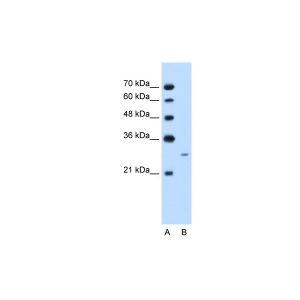
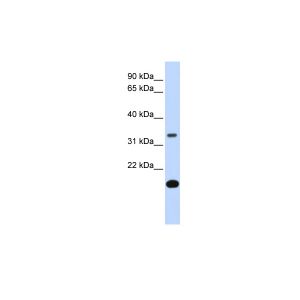
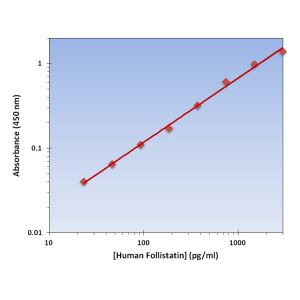
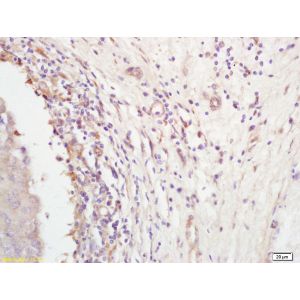
FST Antibody - C-terminal region - Biotin

Referentie ARP42287_T100-Biotin
Formaat : 100ul
Merk : Aviva Systems Biology
FST Antibody - C-terminal region : Biotin (ARP42287_T100-Biotin)

| Datasheets/Manuals | Printable datasheet for anti-FST (ARP42287_T100-Biotin) antibody |
|---|
| Predicted Species Reactivity | Human, Mouse, Rat, Cow, Dog, Goat, Guinea Pig, Horse, Rabbit, Sheep, Zebrafish |
|---|---|
| Product Format | Liquid. Purified antibody supplied in 1x PBS buffer. |
| Clonality | Polyclonal |
| Host | Rabbit |
| Conjugation | Biotin |
| Application | WB |
| Reconstitution and Storage | All conjugated antibodies should be stored in light-protected vials or covered with a light protecting material (i.e. aluminum foil). Conjugated antibodies are stable for at least 12 months at 4C. If longer storage is desired (24 months), conjugates may be diluted with up to 50% glycerol and stored at -20C to -80C. Freezing and thawing conjugated antibodies will compromise enzyme activity as well as antibody binding. |
| Immunogen | The immunogen is a synthetic peptide directed towards the C terminal region of human FST |
| Predicted Homology Based on Immunogen Sequence | Cow: 100%; Dog: 100%; Goat: 100%; Guinea Pig: 100%; Horse: 100%; Human: 100%; Mouse: 100%; Rabbit: 100%; Rat: 100%; Sheep: 100%; Zebrafish: 93% |
| Peptide Sequence | Synthetic peptide located within the following region: SLCDELCPDSKSDEPVCASDNATYASECAMKEAACSSGVLLEVKHSGSCN |
| Concentration | 0.5 mg/ml |
| Blocking Peptide | For anti-FST (ARP42287_T100-Biotin) antibody is Catalog # AAP42287 (Previous Catalog # AAPS12109) |
| Reference | Saito,S., (2005) Endocrinology 146 (12), 5052-5062 |
|---|---|
| Gene Symbol | FST |
| Gene Full Name | Follistatin |
| Alias Symbols | FS |
| NCBI Gene Id | 10468 |
| Protein Name | FST protein EMBL CAG46612.1 |
| Description of Target | Follistatin is a single-chain gonadal protein that specifically inhibits follicle-stimulating hormone release.Follistatin is a single-chain gonadal protein that specifically inhibits follicle-stimulating hormone release. The single FST gene encodes two isoforms, FST317 and FST344 containing 317 and 344 amino acids respectively, resulting from alternative splicing of the precursor mRNA. In a study in which 37 candidate genes were tested for linkage and association with polycystic ovary syndrome (PCOS) or hyperandrogenemia in 150 families, evidence was found for linkage between PCOS and follistatin. |
| Uniprot ID | Q6FHE1 |
| Protein Accession # | NP_006341 |
| Nucleotide Accession # | NM_006350 |
| Protein Size (# AA) | 317 |
| Molecular Weight | 35kDa |
| Protein Interactions | INHBA; BMPR2; BMPR1A; C8orf33; TK1; MEST; INHBE; INHA; FN1; BMP5; TXN; |