


CD90 APC
Catalog #
Size
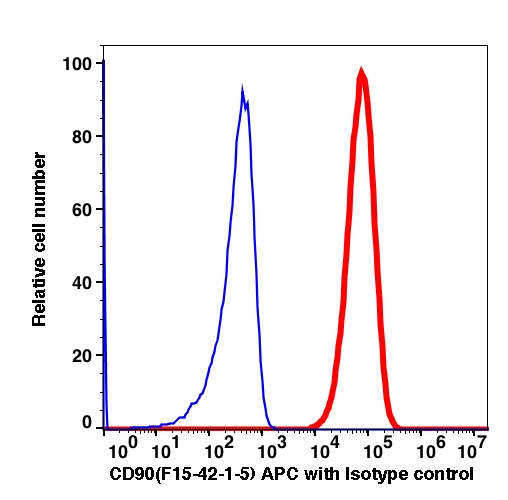
Jurkat E6.1 cells stained with CD90 APC (RED); Jurkat E6.1 cells stained with IgG1 MOPC-31C APC (BLUE).
| Conjugation | APC |
|---|---|
| Antigen | CD90 |
| Clone | F15-42-1 |
| Isotype | IgG1, k |
| Applications | FC |
| Reactivity | Human |
| Host | Mouse |
| Clonality | Monoclonal |
| Primary/Secondary | Primary |
| Immunogen | Unconjugated human brain Thy-2 |
| Storage | 2-8°C |
| Status | RUO |
| Excitation Laser | Red (633nm) |
Description:
The clone F15-42-1, a mouse monoclonal antibody specifically recognizes a 25-35 kD cell adhesion GPI-anchored protein known as Thy-1 based on its presence on mouse thymocytes or CD90. In humans, CD90 is expressed on stem cells including Mesenchymal Stem Cells (MSCs), Hematopoietic Stem Cells (HSCs) and Keratinocytic Stem Cells (KSCs) and at varying levels on non-lymphoid tissues such as fibroblasts, neurons and activated endothelial cells. CD90 plays important role in the process of inflammation and wound healing by synthesizing and releasing growth factors, cytokines and extracellular matrix components to assist in repairing damaged tissue.
The clone F15-42-1, a mouse monoclonal antibody specifically recognizes a 25-35 kD cell adhesion GPI-anchored protein known as Thy-1 based on its presence on mouse thymocytes or CD90. In humans, CD90 is expressed on stem cells including Mesenchymal Stem Cells (MSCs), Hematopoietic Stem Cells (HSCs) and Keratinocytic Stem Cells (KSCs) and at varying levels on non-lymphoid tissues such as fibroblasts, neurons and activated endothelial cells. CD90 plays important role in the process of inflammation and wound healing by synthesizing and releasing growth factors, cytokines and extracellular matrix components to assist in repairing damaged tissue.