


Recombinant porcine (pig) prolactin protein with His-tag derived from E.coli
Recombinant Pig Prolactin Protein, Antigen Grade
Recombinant Pig Prolactin Protein, Antigen Grade
Contact Us for Bulk Request
Product Description
Specifications
| Size | 10 µg, 50 µg, 100 µg, 200 µg |
| Species | Porcine (pig) |
| Accession Number | P01238 |
| Gene Symbols | PRL |
| Protein Name / Synonyms | Prolactin, Decidual Prolactin, Growth Hormone A1, GHA1. |
| Expressed Region | Leu31-Cys229 |
| Expression System | E. coli |
| Tag | N-terminal His-tag |
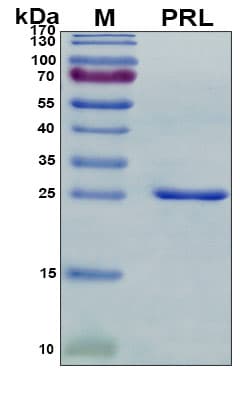
| Purity | >90% |
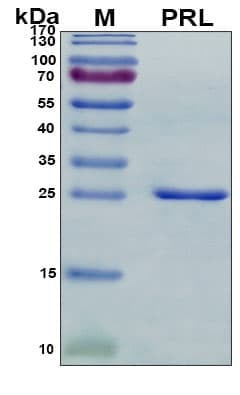
| Purity Determined By | SDS-PAGE under reducing conditions and visualized by Coomassie blue staining |
| Molecular Weight (kDa) | 23 kDa |
| Format | Liquid |
| Formulation | Supplied as a 0.2 µm filtered solution in 15 mM Na2HPO4 (pH 7.4), 5 mM NaH2PO4, 0.5 M NaCl, 80 mM imidazole, 6 M urea. |
| Concentration (lot specific) | Refer to the label on the vial for the specific concentration, determined by Bio-Rad Bradford protein dye reagent concentrate. |
| Research Area | Cytoskeletal Reorganization |
| Shipping Type | Blue ice |
| Storage | -20°C |
SDS-PAGE Image
Storage/Stability
Use a manual defrost freezer and avoid repeated freeze-thaw cycles. Upon arrival, the liquid protein may be stored for 2 weeks at 4°C. For long-term storage, it is recommended to store at -20°C or -80°C in appropriate aliquots. Generally, the shelf life is up to 6 months from the date of receipt at -20°C or -80°C under sterile condition.
Disclaimer
"Antigen Grade" is not a formally regulated industry standard, but it is commonly used to indicate that a protein is intended for antigen-based applications rather than functional assays.
Antigen Grade proteins are recombinant proteins purified under denaturing conditions (e.g., in urea) and may not retain their native conformation or biological activity. These proteins are suitable for antigen-based applications such as antibody generation, ELISA plate coating, Western blotting, and other immunological assays, but are not recommended for functional or activity assays.
Suitable Applications:
✔ Antibody production (immunogen)✔ ELISA coating antigen
✔ Western blot positive control
✔ Dot blot
✔ Epitope mapping
✔ Antibody screening, etc.
Not Recommended:
✘ Enzyme activity assays✘ Ligand-receptor binding assays (unless validated)
✘ Cell-based functional assays
✘ SPR/BLI kinetic studies requiring native folding
Why "Antigen Grade"?
Many bacterial proteins expressed as inclusion bodies are purified in 6–8 M urea. Although they can often be refolded, proteins sold in urea are generally not guaranteed to be correctly refolded or biologically active. "Antigen Grade" proteins are suitable for immunological applications but may not be appropriate for assays requiring native protein function.