


Time Resolved-Fluorescence Resonance Energy Transfer
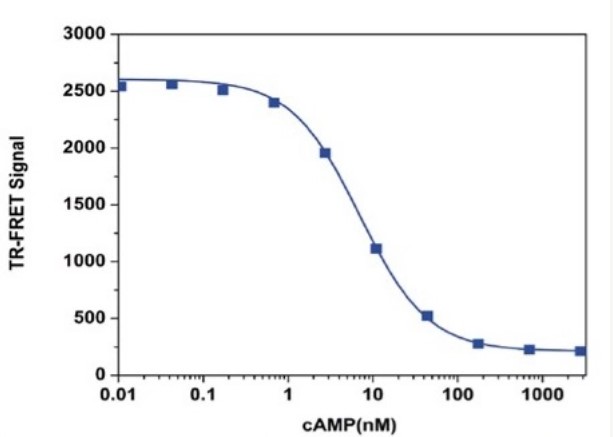
cAMP does response was measured with TR-FRET No Wash cAMP Assay Kit (Cat # KA7581) and fluorescence was measured on CLARIOstar microplate reader (BMG Labtech). The assay demonstrated a detection sensitivity as low as 1 nM cAMP.
Time Resolved-Fluorescence Resonance Energy Transfer
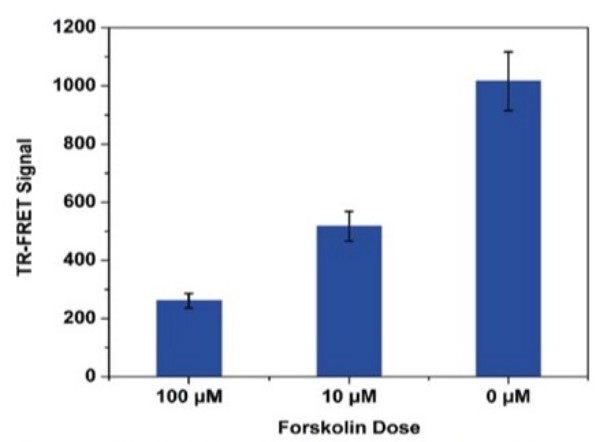
TR-FRET signal reduction was measured using the TR-FRET No Wash cAMP Assay Kit (Cat # KA7581) in HEK cells pre-treated with forskolin. Forskolin stimulation elevated intracellular cAMP levels, leading to a corresponding decrease in TR-FRET signals, consistent with the assay’s competitive binding mechanism.
- Specifications
Product Description
TR-FRET No Wash cAMP Assay Kit is used for monitoring the activation of adenylyl cyclase in G-protein coupled receptor systems. TRF probes enable time-resolved fluorometry (TRF) for the assays that require high sensitivity. TRF probes are insensitive to fluorescence quenching when conjugated to biological polymers such as antibodies.
Recommended plate
Solid black or Black wall/clear bottom
Storage Instruction
Store in the dark at 4°C. Avoid prolonged exposure to light. Standard should be stored at -20°C after reconstitution.
Avoid repeated freezing and thawing. - Applications
Time Resolved-Fluorescence Resonance Energy Transfer
cAMP does response was measured with TR-FRET No Wash cAMP Assay Kit (Cat # KA7581) and fluorescence was measured on CLARIOstar microplate reader (BMG Labtech). The assay demonstrated a detection sensitivity as low as 1 nM cAMP.Time Resolved-Fluorescence Resonance Energy Transfer
TR-FRET signal reduction was measured using the TR-FRET No Wash cAMP Assay Kit (Cat # KA7581) in HEK cells pre-treated with forskolin. Forskolin stimulation elevated intracellular cAMP levels, leading to a corresponding decrease in TR-FRET signals, consistent with the assay’s competitive binding mechanism.