


 For example, if the intended dosage is 10 mg/kg for animals weighing 20 g , with a dosing volume of 100 μL per animal,
 Vincristine [57-22-7]
Referentie T3S0209-1ml
Formaat : 1mLx10mM(inDMSO)
Merk : TargetMol
Vincristine
Copy Product Info

Vincristine binds to tubulin and inhibits the formation of microtubules, thereby inhibiting mitosis of the cancer cell. Vincristine can be used as a microtubule-destabilizing agent for research on the treatment of hematologic cancers, such as leukemia and
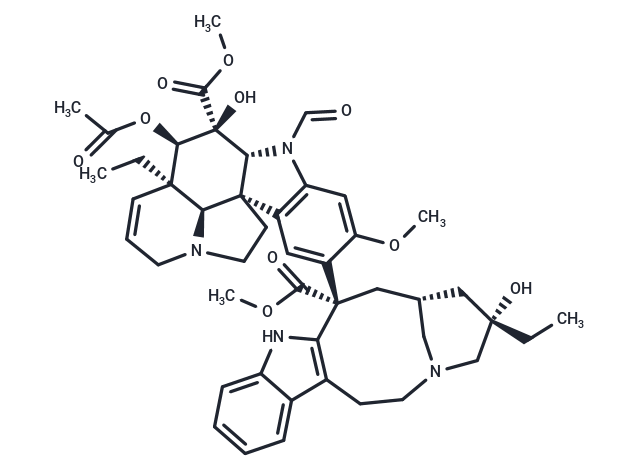
Cas No. 57-22-7
For research use only—not for human use. No sales to individuals. Use as intended only.
Select Batch
Purity:98.53%
Appearance:Solid
Color:White
COA HNMR LCMS
Product Information
Vincristine AI Summary
Vincristine demonstrates a wide spectrum of bioactivities and significant cytotoxic potential against various cancer cell lines. Exhibiting potent antiproliferative and antitumor effects, it inhibits tubulin polymerization with IC50 values as low as 220 nM and disrupts cell spindle formation with an EC50 of 20 nM. It shows cytotoxicity against multiple cell lines, including vincristine-sensitive KB cells (IC50 of 0.014 ug/mL) and vincristine-resistant human oral epidermoid carcinoma cells (IC50 of 1.05 ug/mL). Additionally, it inhibits lymphoid leukemia L1210 cell proliferation with an IC50 of 3.4 nM and increases the lifespan of mice implanted with lymphocytic leukemia P388. Vincristine's bioactivity extends across a spectrum of cell lines, showing IC50 values ranging from nanomolar to low micromolar concentrations. It also exhibits differential sensitivity in multidrug resistance profiles, indicating reduced efficacy in resistant cell lines such as KBV1 cells (IC50 of 2035.0 nM) compared to sensitive KB cells (IC50 of 2.2 nM). Furthermore, the compound affects cell cycle arrest, particularly at the G2/M phase in several cell types, indicating its potential as a cell cycle regulator. In addition to its anticancer effects, Vincristine shows properties of a micelle/water partition coefficient (Pmic) of 2.48, a partition coefficient (LogP) of 2.8, and limited brain permeability, reflecting its amphiphilic nature and bioavailability characteristics. Importantly, it has also demonstrated inhibitory activity against Plasmodium falciparum (IC50 of 1.0 nM) and moderate antiviral activity against SARS-CoV-2. Further investigation into its pharmacokinetic properties reveals a clearance rate of 2.0 mL.min-1.kg-1 and a half-life of 23.0 hours in humans. Overall, these diverse bioactivities underline Vincristine's potential as a multifaceted therapeutic agent, pending further clinical and pharmacological evaluations..
Note: Summary generated by AI. Data source: ChEMBL 
Bioactivity
Chemical Properties
Storage & Solubility Information
| Description | Vincristine binds to tubulin and inhibits the formation of microtubules, thereby inhibiting mitosis of the cancer cell. Vincristine can be used as a microtubule-destabilizing agent for research on the treatment of hematologic cancers, such as leukemia and |
| In vitro | METHODS: Neuroblastoma cells SH-SY5Y were treated with Vincristine (0.001-10 µM) for 24-72 h. Cell viability was measured by MTT assay. RESULTS: Vincristine inhibited the proliferation of SH-SY5Y cells in a dose- and time-dependent manner, with IC50s of 0.113 µM, 0.078 µM, and 0.051 µM at 24, 48, and 72 h, respectively. [1] METHODS: Human leukemia cells MOLT-4 were treated with Vincristine (0.3-3 µM) and SAHA (500 nM) for 24-48 h. Cell cycle was detected using Flow cytometry. RESULTS: Vincristine treatment induced an increase in the G2/M phase of the cell cycle compared to SAHA. the combination of Vincristine plus SAHA resulted in almost complete cell arrest in the G2/M phase after short-term treatment (24 h), followed by induction of the cells into the sub-G1 phase after long-term treatment (48 h). the combination of Vincristine and SAHA resulted in an increase in the G2/M phase of the cell cycle compared to SAHA. [2] |
| In vivo | METHODS: To assay antitumor activity in vivo, Vincristine (0.025 mg/kg, intravenously, once weekly) and SAHA (200 mg/kg, orally, once daily) were administered to SCID mice bearing MOLT-4 xenografts for 24 days. RESULTS: TGD did not improve in mice treated with Vincristine or SAHA alone. However, log-rank analysis showed that co-treatment exhibited significant anti-tumor activity in the MOLT-4 xenograft model. [2] |
| Molecular Weight | 824.96 |
| Formula | C46H56N4O10 |
| Cas No. | 57-22-7 |
| Smiles | CC[C@]1(O)C[C@@H]2CN(C1)CCc1c([nH]c3ccccc13)[C@@](C2)(C(=O)OC)c1cc2c(cc1OC)N(C=O)[C@@H]1[C@]22CCN3CC=C[C@](CC)([C@@H]23)[C@@H](OC(C)=O)[C@]1(O)C(=O)OC |
| Relative Density. | 1.1539 g/cm3 (Estimated) |
| Storage | Keep away from direct sunlight,Store at low temperature,Keep away from moisture Pure form: -20°C for 3 years | In solvent: -80°C for 1 year Shipping with blue ice/Shipping at ambient temperature. | ||||||||||||||||||||
| Solubility Information | DMSO: 12 mg/mL (14.55 mM), Sonication is recommended.  | ||||||||||||||||||||
| In Vivo Formulation | 10% DMSO+40% PEG300+5% Tween-80+45% Saline: 1 mg/mL (1.21 mM), Sonication is recommended. Please add the solvents sequentially, clarifying the solution as much as possible before adding the next one. Dissolve by heating and/or sonication if necessary. Working solution is recommended to be prepared and used immediately. The formulation provided above is for reference purposes only. In vivo formulations may vary and should be modified based on specific experimental conditions. | ||||||||||||||||||||
Solution Preparation Table | |||||||||||||||||||||
DMSO
Note : The dilution table applies only to solid products. For liquid products, please calculate the stock solution based on the stated concentration and/or density. | |||||||||||||||||||||
Calculator
In Vivo Formulation Calculator (Clear solution)
Please enter your animal experiment information in the following box and click Calculate to obtain the stock solution preparation method and in vivo formula preparation method:
For example, if the intended dosage is 10 mg/kg for animals weighing 20 g , with a dosing volume of 100 μL per animal,