

FM4-64 [162112-35-8]

Referentie T23409-1mg
Formaat : 1mg
Merk : TargetMol
FM4-64
(Synonyms: SynaptoRedTM C2) Copy Product Info
FM4-64 (SynaptoRed™ C2) is a styrene-based dye exhibiting membrane-binding and endocytosis tracing properties, yet it remains largely non-fluorescent in aqueous solutions. After binding to the plasma membrane bilayer, FM4-64 cannot passively diffuse into the cell interior and must undergo active transport across the membrane. FM4-64 can be used to study endocytosis, exocytosis, vesicular transport, and cell membrane dynamics.
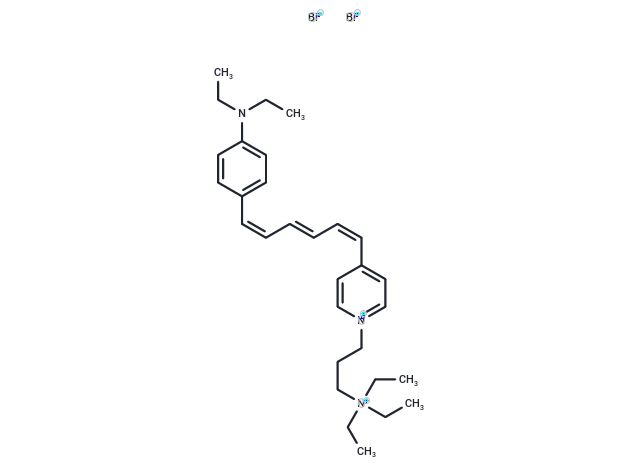
Cas No. 162112-35-8
For research use only—not for human use. No sales to individuals. Use as intended only.
Select Batch
Purity:99.99%
Appearance:Solid
COA LCMS HNMR
Product Information
Bioactivity
Chemical Properties
Storage & Solubility Information
| Description | FM4-64 (SynaptoRed™ C2) is a styrene-based dye exhibiting membrane-binding and endocytosis tracing properties, yet it remains largely non-fluorescent in aqueous solutions. After binding to the plasma membrane bilayer, FM4-64 cannot passively diffuse into the cell interior and must undergo active transport across the membrane. FM4-64 can be used to study endocytosis, exocytosis, vesicular transport, and cell membrane dynamics. |
| In vitro | Methods: One-week-old Arabidopsis (wild-type) root tips (5 mm) were cultured ex vivo in 1/2 MS medium supplemented with 3% sucrose, E-64d (100 μM), and FM4-64 (10 μM). After 3 hours of E-64d pretreatment, FM4-64 staining for 30 minutes, followed by washing and continued cultivation in E-64d-containing medium for 18 hours. FM4-64 fluorescence localization was observed using confocal laser scanning microscopy. Results: In the non-E-64d group after 18 hours, FM4-64 fluorescence was primarily localized to the vacuolar membrane. In the E-64d-treated group, FM4-64 fluorescence predominantly localized to punctate structures (autolysosomes) within the cytoplasm, with weak fluorescence at the vacuolar membrane, indicating convergence of the autophagy and endocytosis pathways at the site of autolysosome formation. [1] |
| Synonyms | SynaptoRedTM C2 |
| Cell Research | Instructions for use I. Solution preparation 1. Stock solution: Dissolve FM4-64 in DMSO or sterile water to prepare a high concentration stock solution (usually 1–5 mM). 2. Working solution: Dilute the stock solution to the working concentration (usually 1–10 µM) according to the experimental needs, using an appropriate buffer (such as PBS or serum-free medium). Notes: 1) FM4-64 is a membrane-affinity dye, but it cannot penetrate into cells, so it is suitable for labeling cell membranes or vesicle membranes. 2) The dye will degrade under light, so try to avoid light during operation. II. Operation steps 1. Cell experiment 1) Cell preparation: Culture cells to an appropriate density. Wash cells with serum-free medium or PBS before staining to remove residual substances. Staining steps: 2) Add the working solution directly to the cell culture medium and mix gently. 3) Incubate at an appropriate temperature (e.g., 37°C) for 5–30 minutes, which needs to be optimized based on the experiment. 4) Washing: Wash the cells multiple times with an appropriate buffer (e.g., PBS) to remove unbound dye. Optionally, use cold PBS to terminate staining and reduce background signal. 5) Imaging: Observe the sample using a fluorescence microscope. Excitation wavelength: ~515–540 nm. Emission wavelength: ~640–700 nm (red fluorescence signal). 2. Tissue experiments 1) Tissue preparation: Fix and permeabilize tissue sections (if necessary) to enhance dye penetration. 2) Staining steps: Add working solution to tissue sections and incubate for 10–30 minutes. 3) Washing: Wash tissue sections with PBS to remove excess dye. 4) Imaging: Also observe the red fluorescence signal using a fluorescence microscope. The above information is based on published literature. Experimental procedures should be appropriately modified to meet specific research demands. |
| Molecular Weight | 607.51 |
| Formula | C30H45Br2N3 |
| Cas No. | 162112-35-8 |
| Smiles | [Br-].[Br-].CCN(CC)c1ccc(\C=C/C=C/C=C\c2cc[n+](CCC[N+](CC)(CC)CC)cc2)cc1 |
| Relative Density. | no data available |
| Storage | Keep away from moisture,Keep away from direct sunlight, Powder: -20°C for 3 years | In solvent: -80°C for 1 year Shipping with blue ice/Shipping at ambient temperature. | |||||||||||||||||||||||||
| Solubility Information | DMSO: 30 mg/mL (49.38 mM), Sonication is recommended. | |||||||||||||||||||||||||
| In Vivo Formulation | 10% DMSO+40% PEG300+5% Tween-80+45% Saline: 1 mg/mL (1.65 mM), Sonication is recommended. Please add the solvents sequentially, clarifying the solution as much as possible before adding the next one. Dissolve by heating and/or sonication if necessary. Working solution is recommended to be prepared and used immediately. The formulation provided above is for reference purposes only. In vivo formulations may vary and should be modified based on specific experimental conditions. | |||||||||||||||||||||||||
Solution Preparation Table | ||||||||||||||||||||||||||
DMSO
Note : The dilution table applies only to solid products. For liquid products, please calculate the stock solution based on the stated concentration and/or density. | ||||||||||||||||||||||||||