

Rabbit Anti-TMEM173 (C-term) Polyclonal Antibody

Referentie AP9747b-ev
Formaat : 80ul
Merk : Abcepta
TMEM173 Antibody (C-term)
Affinity Purified Rabbit Polyclonal Antibody (Pab)
-

Western blot analysis of lysate from U-937 cell line, using TMEM173 Antibody (C-term)(Cat. #AP9747b). AP9747b was diluted at 1:1000 at each lane. A goat anti-rabbit IgG H&L(HRP) at 1:5000 dilution was used as the secondary antibody. Lysate at 35ug per lane.
-
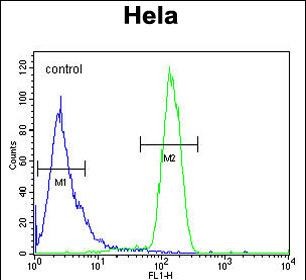
TMEM173 Antibody (C-term) (Cat. #AP9747b) flow cytometric analysis of Hela cells (right histogram) compared to a negative control cell (left histogram).FITC-conjugated goat-anti-rabbit secondary antibodies were used for the analysis.
Western blot analysis of lysate from U-937 cell line, using TMEM173 Antibody (C-term)(Cat. #AP9747b). AP9747b was diluted at 1:1000 at each lane. A goat anti-rabbit IgG H&L(HRP) at 1:5000 dilution was used as the secondary antibody. Lysate at 35ug per lane.
Application 
| WB, FC, E |
|---|---|
| Primary Accession | Q86WV6 |
| Reactivity | Human |
| Predicted | Mouse, Rat, Canine, Rabbit |
| Host | Rabbit |
| Clonality | Polyclonal |
| Isotype | Rabbit IgG |
| Calculated MW | 42193 Da |
| Antigen Region | 311-340 aa |
| Gene ID | 340061 |
|---|---|
| Other Names | Stimulator of interferon genes protein, hSTING, Endoplasmic reticulum interferon stimulator, ERIS, Mediator of IRF3 activation, hMITA, Transmembrane protein 173, TMEM173, ERIS, MITA, STING |
| Target/Specificity | This TMEM173 antibody is generated from rabbits immunized with a KLH conjugated synthetic peptide between 311-340 amino acids from the C-terminal region of human TMEM173. |
| Dilution | WB~~1:1000 FC~~1:10~50 E~~Use at an assay dependent concentration. |
| Format | Purified polyclonal antibody supplied in PBS with 0.09% (W/V) sodium azide. This antibody is purified through a protein A column, followed by peptide affinity purification. |
| Storage | Maintain refrigerated at 2-8°C for up to 2 weeks. For long term storage store at -20°C in small aliquots to prevent freeze-thaw cycles. |
| Precautions | TMEM173 Antibody (C-term) is for research use only and not for use in diagnostic or therapeutic procedures. |
For Research Use Only. Not For Use In Diagnostic Procedures.
| Name | STING1 (HGNC:27962) |
|---|---|
| Function | Facilitator of innate immune signaling that acts as a sensor of cytosolic DNA from bacteria and viruses and promotes the production of type I interferon (IFN-alpha and IFN-beta) (PubMed:18724357, PubMed:18818105, PubMed:19433799, PubMed:19776740, PubMed:23027953, PubMed:23747010, PubMed:23910378, PubMed:27801882, PubMed:29973723, PubMed:30842659, PubMed:35045565, PubMed:35388221, PubMed:36808561, PubMed:37832545, PubMed:25704810, PubMed:39255680). Innate immune response is triggered in response to non-CpG double-stranded DNA from viruses and bacteria delivered to the cytoplasm (PubMed:26300263). Acts by binding cyclic dinucleotides: recognizes and binds cyclic di-GMP (c- di-GMP), a second messenger produced by bacteria, cyclic UMP-AMP (2',3'-cUAMP), and cyclic GMP-AMP (cGAMP), a messenger produced by CGAS in response to DNA virus in the cytosol (PubMed:21947006, PubMed:23258412, PubMed:23707065, PubMed:23722158, PubMed:23747010, PubMed:23910378, PubMed:26229117, PubMed:30842659, PubMed:35388221, PubMed:37379839). Upon binding to c-di-GMP, cUAMP or cGAMP, STING1 oligomerizes, translocates from the endoplasmic reticulum and is phosphorylated by TBK1 on the pLxIS motif, leading to recruitment and subsequent activation of the transcription factor IRF3 to induce expression of type I interferon and exert a potent anti-viral state (PubMed:22394562, PubMed:25636800, PubMed:29973723, PubMed:30842653, PubMed:35045565, PubMed:35388221, PubMed:30643259). Exhibits 2',3' phosphodiester linkage-specific ligand recognition: can bind both 2'-3' linked cGAMP (2'-3'-cGAMP) and 3'-3' linked cGAMP but is preferentially activated by 2'-3' linked cGAMP (PubMed:23747010, PubMed:23910378, PubMed:26300263). The preference for 2'-3'-cGAMP, compared to other linkage isomers is probably due to the ligand itself, which adopts an organized free-ligand conformation that resembles the STING1-bound conformation and pays low energy costs in changing into the active conformation (PubMed:26150511). In addition to promote the production of type I interferons, plays a direct role in autophagy (PubMed:30568238, PubMed:30842662). Following cGAMP-binding, STING1 buds from the endoplasmic reticulum into COPII vesicles, which then form the endoplasmic reticulum-Golgi intermediate compartment (ERGIC) (PubMed:30842662, PubMed:41639454, PubMed:41639452). The ERGIC serves as the membrane source for WIPI2 recruitment and LC3 lipidation, leading to formation of autophagosomes that target cytosolic DNA or DNA viruses for degradation by the lysosome (PubMed:30842662). Promotes autophagy by acting as a proton channel that directs proton efflux from the Golgi to facilitate MAP1LC3B/LC3B lipidation (PubMed:37535724). The autophagy- and interferon-inducing activities can be uncoupled and autophagy induction is independent of TBK1 phosphorylation (PubMed:30568238, PubMed:30842662). Autophagy is also triggered upon infection by bacteria: following c-di-GMP-binding, which is produced by live Gram-positive bacteria, promotes reticulophagy (By similarity). May be involved in translocon function, the translocon possibly being able to influence the induction of type I interferons (PubMed:18724357). May be involved in transduction of apoptotic signals via its association with the major histocompatibility complex class II (MHC-II) (By similarity). Involved in intercellular immune signaling. Cross-activated by 2',3'-cGAMP previously generated in virus-infected cells, triggers type I interferon signaling in macrophages and uninfected neighboring cells to propagate and amplify the antiviral immune response. |
| Cellular Location | Endoplasmic reticulum membrane; Multi-pass membrane protein {ECO:0000255, ECO:0000269|PubMed:30842659, ECO:0000269|PubMed:32690950}. Cytoplasm, perinuclear region. Endoplasmic reticulum-Golgi intermediate compartment membrane; Multi-pass membrane protein {ECO:0000255, ECO:0000269|PubMed:32690950, ECO:0000269|PubMed:41639452}. Golgi apparatus membrane; Multi-pass membrane protein. Cytoplasmic vesicle, autophagosome membrane; Multi-pass membrane protein. Mitochondrion outer membrane; Multi-pass membrane protein. Cell membrane {ECO:0000250|UniProtKB:Q3TBT3}; Multi-pass membrane protein. Note=In response to double-stranded DNA stimulation, translocates from the endoplasmic reticulum through the endoplasmic reticulum-Golgi intermediate compartment and Golgi to post-Golgi vesicles, where the kinase TBK1 is recruited (PubMed:19433799, PubMed:29694889, PubMed:30842653, PubMed:30842659). Upon cGAMP-binding, translocates to the endoplasmic reticulum-Golgi intermediate compartment (ERGIC) in a process that is dependent on COPII vesicles; STING1-containing ERGIC serves as a membrane source for LC3 lipidation, which is a key step in autophagosome biogenesis (PubMed:30842662, PubMed:37832545). Translocation to the ERGIC compartment is also dependent on cholesterol and phosphoinositide, such as phosphatidylinositol 3,5-bisphosphate (PtdIns(3,5)P2), which directly bind STING1 at the interface between dimers and promote STING1 homooligomerization (PubMed:41639452, PubMed:41639454). Localizes in the lysosome membrane in a TMEM203-dependent manner (By similarity) {ECO:0000250|UniProtKB:Q3TBT3, ECO:0000269|PubMed:19433799, ECO:0000269|PubMed:29694889, ECO:0000269|PubMed:30842653, ECO:0000269|PubMed:30842659, ECO:0000269|PubMed:30842662, ECO:0000269|PubMed:32690950, ECO:0000269|PubMed:37832545, ECO:0000269|PubMed:41639452, ECO:0000269|PubMed:41639454} |
| Tissue Location | Ubiquitously expressed (PubMed:18724357, PubMed:18818105). Expressed in skin endothelial cells, alveolar type 2 pneumocytes, bronchial epithelium and alveolar macrophages (PubMed:25029335). |
- Primary Antibodies
- Cancer
- Immunology
- Signal Transduction